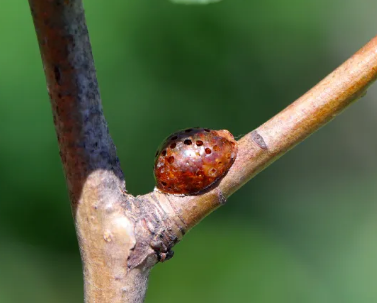
The European Fruit Lecanium (Parthenolecanium corni), also known as the European fruit lecanium scale, is a soft scale insect that attacks fruit trees, ornamental shrubs, and numerous deciduous woody plants. It is an important pest in orchards and landscapes because its feeding can weaken plants and produce large quantities of honeydew.
European fruit lecanium scales attach to twigs, branches, and leaves, where they feed on plant sap. Mature females develop rounded, brown, dome-shaped bodies that can resemble small bumps on bark.
Heavy infestations may cause leaf yellowing, reduced growth, premature leaf drop, and extensive black sooty mold. Honeydew accumulation can also contaminate fruit and reduce its marketability.
Although natural enemies frequently suppress populations, outbreaks can occur when beneficial insects are disrupted or susceptible host plants become stressed.
Taxonomy and Classification
- Common Name: European Fruit Lecanium
- Alternative Name: European Fruit Lecanium Scale
- Scientific Name: Parthenolecanium corni
- Order: Hemiptera
- Family: Coccidae
- Genus: Parthenolecanium
- Species: P. corni
- Primary Hosts: Fruit trees, ornamental shrubs, and deciduous woody plants
- Pest Type: Soft scale insect
European fruit lecanium belongs to the soft scale family Coccidae. Unlike armored scales, mature females do not develop beneath a detachable armored shield. They produce honeydew while feeding.
Physical Description and Identification
Adult Females: Mature females are rounded, convex, and brown to reddish-brown. Their bodies commonly measure approximately 3–6 millimeters across, although size varies.
Eggs: Females produce numerous eggs beneath their bodies, which provide protection during development.
Crawlers: Newly hatched nymphs are tiny, yellowish, and mobile.
Immature Scales: Young scales are flattened and less conspicuous than mature females. They may occur on leaves during the growing season.
Key Identification Features
- Rounded brown scales on twigs and branches.
- Large numbers of dome-shaped female bodies.
- Sticky honeydew on leaves and fruit.
- Black sooty mold on affected surfaces.
- Yellowing or weakened foliage.
- Ant activity associated with honeydew.
Distribution and Habitat
European fruit lecanium occurs in Europe, North America, and other temperate growing regions.
It inhabits commercial orchards, ornamental landscapes, gardens, parks, and natural areas containing suitable woody hosts.
Host plants include various fruit trees and deciduous shrubs. The species has a broad host range, allowing populations to persist across agricultural and ornamental environments.
Population abundance depends on seasonal weather, natural enemies, and host condition. Dense tree canopies may provide protected feeding locations.
Life Cycle and Reproduction
European fruit lecanium generally completes one generation annually in temperate regions.
Overwintering
Immature scales overwinter on twigs and branches.
Spring Development
As temperatures increase, overwintered scales resume feeding and mature into reproductive females.
Egg Production
Females produce numerous eggs beneath their bodies during late spring or early summer.
Crawler Emergence
Newly hatched crawlers move to foliage and settle at suitable feeding locations.
Late-Season Development
Immature scales feed on leaves before moving to woody tissues for overwintering.
Damage and Signs of Infestation
- Sap Feeding: Heavy populations remove nutrients and weaken plants.
- Honeydew: Sticky secretions accumulate on leaves and fruit.
- Sooty Mold: Black fungal growth develops on honeydew.
- Leaf Yellowing: Severe feeding may cause chlorosis.
- Reduced Growth: Repeated infestations may reduce shoot development.
- Fruit Contamination: Honeydew and mold can reduce marketability.
- Branch Decline: Heavy infestations may contribute to dieback in stressed plants.
Management and Integrated Pest Management (IPM)
1. Inspect Dormant Twigs
Examine branches for overwintering scales and mature female bodies.
2. Monitor Crawlers
Use visual inspection or monitoring tape to identify periods when crawlers are active.
3. Encourage Natural Enemies
Lady beetles, parasitoid wasps, and other predators can suppress populations.
4. Manage Ants
Where ants protect scale colonies, reducing ant activity may improve biological control.
5. Prune Infested Growth
Remove heavily infested branches where practical.
6. Apply Horticultural Oils
Registered dormant or growing-season oils may suppress vulnerable scale stages. Follow label restrictions for crop type and temperature.
7. Avoid Unnecessary Broad-Spectrum Insecticides
Protect beneficial insects that naturally regulate scale populations.
Conclusion
The European Fruit Lecanium (Parthenolecanium corni) is a widespread soft scale insect capable of damaging fruit trees and ornamentals through sap feeding and honeydew production. Regular monitoring, natural enemy conservation, ant management, and properly timed treatments can prevent severe infestations and protect plant health.