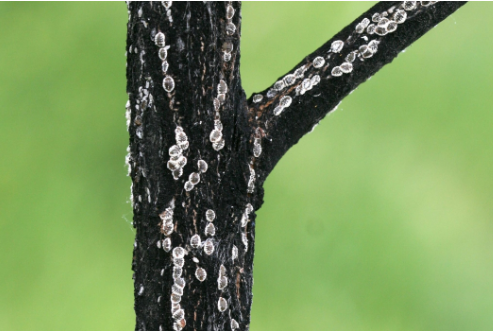
The Elm Scurfy Scale (Chionaspis americana) is an armored scale insect associated primarily with elm trees. It feeds by inserting specialized mouthparts into plant tissues and extracting cellular contents. Infestations may develop on twigs, branches, and other suitable surfaces, where the insects remain protected beneath small waxy covers.
The common name refers to the scurfy or flaky appearance produced when numerous scale coverings accumulate on infested bark. Heavy infestations can contribute to twig decline, reduced vigor, and weakened growth, especially in young or stressed trees.
Because armored scales are small and relatively stationary, they may remain unnoticed until populations become abundant. Their protective coverings can also make established infestations difficult to manage with contact insecticides.
Early detection, careful identification, and treatment timed to the mobile crawler stage are important components of effective management.
Taxonomy and Classification
- Common Name: Elm Scurfy Scale
- Scientific Name: Chionaspis americana
- Order: Hemiptera
- Family: Diaspididae
- Genus: Chionaspis
- Species: C. americana
- Primary Hosts: Elm trees (Ulmus species)
- Pest Type: Armored scale insect
The Elm Scurfy Scale belongs to the family Diaspididae. Armored scales develop beneath protective coverings composed of wax and shed skins. Unlike soft scales, they do not produce honeydew.
Physical Description and Identification
Adult Females: Female scales are small and remain beneath elongated or irregular whitish protective covers. The cover conceals the soft-bodied insect feeding beneath it.
Male Scales: Developing males may form smaller, narrow, pale coverings.
Eggs: Eggs develop beneath the female’s protective shield.
Crawlers: Newly hatched nymphs are minute, mobile insects that disperse before settling and producing their own covers.
Key Identification Features
- Small pale scale coverings attached to elm bark.
- Scurfy or flaky appearance on infested twigs.
- Stationary insects protected beneath waxy shields.
- Yellowing or declining foliage during severe infestations.
- Possible twig dieback.
- No honeydew or associated sooty mold.
Distribution and Habitat
Chionaspis americana is associated with North American elm-growing habitats, including woodland, ornamental landscapes, parks, and urban street plantings.
Infestations may develop on trees experiencing environmental stress or in locations where natural enemy activity is limited.
Protected bark surfaces and small branches provide suitable feeding sites. Population abundance may vary substantially among individual trees and growing seasons.
Life Cycle and Reproduction
Elm scurfy scale develops through egg, crawler, settled immature, and adult stages.
Egg Stage
Females produce eggs beneath their protective covers, where they remain sheltered until hatching.
Crawler Stage
Newly hatched crawlers move across plant surfaces and select feeding sites.
Settled Nymphs
After settling, young scales begin feeding and produce protective coverings.
Adult Stage
Females remain attached to the host plant, while males develop into small winged adults.
The number of generations and timing of crawler emergence depend on local climate. Monitoring is necessary to determine treatment windows.
Damage and Signs of Infestation
- Heavy Bark Colonies: Scale coverings accumulate on branches and twigs.
- Sap Removal: Feeding may reduce plant vigor.
- Leaf Discoloration: Severely affected branches may develop yellowing foliage.
- Twig Dieback: Heavy infestations can contribute to branch decline.
- Reduced Growth: Young or stressed trees may grow more slowly.
- Ornamental Damage: Scale-covered branches reduce tree appearance.
Light infestations may cause little measurable injury. Treatment should be based on pest abundance, tree condition, and observed damage.
Management and Integrated Pest Management (IPM)
1. Inspect Bark and Twigs
Check branches for pale scale coverings, especially on weakened or declining trees.
2. Monitor Crawler Emergence
Use double-sided monitoring tape or close inspection to identify the vulnerable crawler stage.
3. Encourage Natural Enemies
Predatory beetles and parasitoid wasps may contribute to natural suppression.
4. Prune Infested Branches
Remove heavily infested twigs where practical without excessive pruning.
5. Apply Horticultural Oils
Registered horticultural oils may suppress exposed scales when applied with adequate coverage and appropriate timing.
6. Maintain Elm Health
Provide suitable watering, mulching, and protection from root damage.
7. Avoid Disruptive Insecticides
Broad-spectrum applications can harm beneficial insects and contribute to recurring scale outbreaks.
Conclusion
The Elm Scurfy Scale (Chionaspis americana) is an armored scale insect that can accumulate on elm bark and contribute to twig decline. Monitoring, natural enemy conservation, pruning, and crawler-timed treatments provide practical management options while minimizing unnecessary pesticide use.