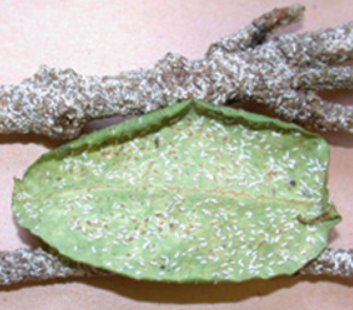
The Euonymus Scale (Unaspis euonymi) is a destructive armored scale insect that attacks euonymus shrubs and several related ornamental plants. It is among the most common and damaging pests of evergreen euonymus in residential and commercial landscapes.
Infestations often begin on stems and leaf undersides, where small scales attach and feed on plant tissues. As populations increase, affected foliage develops yellow spots, leaves may drop prematurely, and branches can decline.
Heavily infested shrubs may appear coated with numerous small white scales, particularly on stems. Severe infestations can cause extensive dieback and occasionally kill susceptible plants.
The pest is especially troublesome in dense ornamental plantings, where its small size and protected feeding locations make early detection difficult.
Taxonomy and Classification
- Common Name: Euonymus Scale
- Scientific Name: Unaspis euonymi
- Order: Hemiptera
- Family: Diaspididae
- Genus: Unaspis
- Species: U. euonymi
- Primary Hosts: Euonymus species
- Pest Type: Armored scale insect
Euonymus scale belongs to the armored scale family Diaspididae. The insect develops beneath a waxy protective cover and does not produce honeydew.
Physical Description and Identification
Adult Females: Female scales are dark brown, elongated, and somewhat oyster-shaped. They remain attached beneath their protective covers.
Male Scales: Immature males develop beneath narrow, white, elongated covers. Large numbers may give stems a pale or snowy appearance.
Eggs: Females produce eggs beneath their protective shields.
Crawlers: Newly hatched nymphs are tiny, yellowish, and mobile before settling on suitable feeding sites.
Key Identification Features
- Numerous white male scale covers on stems.
- Dark brown female scales on leaves and branches.
- Yellow spots on infested foliage.
- Premature leaf drop.
- Branch thinning and dieback.
- No sticky honeydew or sooty mold.
Distribution and Habitat
Euonymus scale occurs widely in temperate and subtropical landscapes where suitable ornamental hosts are cultivated.
It is common in residential gardens, hedges, commercial landscapes, parks, and ornamental nurseries.
Evergreen euonymus varieties are especially susceptible, although host preference varies among cultivars and species.
Dense plantings may provide protected feeding sites and make thorough treatment coverage more difficult.
Life Cycle and Reproduction
Overwintering
Females commonly overwinter on host plants beneath their protective coverings.
Egg Production
Females produce eggs beneath their shields as temperatures become favorable.
Crawler Emergence
Mobile crawlers disperse and settle on leaves and stems.
Immature Development
Settled nymphs feed and form protective scale coverings.
Adult Development
Mature females remain stationary, while males emerge as small winged adults. Two or more generations may occur annually, depending on climate.
Damage and Signs of Infestation
- Leaf Spotting: Feeding produces small yellow areas.
- Leaf Drop: Severely infested foliage may fall prematurely.
- Stem Colonies: Large numbers of scales accumulate on branches.
- Reduced Vigor: Persistent feeding weakens shrubs.
- Branch Dieback: Heavy infestations can kill individual branches.
- Plant Death: Severe, untreated infestations may kill susceptible shrubs.
Management and Integrated Pest Management (IPM)
1. Inspect Leaves and Stems
Examine leaf undersides and branch surfaces for male and female scales.
2. Prune Heavily Infested Growth
Remove badly affected branches to reduce local populations and improve plant structure.
3. Monitor Crawlers
Use crawler-monitoring tape or close observation to identify the most vulnerable stage.
4. Encourage Natural Enemies
Lady beetles and parasitoid wasps can contribute to scale suppression.
5. Use Horticultural Oils
Registered horticultural oils may suppress scales when applied thoroughly and at appropriate temperatures.
6. Select Less Susceptible Plants
Where euonymus scale is a persistent problem, consider resistant or less susceptible euonymus varieties or alternative ornamental species.
7. Avoid Unnecessary Broad-Spectrum Sprays
Disruptive insecticides may eliminate beneficial insects and increase the likelihood of future outbreaks.
Conclusion
The Euonymus Scale (Unaspis euonymi) is a serious ornamental pest that can cause yellowing, leaf loss, branch dieback, and plant death. Early detection, pruning, natural enemy conservation, crawler monitoring, and appropriate plant selection provide effective long-term management options.