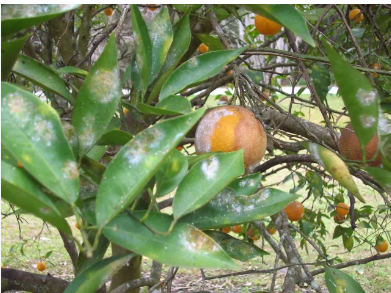
The Citrus Snow Scale (Unaspis citri) is an armored scale insect that attacks citrus trees and several related host plants. It is named for the conspicuous white appearance of male scale colonies, which can make infested trunks and branches look as though they are covered with snow.
Citrus snow scale feeds on plant tissues beneath protective waxy coverings. Heavy infestations can cause bark deterioration, twig dieback, reduced tree vigor, and weakening of citrus trees.
The insect is particularly troublesome when populations accumulate on trunks and major branches, where infestations may persist for extended periods.
Taxonomy and Classification
- Common Name: Citrus Snow Scale
- Scientific Name: Unaspis citri
- Order: Hemiptera
- Family: Diaspididae
- Genus: Unaspis
- Species: U. citri
- Primary Hosts: Citrus trees
Physical Description and Identification
Adult Females: Female scales are small, dark brown to purplish, and covered by elongated protective shields that blend into bark surfaces.
Male Scales: Immature males develop beneath narrow, white, elongated covers. Large colonies create the characteristic snowy appearance.
Eggs: Eggs develop beneath female scale coverings.
Crawlers: Newly hatched nymphs are tiny, mobile insects that disperse before settling.
Key Identification Features
- White, snow-like scale colonies on citrus bark.
- Dark female scales mixed among white male covers.
- Heavy infestations on trunks and branches.
- Bark discoloration or deterioration.
- Reduced tree vigor and twig dieback.
- No honeydew production typical of soft scales.
Distribution and Habitat
Citrus snow scale occurs in tropical and subtropical citrus-growing regions.
It is associated with commercial orchards, backyard citrus trees, and ornamental citrus plantings.
Warm conditions and protected bark surfaces may support persistent populations.
Life Cycle and Reproduction
Egg Stage
Females produce eggs beneath their protective covers.
Crawler Stage
Young crawlers disperse across bark and other plant surfaces.
Settled Nymphs
After settling, nymphs begin feeding and forming protective coverings.
Adult Stage
Females remain attached to the host, while males emerge as small winged adults. Multiple generations may occur in warm climates.
Damage and Signs of Infestation
- Bark Infestation: Large colonies cover trunks and branches.
- Tree Weakening: Heavy feeding reduces vigor.
- Twig Dieback: Severely infested branches may decline.
- Bark Injury: Persistent feeding may contribute to damaged bark.
- Reduced Productivity: Severe infestations can affect tree growth and fruit production.
Management and Integrated Pest Management (IPM)
1. Inspect Trunks and Branches
Monitor citrus bark for white male scale colonies and dark female scales.
2. Monitor Crawlers
Identify periods of crawler emergence because young scales are more vulnerable to contact treatments.
3. Encourage Natural Enemies
Parasitoid wasps and predatory insects can help suppress armored scale populations.
4. Prune Infested Growth
Remove heavily infested branches when practical.
5. Use Horticultural Oils
Registered horticultural oils may reduce scale populations when applied thoroughly to infested surfaces.
6. Maintain Tree Health
Proper irrigation, nutrition, and orchard maintenance can improve tree tolerance.
Conclusion
The Citrus Snow Scale (Unaspis citri) is a distinctive armored scale pest recognized by its white colonies on citrus bark. Severe infestations can weaken trees and damage branches. Monitoring, natural enemy conservation, pruning, and properly timed treatments provide effective management options.