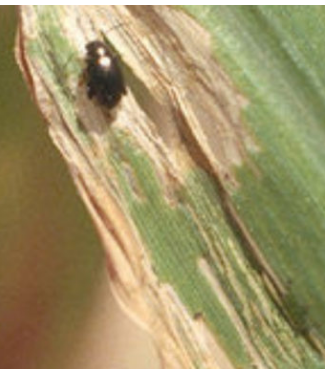
The Corn Flea Beetle (Chaetocnema pulicaria) is a small, dark beetle that feeds on corn foliage and is especially important because it transmits the bacterium responsible for Stewart’s wilt of corn.
Adult beetles scrape and chew narrow feeding scars into leaves, producing pale streaks and small damaged areas. Although direct feeding damage is often relatively minor, transmission of the bacterial pathogen Pantoea stewartii subsp. stewartii can cause serious losses in susceptible corn varieties.
The pest is particularly important in sweet corn and seed corn production, where Stewart’s wilt can reduce plant growth, yield, and marketability.
Taxonomy and Classification
- Common Name: Corn Flea Beetle
- Scientific Name: Chaetocnema pulicaria
- Order: Coleoptera
- Family: Chrysomelidae
- Genus: Chaetocnema
- Species: C. pulicaria
- Primary Host: Corn (Zea mays)
Physical Description and Identification
Adults: Adult corn flea beetles are tiny, approximately 1.5–2 millimeters long, with dark metallic bodies.
Hind Legs: Enlarged hind femora allow adults to jump rapidly when disturbed.
Eggs: Females deposit eggs in soil near host plants.
Larvae: Larvae develop in the soil and feed on underground plant tissues.
Key Identification Features
- Tiny dark beetles that jump when disturbed.
- Narrow pale feeding scars on corn leaves.
- Small surface scratches or streaks.
- Yellowing and wilting associated with Stewart’s wilt.
- Increased concern following mild winters in affected regions.
Distribution and Habitat
Corn flea beetles occur in North American corn-growing regions.
They inhabit cornfields, field margins, and locations containing suitable grassy hosts.
Adult survival during winter is influenced by temperature, and mild winters may increase the number of beetles available to colonize spring crops.
Life Cycle and Reproduction
Overwintering
Adult beetles overwinter in protected locations such as plant debris and field margins.
Spring Activity
Surviving adults emerge and feed on young corn plants.
Egg and Larval Development
Females deposit eggs in soil, where larvae develop.
Adult Emergence
New adults emerge and continue feeding. Multiple generations may occur during the growing season.
Damage and Signs of Infestation
- Leaf Scarring: Adults create pale feeding streaks.
- Seedling Injury: Heavy feeding may damage young corn.
- Stewart’s Wilt Transmission: Beetles transmit the bacterial pathogen.
- Leaf Wilting: Infected plants may develop long yellow streaks and wilt.
- Yield Reduction: Severe disease can reduce corn production.
Management and Integrated Pest Management (IPM)
1. Plant Resistant Hybrids
Use corn varieties with resistance to Stewart’s wilt where available.
2. Monitor Seedlings
Inspect emerging corn for flea beetles and feeding scars.
3. Assess Seasonal Risk
Use regional Stewart’s wilt risk forecasts and local extension recommendations.
4. Manage Volunteer Hosts
Control volunteer corn and suitable weed hosts where appropriate.
5. Use Registered Seed Treatments
In high-risk production systems, approved seed treatments may reduce early beetle feeding.
6. Apply Foliar Treatments When Justified
Use locally recommended insecticides only when monitoring and crop risk justify treatment.
Conclusion
The Corn Flea Beetle (Chaetocnema pulicaria) is important primarily because of its role in transmitting Stewart’s wilt. Resistant corn varieties, early monitoring, seasonal risk assessment, and targeted management can help reduce crop losses.