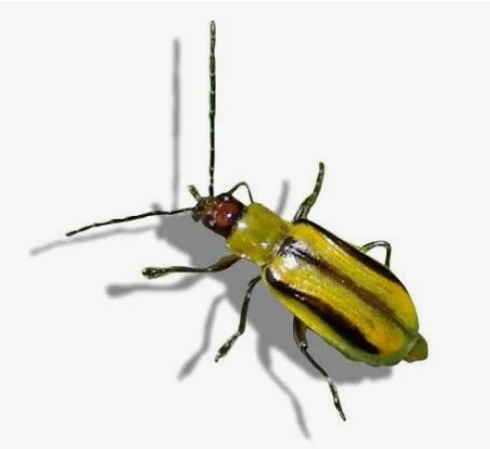
Corn rootworms are among the most economically important insect pests of corn in the United States. The name refers to several closely related beetles whose larvae feed on corn roots beneath the soil. Because this damage is initially hidden, an infestation may not become obvious until plants begin to lodge, lean, or develop the curved appearance known as “goosenecking.”
Western and northern corn rootworms are particularly serious in the Corn Belt. Both species have demonstrated an impressive ability to adapt to management practices, including crop rotation, insecticides, and certain genetically engineered corn traits. Successful control therefore depends on regular scouting and an integrated pest management strategy rather than repeated reliance on a single treatment.
Taxonomy and Classification
- Kingdom: Animalia
- Phylum: Arthropoda
- Class: Insecta
- Order: Coleoptera
- Family: Chrysomelidae
- Genus: Diabrotica
The most important North American species are the western corn rootworm, Diabrotica virgifera virgifera; northern corn rootworm, Diabrotica barberi; and southern corn rootworm, Diabrotica undecimpunctata howardi. The adult southern corn rootworm is more commonly called the spotted cucumber beetle.
Major Corn Rootworm Species
Western Corn Rootworm
The western corn rootworm is one of the most destructive corn pests in the central United States. Adults are approximately one-quarter inch long and usually yellow or yellow-green with black markings on their wing covers. Females commonly have three distinct black stripes, while the markings on males may merge and make them appear considerably darker.
Northern Corn Rootworm
Northern corn rootworm adults are similar in size but lack the prominent black stripes of western rootworms. They are generally pale green, yellow-green, tan, or light brown. This species is especially common in the northern Corn Belt and can survive crop rotation through an adaptation called extended diapause.
Southern Corn Rootworm
Southern corn rootworm adults are yellow-green beetles with 12 black spots. Unlike the western and northern species, they feed and reproduce on numerous crops and wild plants. They are more important in southern regions, although adults may migrate northward during the growing season.
Identifying Corn Rootworm Larvae
Corn rootworm larvae are slender, cream-colored grubs that can reach approximately one-half inch in length. Each larva has a brown head capsule and a small, dark plate at the end of its abdomen. These two dark areas can make the larva appear to have a head at both ends.
Young larvae are extremely small and may be difficult to find without carefully examining the roots and surrounding soil. Older larvae usually occur on or inside corn roots. They differ from the thick, curled, C-shaped white grubs commonly found beneath turf because corn rootworm larvae have narrow, elongated bodies.
Distribution and Habitat
Corn rootworms occur throughout many corn-producing areas of North America. Western corn rootworms are widespread across the central and western Corn Belt and have expanded into additional regions over time. Northern corn rootworms are most prevalent in cooler northern states, while southern corn rootworms are associated with warmer climates and a broader range of host plants.
Western and northern rootworm problems are most likely in fields planted continuously with corn. However, rotation-resistant populations can infest first-year corn. Adult western rootworms in some areas lay eggs in soybean and other noncorn fields, while northern rootworm eggs may remain dormant in the soil for two or more winters.
Life Cycle and Behavior
Western and northern corn rootworms generally complete one generation per year. They overwinter as eggs in the soil. Hatching begins during late spring or early summer, often around the time corn roots are becoming established. Newly hatched larvae must locate suitable roots relatively quickly to survive.
The larvae pass through three growth stages while feeding on root hairs and larger roots. Mature larvae pupate in earthen chambers near the plants. Adults usually begin emerging around corn silking and may continue appearing for several weeks.
Adult beetles feed on pollen, corn silks, tassels, leaves, and the pollen or flowers of other plants. After mating, females deposit eggs in cracks and spaces in the soil, usually in or near cornfields. Southern corn rootworms may produce multiple generations annually in warm regions and do not depend exclusively on corn.
Corn Rootworm Damage
Root Injury
Larval feeding causes the most significant economic damage. Small larvae initially consume fine root hairs, while larger larvae tunnel into roots or prune them back toward the base of the plant. Severe pruning reduces the plant’s ability to absorb water and nutrients.
Damaged plants may become stunted, show nutrient-deficiency symptoms, or wilt during hot and dry weather. Plants with weakened root systems can fall after wind or heavy rain. Lodged plants sometimes resume upright growth from the upper stem, producing the characteristic curved or gooseneck appearance.
Root injury can reduce yield even when plants remain standing. Lodging also creates uneven maturity and makes mechanical harvesting more difficult. Drought conditions may magnify losses because damaged roots cannot supply adequate moisture to the developing plant.
Adult Feeding
Adults may scrape leaf surfaces and feed on tassels, pollen, and developing silks. Silk clipping is potentially damaging when it occurs before or during pollination because shortened silks may prevent successful fertilization and reduce kernel formation. Feeding after pollination is normally less important.
Scouting and Diagnosis
Fields should be scouted even when resistant hybrids, crop rotation, or soil insecticides are used. Past control can fail when populations develop resistance or when equipment, placement, and environmental conditions reduce treatment performance.
Larval scouting involves examining corn roots and nearby soil during the early feeding period. Once adults begin emerging, representative plants can be dug up, washed, and evaluated for root pruning. Agricultural specialists commonly use the zero-to-three Node Injury Scale to record how many root nodes have been eaten.
Yellow sticky traps placed in fields around silking can help measure adult activity and estimate the likelihood of egg-laying. Beetle counts should be collected from several representative locations rather than only field edges. Lodged corn should also be examined for root pruning because wind, compaction, stalk rots, and other problems can produce similar symptoms.
Corn Rootworm Management and Control
Rotate Crops Strategically
Rotating corn with a nonhost crop remains one of the most effective management practices in many areas. Rootworm larvae generally cannot complete development without suitable grass roots, particularly corn. Rotation breaks the normal connection between egg-laying in one season and larval access to corn the following year.
Rotation is less reliable where northern rootworms have extended diapause or western rootworms lay eggs outside cornfields. Growers in affected regions should use local Extension recommendations and field scouting to determine whether first-year corn requires additional protection.
Manage Trait Resistance
Several Bt corn traits and newer RNA interference technologies target corn rootworm larvae. These products can be valuable, but they should be selected according to field history and local resistance information. A trait that has performed poorly in a field should not be repeatedly planted without investigating the cause.
Follow all refuge and insect resistance management requirements associated with the seed. Rotate effective tactics rather than simply changing brand names, since different products may contain the same insecticidal proteins. Current university trait tables can help identify the active technologies contained in each hybrid.
Use Insecticides Selectively
Soil-applied insecticides may be appropriate in fields with a documented history of economically damaging populations. Correct calibration and placement are essential. Adding a soil insecticide automatically to a rootworm-targeting hybrid may increase cost without correcting resistance to a failing trait.
Foliar treatments aimed at adults are difficult to time because beetles emerge over an extended period. They should only be considered when scouting indicates that adult abundance, silk clipping, or anticipated egg-laying justifies treatment. Unnecessary applications can harm pollinators and beneficial insects. Always follow the product label and applicable local regulations.
Combine Cultural Practices
Control volunteer corn in rotational crops because it can support rootworm development and expose insects to the same traits used in commercial hybrids. Maintain records of crop history, hybrids, root injury, adult counts, lodging, and treatments. These records make it easier to recognize population changes and resistance warning signs.
Predators, parasitic organisms, and soil pathogens attack corn rootworms naturally, but biological control usually does not provide dependable suppression by itself. Protecting beneficial organisms remains worthwhile as one part of a broader integrated program.
Managing Rootworms in Sweet Corn
Corn rootworms are generally a greater concern in large commercial fields than in small home gardens. Gardeners can reduce problems by moving sweet corn to a different part of the garden each season, removing volunteer corn, and checking plants for beetles around silking. Avoid treating adult beetles after pollination unless damage is continuing and accurately identified.
Conclusion
Corn rootworms are adaptable pests capable of overcoming repeatedly used control practices. Their larvae secretly prune roots, while adults may interfere with pollination by clipping silks. Crop rotation, field scouting, appropriate hybrid selection, resistance management, and carefully justified insecticide use provide the most dependable protection. Because species behavior and resistance patterns vary across the Corn Belt, management decisions should be based on local field history and current Extension guidance.