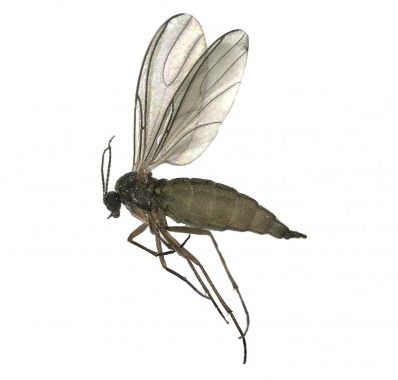
Damping-Off Fungus Gnats are small, soil-dwelling insects closely associated with overly moist growing conditions and fungal pathogens that cause damping-off disease in seedlings. While the adult gnats are mostly a nuisance, the larval stage can damage plant roots and stems, and their activity is often linked with the spread or worsening of fungal infections in greenhouses, nurseries, and indoor plant systems.
These insects are commonly found in seed-starting trays, potted plants, hydroponic systems, and commercial growing operations where moisture levels remain consistently high.
Taxonomy and Classification
Damping-off fungus gnats belong primarily to the family Sciaridae within the order Diptera (true flies). They are commonly grouped with other small, soil-associated flies that thrive in damp environments.
They are closely related to other gnats and differ from fruit flies in their preference for soil and organic growing media rather than fermenting foods.
Fungus gnats undergo complete metamorphosis, progressing through egg, larva, pupa, and adult stages.
Identification
Fungus gnats are small and delicate insects that are often mistaken for mosquitoes due to their long legs and narrow bodies.
- Adults: Approximately 1/8 inch long, dark gray or black, with long legs and antennae
- Wings: Clear or lightly tinted, held flat over the body
- Flight: Weak fliers, often seen hovering near soil surfaces
The larvae are the damaging stage and are characterized by:
- Translucent, worm-like bodies
- Black head capsules
- Living within the top layer of moist soil
Larvae are typically found just below the soil surface, feeding on organic matter and plant roots.
Distribution and Habitat
Damping-off fungus gnats are cosmopolitan and occur worldwide wherever moist soil and organic matter are present.
They are especially common in:
- Greenhouses and nurseries
- Indoor houseplants
- Seed-starting trays
- Hydroponic and propagation systems
- Overwatered garden beds
Their populations thrive in environments with excess moisture, poor drainage, and high organic content.
Behavior and Life Cycle
The life cycle of fungus gnats is rapid and closely tied to environmental conditions:
- Egg: Laid in moist soil or organic media
- Larva: Feeds on fungi, organic matter, and plant roots
- Pupa: Develops in the soil
- Adult: Emerges to reproduce and lay eggs
Under favorable conditions, the entire life cycle can be completed in 2 to 4 weeks, allowing populations to build quickly.
Adults are attracted to light and are often seen resting on pots, soil surfaces, or nearby windows.
Relationship to Damping-Off Disease
Damping-off is a fungal disease caused by pathogens such as Pythium, Rhizoctonia, and Fusarium. Fungus gnats are closely associated with this disease in two key ways:
- Direct Damage: Larvae feed on tender roots and stems of seedlings, weakening plants
- Pathogen Transmission: Gnats can carry fungal spores on their bodies, spreading disease between plants
Seedlings affected by damping-off often:
- Collapse at the soil line
- Wilt suddenly
- Fail to establish properly
While fungus gnats do not cause the disease directly, they contribute significantly to its severity.
Feeding and Damage
The larval stage is responsible for most plant damage.
Common effects include:
- Root feeding that reduces plant vigor
- Damage to germinating seeds and young seedlings
- Increased susceptibility to fungal infections
In severe infestations, plants may exhibit:
- Stunted growth
- Yellowing leaves
- Wilting despite adequate watering
Adults do not feed on plants but are considered nuisance pests due to their presence.
Pest Status
Damping-off fungus gnats are considered significant pests in controlled growing environments, particularly in:
- Seedling production
- Greenhouse operations
- Indoor plant cultivation
They are less problematic in well-managed outdoor landscapes where natural controls are present.
Management and Control
Effective management focuses on reducing moisture and interrupting the life cycle.
| Strategy | Purpose | Benefit |
|---|---|---|
| Moisture Control | Allow soil to dry between watering | Reduces egg-laying sites |
| Sanitation | Remove decaying organic matter | Eliminates food sources |
| Biological Control | Use beneficial nematodes or microbes | Targets larvae safely |
| Monitoring | Use sticky traps | Tracks adult populations |
Yellow sticky traps are particularly effective for monitoring adult activity.
Prevention
- Avoid overwatering plants and seedlings
- Use well-draining soil mixes
- Allow the soil surface to dry between watering
- Remove plant debris and algae from growing areas
- Use sterile or pasteurized growing media when possible
Preventative care is the most effective way to avoid infestations and associated disease problems.
Related Articles
Conclusion
Damping-off fungus gnats are a common and often underestimated problem in moist growing environments. While adult flies are mostly a nuisance, their larvae can damage plant roots and contribute to serious fungal diseases that affect seedling survival.
Through proper moisture management, sanitation, and integrated pest management strategies, growers can effectively reduce fungus gnat populations and protect plants from both insect damage and disease.