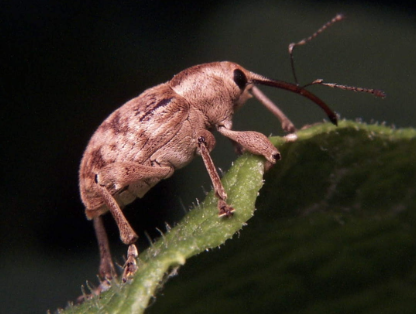
Deep-Snouted Weevils are a descriptive group of beetles within the family Curculionidae, recognized for their elongated snout, or rostrum, which extends forward from the head. This specialized structure allows them to bore into plant tissues, seeds, stems, or fruit, where they feed and often deposit eggs. Many species are important plant pests in gardens, landscapes, and agricultural systems.
Because of their concealed feeding habits and wide host range, deep-snouted weevils can be challenging to detect and manage. Their larvae frequently develop inside plant material or in the soil, where they are protected from predators and environmental exposure.
Quick Facts
- Common Name: Deep-Snouted Weevils
- Family: Curculionidae
- Order: Coleoptera
- Habitat: Gardens, fields, forests, and ornamental plantings
- Diet: Leaves, seeds, stems, roots, or fruit depending on species
- Status: Plant pest
Taxonomy and Classification
Deep-snouted weevils belong to the family Curculionidae, one of the largest beetle families, containing tens of thousands of species worldwide. They are part of the broader group of weevils, known for their distinctive snouts and plant-feeding behavior.
Within this family, species vary widely in size, host preference, and behavior. Some are minor pests, while others are major agricultural threats.
They undergo complete metamorphosis, developing through egg, larva, pupa, and adult stages.
Identification
Deep-snouted weevils are easily identified by their distinctive head structure.
- Body Shape: Compact, oval beetle body
- Snout (Rostrum): Long and extended forward
- Antennae: Elbowed and attached along the snout
- Color: Brown, black, gray, or mottled for camouflage
The elongated rostrum is used for:
- Boring into plant tissue
- Feeding internally
- Creating sites for egg-laying
Larvae are typically:
- Legless, white or cream-colored grubs
- Curved or C-shaped
- Found inside plant tissue or in soil near roots
Because larvae remain hidden, damage is often detected before the insect itself is seen.
Distribution and Habitat
Deep-snouted weevils are distributed worldwide and are found wherever suitable host plants are available.
Common habitats include:
- Home gardens and landscapes
- Agricultural fields
- Ornamental plantings
- Forests and natural vegetation
They are particularly common in areas with dense plant growth and a variety of host species.
Behavior and Life Cycle
The life cycle of deep-snouted weevils varies by species but generally follows a similar pattern:
- Egg Stage: Eggs are deposited in plant tissue, seeds, or soil
- Larval Stage: Larvae feed internally or on roots
- Pupal Stage: Pupation occurs within plant material or soil
- Adult Stage: Adults emerge to feed and reproduce
Many species exhibit concealed development, meaning larvae remain protected inside plant tissues or underground. This makes early detection difficult and allows populations to build unnoticed.
Feeding and Damage
Deep-snouted weevils damage plants in multiple ways depending on the species.
- Leaf Feeding: Adults chew notches or holes in foliage
- Stem and Seed Damage: Larvae bore into plant tissues
- Root Feeding: Larvae damage root systems, weakening plants
- Fruit and Seed Infestation: Some species develop inside seeds or fruit
Common signs of infestation include:
- Notched or chewed leaves
- Wilting or stunted growth
- Damaged or hollow stems
- Reduced crop yield
Damage severity varies widely, from minor cosmetic issues to significant economic loss in crops.
Pest Status
Deep-snouted weevils are considered plant pests, with some species classified as major agricultural threats.
They can impact:
- Vegetable crops
- Fruit and seed production
- Ornamental plants
- Forest vegetation
Their concealed larval stage makes them particularly difficult to control once established.
Management and Control
Effective management focuses on monitoring and reducing favorable conditions.
| Strategy | Purpose | Benefit |
|---|---|---|
| Monitoring | Check plants for feeding damage | Early detection |
| Sanitation | Remove infested plant material | Reduces population sources |
| Soil Management | Disrupt larval habitats | Limits development |
| Plant Health | Maintain vigorous growth | Improves resistance to damage |
In agricultural settings, integrated pest management (IPM) strategies may include biological controls, crop rotation, and targeted treatments when necessary.
Prevention
- Inspect plants regularly for feeding signs
- Remove and dispose of infested debris
- Rotate crops to disrupt life cycles
- Maintain healthy soil and plant conditions
Preventative practices are especially important in high-value crops and ornamental plantings.
Related Articles
Conclusion
Deep-snouted weevils are a diverse group of plant-feeding beetles known for their distinctive elongated snouts and concealed feeding habits. While some species cause only minor damage, others can significantly impact crops and ornamental plants.
Through regular monitoring, good sanitation practices, and integrated management strategies, these pests can be effectively controlled and prevented from causing serious plant damage.