Termites are eusocial insects that are classified at the taxonomic rank of infraorder Isoptera, or as epifamily Termitoidae within the cockroach order Blattodea. As of current knowledge, there are about 3,106 species of termites, some of which cause serious structural damage to buildings, crops, or plantation forests. Termites are found on all continents except Antarctica.
Description and Biology
Termites are usually small, measuring between 4 to 15 millimeters (0.16 to 0.59 in) in length. The largest of all termite species, such as Macrotermes bellicosus, Macrotermes goliath, and Macrotermes natalensis, can reach lengths of up to 5 cm (2.0 in).
Termites have a soft cuticle, making them relatively fragile but they compensate for this with a hard, protective outer shell. Termites have two pairs of wings that are of equal length which distinguishes them from ants.
Behavior and Ecology
Termites thrive in diverse habitats and are found in the rainforest, savannah, and desert ecosystems. They are detritivores, feeding on dead plants and trees, and dead parts of living trees, including wood and wood in the soil.
Termites are known for their ability to damage wooden structures and furniture through their habit of feeding on the cellulose contained within these materials. Some species are also known to tunnel through the soil and build massive and complex mounds that can reach several meters in height.
Diet and Digestion
Termites primarily feed on wood, dead plant material, and leaf litter, making them important recyclers in many ecosystems. However, they aren’t able to digest tough cellulose on their own. Instead, termites rely on a fascinating partnership with microorganisms—specialized bacteria and protozoa living in their guts—which help break down the cellulose and other complex plant fibers. This symbiotic relationship enables termites to extract nutrients from materials that many other creatures can’t digest.
Social Structure
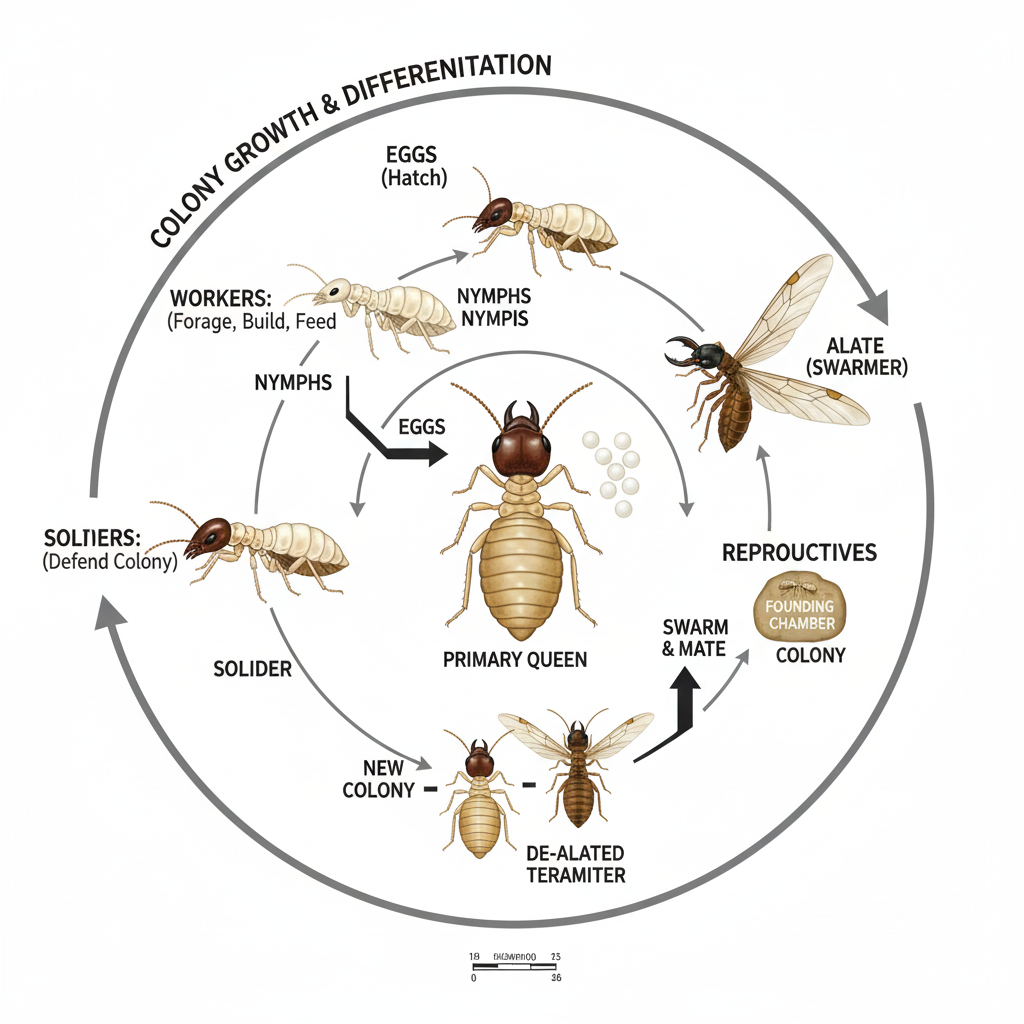
Termite colonies are highly structured social systems with well-defined castes, which generally include a king, a queen, soldiers, workers, and alates (winged termites). The queen and king termites are responsible for reproduction. Worker termites, which are typically the most numerous, do the work of the colony: foraging, food storage, and brood and nest maintenance. Soldier termites are responsible for defense against predators, primarily ants.
Formation of New Colonies
New termite colonies are formed through a reproductive process known as swarming, during which winged termites called alates leave their original colony to establish new ones. This event typically occurs during warm, humid weather—often after rainfall—when environmental conditions are ideal for survival and dispersal.
During a swarm, large numbers of alates take flight simultaneously, increasing the chances of finding a mate. After a brief flight, these reproductive termites land, shed their wings, and begin searching for a suitable nesting site. Common locations include moist soil, decaying wood, or areas near structural foundations where food sources are readily available.
Once a pair of alates selects a location, they form a mating pair and burrow into the soil or wood to create a small chamber. Within this protected space, they become the new king and queen of the developing colony. The queen begins laying eggs, while both termites care for the first generation of offspring.
As the colony grows, the initial brood develops into worker termites, which take over responsibilities such as foraging, feeding the colony, and expanding the nest. Over time, soldier termites are also produced to defend against predators like ants. This structured division of labor allows the colony to grow rapidly and become well-established.
The formation of new colonies is a critical phase in the termite life cycle and a primary reason infestations can spread quickly across properties and neighborhoods. Even a single successful pair of alates can eventually develop into a large, destructive colony if left undetected.
Lifespan of the Queen Termite
The queen termite stands out not only for her enlarged size but also for her extraordinary lifespan compared to other insects. While most worker and soldier termites live for only a few months to a few years, the queen can survive for decades under the right conditions.
In many termite species, queens are capable of living for 15 to 25 years, and in some cases even longer. This extended lifespan allows the colony to remain stable and continuously grow without disruption. As the primary reproductive member of the colony, the queen’s survival is critical to maintaining population levels and ensuring the long-term success of the termite colony.
Throughout her life, the queen produces thousands—sometimes millions—of eggs, depending on the species. This constant reproduction supports the colony’s expansion and replaces workers, soldiers, and reproductive swarmers as needed. Because of her central role, the queen is heavily protected by worker termites, who feed and groom her while maintaining the nest environment.
The longevity of a queen termite is one of the key reasons why termite infestations can persist for years if left untreated. Even if visible termites are eliminated, the colony can quickly recover as long as the queen remains alive and continues laying eggs.
Human Interactions
In many cultures, termites are important as a source of food. They are rich in proteins, fatty acids, and other micronutrients. Fried or roasted termites are a common snack in many cultures.
On the other hand, termites can cause significant damage to human structures. This is particularly the case for subterranean and drywood termites in tropical and subtropical climates. Over time, termite damage can become significant where timber is the primary material for buildings.
Cultural Significance
Termites are viewed in different ways in human cultures. They are revered in some cultures because they are rich in nutrients and their mounds are seen as a symbol of longevity. However, in most cultures, termites are considered pests because of their destructive nature towards wooden structures.
See also