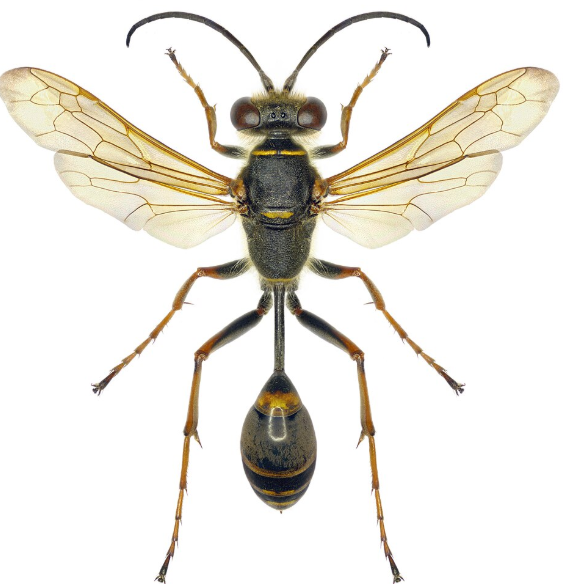
Dirt Dauber Wasps (commonly known as mud daubers) are solitary wasps recognized for their habit of building nests from mud. These wasps are widely distributed across North America and are commonly found around homes, garages, sheds, and other sheltered structures. Unlike social wasps, dirt daubers are non-aggressive and rarely sting, making them far less threatening to humans.
They are considered beneficial insects because they prey on spiders and other arthropods, helping to naturally regulate pest populations in residential and natural environments.
Taxonomy and Classification
Dirt dauber wasps belong to the order Hymenoptera, which includes bees, ants, and wasps. They are most commonly associated with the families Sphecidae and Crabronidae.
Unlike social wasps such as yellowjackets, dirt daubers are solitary, meaning each female builds and provisions her own nest independently.
They undergo complete metamorphosis, developing through egg, larva, pupa, and adult stages.
Identification
Dirt dauber wasps vary in appearance depending on species but share several common traits:
- Body Shape: Slender with a narrow “waist” (petiole)
- Size: Typically 1/2 to 1 inch long
- Color: Black, metallic blue, or black and yellow depending on species
- Wings: Clear or slightly smoky
Some species, such as the black and yellow mud dauber, have bright markings, while others, like the blue mud dauber, display metallic coloration.
Their most recognizable sign is their mud nests, which are often found attached to walls, ceilings, or sheltered surfaces.
Distribution and Habitat
Dirt dauber wasps are widely distributed throughout North America and are commonly found in:
- Residential buildings (garages, sheds, eaves)
- Barns and outbuildings
- Bridges and overhangs
- Natural sheltered areas such as rock ledges
They prefer locations that provide protection from weather and easy access to mud and prey.
Behavior and Life Cycle
Dirt daubers exhibit unique nesting and hunting behaviors that distinguish them from other wasps.
The life cycle includes:
- Egg: Laid inside a mud chamber
- Larva: Feeds on stored prey
- Pupa: Develops within the sealed chamber
- Adult: Emerges from the nest
Female wasps construct nests using mud, forming tube-like or cell-like structures. Inside each chamber, they place several paralyzed spiders or other insects as food for the developing larvae.
Once provisioning is complete, the female seals the chamber with mud and moves on to build additional nests.
Feeding and Ecological Role
Dirt dauber wasps are predatory insects that play an important ecological role.
- Adults: Feed on nectar and plant sugars
- Larvae: Feed on paralyzed prey provided by the female
Common prey includes:
- Spiders (especially orb-weavers and house spiders)
- Small insects and arthropods
By hunting spiders and other insects, dirt daubers help reduce pest populations around homes and gardens.
Pest Status
Dirt dauber wasps are considered beneficial insects and are not aggressive toward humans.
They may become a nuisance due to:
- Unsightly mud nests on structures
- Accumulation of abandoned nests over time
However, they do not defend their nests aggressively and rarely sting unless directly handled.
Management and Control
Because they are beneficial, control is generally unnecessary. When needed, management focuses on simple removal and prevention.
| Method | Purpose | Effectiveness |
|---|---|---|
| Physical Removal | Scrape off mud nests | Highly effective for immediate cleanup |
| Exclusion | Seal entry points to structures | Prevents nesting indoors |
| Surface Cleaning | Reduce nesting surfaces | Discourages rebuilding |
Nests can be safely removed once inactive, typically during cooler months when wasp activity is low.
Prevention
- Seal cracks and openings in structures
- Reduce access to sheltered nesting areas
- Keep surfaces clean and free of mud buildup
- Limit spider populations that attract hunting wasps
Preventative measures are usually sufficient to reduce unwanted nesting.
Related Articles
Conclusion
Dirt dauber wasps are fascinating and beneficial insects that contribute to natural pest control by preying on spiders and other arthropods. Their solitary nature and low aggression make them far less concerning than social wasps.
While their mud nests may be considered unsightly, these insects provide valuable ecological services, and simple maintenance practices are usually sufficient to manage their presence around structures.