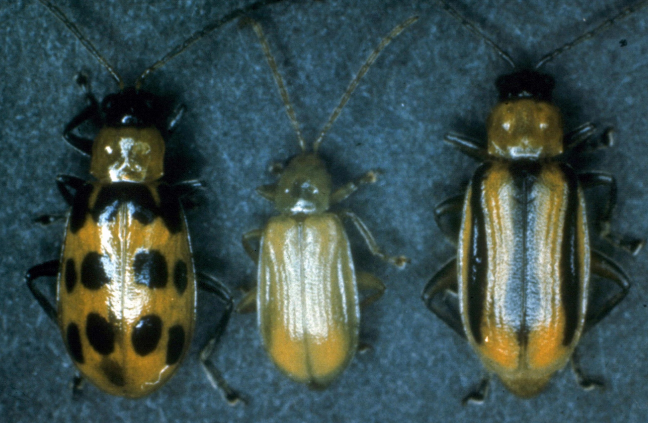
Cucumber beetles are small leaf beetles that attack cucumbers, melons, squash, pumpkins, zucchini, gourds, and related plants. Adults chew foliage, blossoms, stems, and fruit, while their larvae feed on roots. These beetles are particularly dangerous to young plants because they can cause rapid defoliation and transmit bacterial wilt and certain plant viruses.
The two principal cucumber beetles in the eastern United States are the striped cucumber beetle, Acalymma vittatum, and the spotted cucumber beetle, Diabrotica undecimpunctata howardi. Related western species cause similar problems. Although the striped and spotted beetles look alike in size and color, their larvae have different host preferences and their seasonal behavior differs.
Taxonomy and Classification
- Order: Coleoptera
- Family: Chrysomelidae
- Striped cucumber beetle: Acalymma vittatum
- Western striped cucumber beetle: Acalymma trivittatum
- Spotted cucumber beetle: Diabrotica undecimpunctata howardi
- Western spotted cucumber beetle: Diabrotica undecimpunctata undecimpunctata
Cucumber beetles belong to the same family as flea beetles, Colorado potato beetles, and numerous other plant-feeding beetles. The spotted cucumber beetle larva is also called the southern corn rootworm because it feeds on corn and the roots of other grasses.
Identification
Striped Cucumber Beetles
Adult striped cucumber beetles are approximately 1/4 inch long. They have yellow or yellow-green wing covers marked with three lengthwise black stripes. The head, antennae, and abdomen are generally dark. The body is relatively narrow and slightly elongated.
The western striped cucumber beetle has a similar appearance. Geographic location and examination by a specialist may be necessary to distinguish closely related species.
Spotted Cucumber Beetles
Adult spotted cucumber beetles are also approximately 1/4 inch long. Their yellow-green wing covers display 12 round black spots. Six spots occur on each wing cover, although adjacent markings may appear connected when viewed from certain angles.
Spotted cucumber beetles are sometimes mistaken for yellow lady beetles. Lady beetles have rounded, dome-shaped bodies and short, partly concealed antennae. Cucumber beetles have more elongated bodies and clearly visible threadlike antennae.
Eggs and Larvae
Cucumber beetle eggs are small, oval, and yellow to orange. Females deposit them in soil cracks near host plants or around the bases of stems. The larvae are slender, pale cream or white, and have brown head capsules. Mature larvae may reach approximately 1/2 inch long.
Striped cucumber beetle larvae develop primarily around cucurbit roots. Spotted cucumber beetle larvae feed on the roots of corn, grasses, beans, and numerous other plants. Because the larvae remain underground, gardeners are far more likely to encounter the adults.
Distribution and Host Plants
Cucumber beetles occur throughout most of the United States. Species composition varies by region, but striped and spotted forms are widespread agricultural and garden pests. They inhabit vegetable gardens, commercial cucurbit fields, farms, weedy borders, and landscapes containing suitable host plants.
Striped cucumber beetle adults strongly prefer plants in the cucurbit family. Important hosts include cucumbers, muskmelons, watermelons, squash, zucchini, pumpkins, and gourds. Adults may also visit other flowering plants when cucurbits are unavailable.
Spotted cucumber beetles have a much broader adult diet. They feed on cucurbits as well as beans, corn, potatoes, fruit trees, and ornamental plants. Their larvae are especially associated with corn and grass roots.
Life Cycle and Seasonal Activity
Striped cucumber beetles usually overwinter as adults beneath leaves, plant debris, hedgerows, and other protected sites. They become active in spring and fly to cucurbit seedlings soon after the plants emerge. Females lay eggs in the soil near plant bases, and the larvae feed on roots before pupating underground.
New adults emerge later in the growing season and feed on foliage, flowers, and developing fruit. Depending on the region, one or more generations may occur annually.
Spotted cucumber beetles cannot survive severe northern winters as successfully as striped beetles. In northern states, adults often migrate from warmer southern areas during late spring or summer. Southern populations may remain active or overwinter locally. Females commonly lay eggs near corn, grasses, and other larval hosts rather than directly beside cucurbits.
Feeding Damage
Adult cucumber beetles chew irregular holes in cotyledons and leaves. They also feed on tender stems, pollen, blossoms, and young fruit. Seedlings between emergence and the third true-leaf stage are particularly vulnerable. Several beetles can severely injure or completely defoliate a young plant before it becomes established.
Older squash and pumpkin plants can tolerate substantial leaf feeding without losing yield. Cucumbers and muskmelons remain more vulnerable because even limited beetle feeding can introduce bacterial wilt. Feeding scars on cucumbers, melons, and squash may reduce fruit quality or allow decay organisms to enter.
Larval root feeding can reduce plant vigor, but it is usually less noticeable than adult injury. Spotted cucumber beetle larvae can damage corn roots and underground portions of other crops.
Bacterial Wilt
Striped cucumber beetles are important carriers of bacterial wilt, caused by Erwinia tracheiphila. Spotted cucumber beetles may also participate in transmission. Beetles acquire the bacterium while feeding on infected plants and carry it to healthy plants. The pathogen enters through feeding wounds in contaminated mouthparts or beetle feces.
Leaves on an infected plant initially appear dull green and wilt during the heat of the day. They may temporarily recover at night before wilting again. Symptoms gradually spread along a runner until the entire vine collapses and dies. There is no pesticide or curative treatment that will restore an infected plant.
Cucumbers and muskmelons are highly susceptible. Pumpkins and squash are generally less severely affected, while watermelon is not considered a host of cucurbit bacterial wilt. Cucumber beetles can also transmit squash mosaic virus and other plant pathogens in certain regions and crops.
Monitoring
Begin inspecting plants as soon as seedlings emerge or transplants are placed in the garden. Check the upper and lower surfaces of cotyledons, young leaves, stems, and soil around plant bases. Beetles may hide inside blossoms after flowering begins.
Monitor young plants every few days when beetles are present. One useful garden guideline is to consider action when plants with two or more true leaves approach 25 percent defoliation. Cucumbers and muskmelons may require protection at lower beetle numbers because of bacterial-wilt risk. Regional commercial thresholds differ by crop and should be obtained from the local Cooperative Extension service.
Cucumber Beetle Management and Control
Use Row Covers
Floating row covers or fine insect netting provide one of the most effective protections for young plants. Install the barrier immediately after planting or before seedlings emerge. Secure every edge with soil, boards, or landscape staples so beetles cannot crawl underneath.
Remove or open covers when female flowers appear so bees can pollinate the crop. Parthenocarpic cucumber varieties that produce fruit without pollination may remain covered longer when allowed by the growing system.
Hand Removal
Inspect plants early in the morning when beetles are less active. Knock adults into a container of soapy water or remove them with a handheld vacuum reserved for garden use. Beetles may drop from the plant when disturbed, so position the container beneath the foliage before touching them.
Trap Crops
Blue Hubbard squash is highly attractive to cucumber beetles and can be planted as a trap crop around or near more valuable cucurbits. Plant the trap crop one or two weeks earlier so it attracts the season’s first beetles. Monitor it frequently and physically remove or treat beetles before they move into the main crop. An unmanaged trap crop can become a breeding site and make the problem worse.
Sanitation and Plant Care
- Remove weeds that provide alternate food or shelter.
- Destroy severely wilted plants so beetles cannot acquire bacteria from them.
- Remove cucurbit residue after harvest to reduce protected overwintering sites.
- Rotate cucurbits when space permits, although mobile adults can fly into rotated plantings.
- Keep plants adequately watered and mulched so they tolerate moderate feeding.
- Use locally recommended bacterial-wilt-tolerant varieties where available.
- Avoid planting cucurbits directly beside corn when spotted cucumber beetles are a recurring problem.
Mulches and Barriers
Straw mulch can make it more difficult for striped cucumber beetles to reach the soil and lay eggs near plant bases. Reflective mulches may interfere with beetle host-finding in some production systems. Kaolin clay particle films can deter feeding but must cover foliage thoroughly and may require reapplication after rain or new growth.
Pesticide Options
Pesticides should be considered only after beetles and damaging activity have been confirmed. Select a product specifically labeled for cucumber beetles and the crop being treated. Direct treatment toward active adults because underground larvae are difficult to reach.
Cucurbits depend heavily on bees for pollination. Never spray open flowers or apply a product while bees are visiting. Follow all pollinator precautions, application timing, preharvest intervals, and other label requirements. Botanical and organic-approved insecticides can still kill bees and beneficial insects if misused.
Conclusion
Cucumber beetles are small but serious cucurbit pests. Striped beetles have three black lines, while spotted beetles have 12 black spots. Both chew leaves, flowers, stems, and fruit, but their ability to spread plant diseases makes early-season feeding especially important. Timely monitoring, row covers, hand removal, managed trap crops, sanitation, healthy plants, and pollinator-conscious treatments provide the strongest integrated defense.