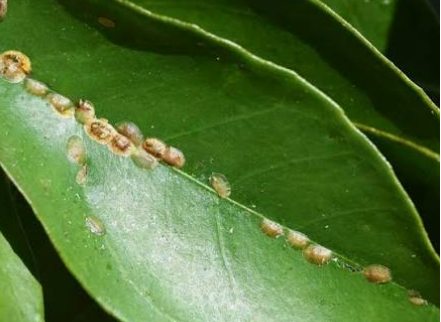
Citrus scale insects are small, sap-feeding pests that attach themselves to the leaves, twigs, branches, trunks, or fruit of citrus trees. Most mature females remain in one place beneath a waxy or shell-like covering, making them look more like bumps on the plant than insects. Heavy infestations can cause yellow foliage, leaf drop, fruit blemishes, twig dieback, reduced growth, and declining fruit production.
Numerous scale species attack oranges, lemons, limes, grapefruit, mandarins, kumquats, and ornamental citrus in the United States. The species present vary by region, but they can be divided into three useful groups: armored scales, soft scales, and cottony scales. Correctly identifying the group is essential because they produce different symptoms and respond differently to management.
Taxonomy and Classification
- Order: Hemiptera
- Superfamily: Coccoidea
- Armored-scale family: Diaspididae
- Soft-scale family: Coccidae
- Cottony cushion scale: Icerya purchasi
Scale insects are true bugs related to aphids, whiteflies, psyllids, and mealybugs. They have piercing-sucking mouthparts that remain inserted into plant tissue while the insects feed. Unlike beetles or caterpillars, scales do not chew holes in foliage.
Common Citrus Scale Species
Armored Scales
Armored scales produce a hard, detachable shield made from wax and shed skins. The insect’s body remains beneath this cover but is not physically attached to it. Armored scales do not excrete honeydew, so they are not normally associated with sticky leaves or black sooty mold.
- California red scale: Aonidiella aurantii
- Florida red scale: Chrysomphalus aonidum
- Yellow scale: Aonidiella citrina
- Purple scale: Lepidosaphes beckii
- Glover’s scale: Lepidosaphes gloverii
- Citrus snow scale: Unaspis citri
- Chaff scale: Parlatoria pergandii
Red scales are rounded and reddish-brown, while purple and Glover’s scales have elongated, oystershell-shaped coverings. Citrus snow scale commonly infests trunks and large limbs. Large colonies of its white male covers create a snow-sprinkled appearance, while females are darker and less conspicuous.
Soft Scales
Soft scales have a thin, waxy covering that is part of the insect’s body and cannot be separated like an armored shield. They feed on phloem sap and release sugary liquid called honeydew. Ants, flies, bees, and wasps may visit the honeydew, while dark sooty mold grows across contaminated leaves and fruit.
- Brown soft scale: Coccus hesperidum
- Black scale: Saissetia oleae
- Citricola scale: Coccus pseudomagnoliarum
Brown soft scales are oval, flattened to slightly convex, and range from yellowish-brown to dark brown. Mature black scales are dark, dome-shaped, and may have an H-shaped ridge on their backs. Citricola scale is a serious regional pest of California citrus but is often controlled by parasitoids in southern portions of the state.
Cottony Cushion Scale
Cottony cushion scale females are orange-brown and produce elongated, white, fluted egg sacs. The combined female and egg sac can approach 1/2 inch long. This species produces large quantities of honeydew and may cause severe citrus decline when natural enemies have been disrupted.
Identification
Adult female scales may appear as circular, oval, elongated, or oyster-shaped bumps. Depending on the species and age, their coverings can be white, gray, yellow, orange, red, brown, purple, or black. Most are between approximately 1/25 and 1/4 inch long, although cottony species may appear larger because of their egg sacs.
The first immature stage is called a crawler. Crawlers are tiny, flattened, yellow to orange insects with functional legs and antennae. They move across the tree or are carried by wind, animals, people, tools, and infested nursery plants. After finding a feeding site, most species settle, insert their mouthparts, and gradually lose their obvious legs.
Scale covers can remain attached after the insects die. To determine whether a scale is alive, gently lift or crush several specimens with a fingernail or small tool. Living scales usually contain moist, colored tissue, while dead scales are dry and hollow. Small round holes in covers may indicate that beneficial parasitic wasps have emerged.
Life Cycle
Most citrus scales develop through egg, crawler, settled nymph, and adult stages. Females place eggs beneath their bodies or inside waxy egg sacs. Some species produce living crawlers rather than exposed eggs. Development speed depends on species, temperature, humidity, host condition, and geographic region.
Many scale species produce multiple overlapping generations annually in warm citrus-growing regions. This means crawlers, young nymphs, mature females, and dead covers may occur together. Other species have one principal generation and move between leaves and twigs as they mature.
Males occur in certain species but are much less noticeable than females. Adult males are tiny, delicate, winged insects that do not feed. Some citrus scales reproduce without mating.
Distribution and Habitat
Citrus scale insects occur in citrus-growing regions throughout the United States, including Florida, California, Arizona, Texas, Louisiana, and other warm states. Potted citrus can support infestations indoors, in greenhouses, or in cooler regions where trees are overwintered inside.
Scale populations often build in dense, shaded portions of the canopy where air circulation is poor. Some species prefer leaves and young twigs, while others concentrate on fruit, trunks, or scaffold limbs. Citrus snow scale is especially associated with bark, whereas Florida and California red scales commonly occur on leaves, fruit, and small branches.
Damage to Citrus Trees
Scale insects remove plant fluids and nutrients through continuous feeding. Low populations may cause little noticeable injury, but large colonies can produce yellow spotting, reduced growth, leaf drop, twig death, bark splitting, or weakened branches. Young, drought-stressed, container-grown, or otherwise unhealthy trees are particularly vulnerable.
Armored scales may create yellow or reddish feeding halos on leaves and blemishes on fruit. Heavy infestations form crust-like layers on bark, leaves, or fruit. Fruit remains edible when damage is only superficial, but its appearance and commercial value may be reduced.
Soft and cottony scales cover foliage and fruit with sticky honeydew. Sooty mold growing on this material creates a black coating that blocks light, reduces photosynthesis, and soils harvested fruit. Ant activity around a citrus tree is often an early sign of honeydew-producing insects.
Monitoring Citrus Scales
Inspect citrus regularly rather than waiting for widespread decline. Check the undersides of leaves, leaf midribs, young twigs, fruit stems, branch junctions, trunks, and protected interior foliage. Use a hand lens to distinguish live insects from bark features, fungal growth, or old scale covers.
Crawler timing can be monitored by wrapping double-sided tape around an infested twig. Tiny yellow or orange crawlers become trapped as they move. Treatment is usually most effective against crawlers and young settled nymphs before their protective coverings become fully developed.
Citrus Scale Management and Control
Maintain Tree Health
Provide citrus with appropriate sunlight, drainage, irrigation, and nutrition. Avoid drought stress, waterlogged soil, trunk injuries, and excessive nitrogen fertilization. Prune dead or heavily infested twigs and thin overcrowded growth where appropriate to improve inspection, spray coverage, and air movement.
Mechanical Control
Small infestations can be rubbed from twigs with a soft brush or wiped from leaves and stems. A firm water spray may remove crawlers, honeydew, dust, and some loose scales. Dispose of heavily infested prunings away from susceptible citrus. Isolate infested potted trees from other plants until the population has been controlled.
Protect Natural Enemies
Lady beetles, lacewings, predatory mites, predatory flies, and tiny parasitic wasps provide important biological control. The vedalia beetle, Rodolia cardinalis, is an especially effective predator of cottony cushion scale. Aphytis parasitoids help suppress California red, yellow, and purple scales.
Avoid repeated broad-spectrum insecticide applications that kill these beneficial species. Wash dust from trees near unpaved roads and control honeydew-feeding ants. Ants protect scales from predators and parasitoids, allowing populations to increase. Use labeled ant baits or trunk barriers installed so they do not contact or injure the bark.
Horticultural Oils
Horticultural oils can control many citrus scales by coating and suffocating exposed insects. Oils are most effective against crawlers and young nymphs and require thorough coverage of infested plant surfaces. They leave little persistent residue and are generally less disruptive to natural enemies than many conventional insecticides.
Oil can injure citrus when applied during excessive heat, drought stress, freezing conditions, or other unsuitable weather. Certain combinations or closely timed applications of sulfur and oil can also damage plants. Always follow the product label’s temperature limits, crop directions, mixing restrictions, and harvest interval.
Other Insecticides
Insecticidal soaps and other labeled scale products may suppress exposed crawlers but provide limited control of mature armored scales. Systemic or residual insecticides should be reserved for confirmed, damaging infestations that cannot be managed through less disruptive methods.
Never apply an insecticide to blooming citrus while bees are visiting. Product choices and legal uses differ among states, commercial orchards, home landscapes, and indoor citrus. Follow the complete label and consult the local Cooperative Extension service or a licensed pest-management professional for severe infestations.
Conclusion
Citrus scale insects include armored, soft, and cottony species with different appearances and effects. Armored scales form detachable covers and do not produce honeydew, while soft and cottony scales commonly cause sticky deposits and sooty mold. Regular inspection, confirmation of living scales, crawler monitoring, healthy tree care, ant management, conservation of natural enemies, and properly timed horticultural oils provide an effective integrated approach.