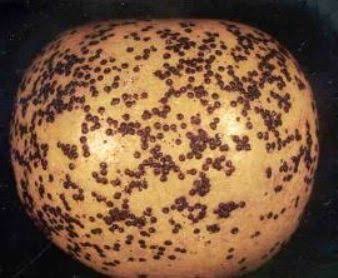
The California Red Scale (Aonidiella aurantii) is a serious armored scale insect pest of citrus and several ornamental and agricultural plants. Despite its common name, this species occurs in many citrus-growing regions worldwide and is not restricted to California.
California red scale feeds by inserting specialized mouthparts into plant tissues and extracting nutrients from leaves, twigs, branches, and fruit. Heavy infestations can weaken trees, cause leaf yellowing and premature leaf drop, contribute to twig dieback, and reduce the commercial value of citrus fruit.
The insect is especially important in commercial citrus production because even relatively low numbers on harvested fruit can create cosmetic defects that affect grading and marketability.
Taxonomy and Classification
- Common Name: California Red Scale
- Scientific Name: Aonidiella aurantii
- Order: Hemiptera
- Family: Diaspididae
- Genus: Aonidiella
- Species: A. aurantii
- Primary Hosts: Citrus species, including oranges, lemons, grapefruit, and mandarins
The California Red Scale belongs to the family Diaspididae, commonly known as armored scale insects. Unlike soft scales, armored scales do not normally produce honeydew. Their protective covers make established individuals difficult to control with treatments that rely on direct contact.
Physical Description and Identification
Adult Females: Mature females remain beneath rounded, reddish-brown protective covers approximately 1.5–2 millimeters in diameter. The cover is flattened to slightly convex and may show a central or near-central raised area.
Adult Males: Males develop beneath smaller, more elongated covers. Winged adult males are tiny, short-lived insects whose primary role is mating.
Crawlers: Newly emerged young are minute, yellowish, mobile insects that disperse across the host plant before settling and beginning to feed.
Settled Immature Stages: After locating a feeding site, crawlers insert their mouthparts into plant tissue and begin forming protective covers. They become increasingly immobile as development progresses.
Key Identification Features
- Small, circular, reddish-brown scales attached to citrus fruit, leaves, and twigs.
- Flattened protective covers that remain attached to plant surfaces.
- Clusters of scales around fruit depressions and protected areas.
- Yellowing foliage and weakened twigs during heavy infestations.
- Cosmetic blemishes on citrus fruit.
- Absence of the sticky honeydew typically associated with soft scale insects.
Distribution and Habitat
California red scale occurs in many warm and subtropical regions where citrus is grown. It is established in major citrus-producing areas, including parts of the United States, the Mediterranean region, Africa, Asia, Australia, and other suitable locations.
In the United States, it is especially associated with citrus production in California and other warm growing regions.
The insect inhabits commercial orchards, backyard citrus trees, nurseries, and ornamental plantings containing susceptible hosts. Population growth is influenced by temperature, host condition, natural enemies, and pest management practices.
Life Cycle and Reproduction
California red scale develops through several distinct stages, with important differences between male and female development.
Crawler Stage
Females produce live crawlers that emerge from beneath the maternal scale cover. These tiny mobile insects disperse to suitable feeding locations on leaves, twigs, branches, and fruit.
Settled Immature Stages
After settling, crawlers insert their mouthparts into the host and begin producing a waxy protective cover. Females remain attached to the plant throughout their later development.
Female Development
Females continue developing beneath their protective covers and eventually become reproductive adults. Mature females remain wingless and largely immobile.
Male Development
Males pass through additional developmental stages beneath their covers before emerging as small winged adults. Adult males survive for a relatively short period and seek receptive females.
Multiple Generations
Several overlapping generations can occur annually in favorable climates. The number and timing of generations vary with local temperature and seasonal conditions.
Damage and Signs of Infestation
California red scale causes both direct feeding injury and economic losses associated with contaminated fruit.
- Fruit Blemishes: Scale covers and associated discoloration reduce the appearance and commercial grade of citrus fruit.
- Leaf Yellowing: Heavy feeding may cause chlorosis and premature leaf drop.
- Twig Dieback: Severe infestations can weaken or kill smaller branches.
- Reduced Tree Vigor: Persistent feeding may impair overall growth and productivity.
- Fruit Downgrading: Visible scale infestations can result in rejected or lower-grade harvested fruit.
- Increased Management Costs: Commercial growers may face additional monitoring, biological control, and treatment expenses.
Unlike honeydew-producing soft scales, California red scale does not normally cause sooty mold through honeydew secretion. This distinction can help separate armored scale infestations from other common citrus pests.
Management and Integrated Pest Management (IPM)
1. Regular Orchard Monitoring
Inspect citrus leaves, twigs, and fruit for developing scale populations. Pay particular attention to previously infested trees and areas where natural enemy activity appears limited.
2. Monitor Male Flight
Species-specific pheromone traps can help detect adult male activity and improve the timing of monitoring and control decisions.
3. Monitor Crawlers
Because crawlers are mobile and have not yet developed thick protective covers, they are often more susceptible to appropriately timed treatments than older settled stages.
4. Encourage Natural Enemies
Parasitoid wasps, particularly Aphytis melinus, are important biological control agents of California red scale in many citrus production systems.
Predatory insects can also contribute to population suppression. Avoid unnecessary broad-spectrum insecticide applications that may disrupt beneficial species.
5. Horticultural Oils
Properly applied horticultural oils can help suppress scale populations by contacting susceptible developmental stages. Complete coverage is important, and applications must follow crop-specific label directions.
6. Selective Insecticides
Where monitoring indicates that treatment is necessary, growers may use registered selective insecticides or insect growth regulators. Product selection should account for resistance management, natural enemy conservation, and local recommendations.
7. Pruning and Tree Maintenance
Maintain healthy citrus trees through appropriate irrigation, nutrition, and pruning. Improved canopy access can facilitate monitoring and spray coverage, although pruning alone will not eliminate established infestations.
8. Prevent Spread Through Plant Material
Inspect nursery stock and avoid introducing infested plants into uninfested growing areas. Follow applicable plant movement and quarantine requirements.
Conclusion
The California Red Scale (Aonidiella aurantii) is an important armored scale pest capable of reducing citrus tree vigor and significantly affecting fruit quality. Its protective covering and overlapping generations can make established infestations challenging to manage. Effective control depends on regular monitoring, conservation of natural enemies, crawler-stage detection, and selective treatments when necessary. A well-designed integrated pest management program can reduce scale populations while minimizing unnecessary pesticide use.