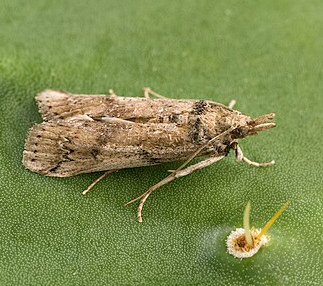
The Cactus Moth (Cactoblastis cactorum) is a cactus-feeding moth whose caterpillars tunnel into prickly pear cacti (Opuntia species). Native to South America, this species is widely recognized for its unusual history as both a successful biological control agent and a destructive invasive pest.
The moth was deliberately introduced into several regions to suppress invasive prickly pear populations. Its use in Australia became a prominent example of successful biological weed control. However, its subsequent establishment in the Caribbean and southeastern United States created serious concerns for native cactus populations and ecosystems.
Cactus moth larvae feed collectively inside cactus pads, consuming internal tissues and leaving damaged pads vulnerable to collapse and secondary decay. Repeated infestations can weaken or kill entire plants.
Taxonomy and Classification
- Common Name: Cactus Moth
- Scientific Name: Cactoblastis cactorum
- Order: Lepidoptera
- Family: Pyralidae
- Genus: Cactoblastis
- Species: C. cactorum
- Primary Hosts: Prickly pear cacti (Opuntia species)
The Cactus Moth belongs to the family Pyralidae, which includes numerous species whose larvae feed on stored products, plant materials, and living vegetation. Cactoblastis cactorum is especially notable for its close association with prickly pear cacti.
Physical Description and Identification
Adults: Adult cactus moths are grayish-brown moths with relatively narrow forewings and lighter hindwings. Their subdued coloration provides camouflage when resting on vegetation or other surfaces.
Eggs: Females arrange their eggs in distinctive elongated chains that resemble cactus spines. These structures are commonly called egg sticks and are often attached to cactus pads.
Larvae: Young caterpillars are initially pale but develop conspicuous orange-red coloration with dark markings as they mature. They feed together inside cactus pads, often producing extensive internal damage.
Pupae: Mature larvae leave the host pad and pupate in silken cocoons, commonly among debris or in sheltered locations near the plant.
Key Identification Features
- Elongated egg sticks attached to prickly pear pads.
- Orange-red caterpillars with dark markings.
- Groups of larvae feeding inside cactus pads.
- Entry holes and frass associated with infested pads.
- Discolored, hollowed, or collapsing cactus pads.
- Premature pad detachment or extensive plant deterioration.
Distribution and Habitat
The Cactus Moth is native to South America and has been introduced to several other regions. It became famous for controlling invasive prickly pear cacti in Australia, where the moth helped suppress extensive cactus infestations.
However, its establishment in the Caribbean and southeastern United States has raised significant ecological concerns. Native Opuntia species may be vulnerable to feeding damage, including species important for wildlife habitat and ecosystem stability.
The moth is associated with coastal habitats, dry scrublands, grasslands, disturbed sites, ornamental cactus plantings, and other areas supporting suitable prickly pear hosts.
Because its distribution can change, current occurrence records should be checked with agricultural authorities or invasive-species monitoring programs.
Life Cycle and Reproduction
The Cactus Moth undergoes complete metamorphosis, developing through egg, larval, pupal, and adult stages.
Egg Stage
Females deposit eggs in chains on cactus pads. After hatching, the young caterpillars enter the cactus tissue and begin feeding.
Larval Stage
Larvae feed collectively within the cactus pad, consuming internal tissues while remaining protected from many predators and environmental hazards.
As feeding progresses, the interior of the pad may become extensively hollowed, leaving the outer tissue weakened and susceptible to collapse.
Pupal Stage
Mature larvae exit the cactus and form protective cocoons in sheltered locations, often among plant debris.
Adult Stage
Adult moths emerge, mate, and deposit new egg sticks on suitable hosts. Several generations may occur annually in favorable climates.
Damage and Signs of Infestation
Cactus moth larvae are capable of causing extensive injury to prickly pear plants.
- Internal Pad Feeding: Caterpillars consume the fleshy interior of cactus pads.
- Discoloration: Infested pads may turn yellow, brown, or otherwise appear unhealthy.
- Frass and Exudates: Feeding sites may contain waste material and plant fluids.
- Structural Collapse: Hollowed pads may weaken, collapse, or detach.
- Secondary Decay: Damaged tissue may become colonized by microorganisms.
- Plant Mortality: Repeated or severe infestations can kill vulnerable cactus plants.
Beyond damage to individual plants, widespread infestations may threaten native cactus communities and the wildlife that depends on them for food, shelter, and nesting habitat.
Management and Integrated Pest Management (IPM)
1. Inspect Cactus Pads
Regularly examine prickly pear plants for egg sticks, entry holes, frass, discoloration, and damaged pads.
2. Remove Egg Sticks
When practical, carefully remove visible egg sticks before the larvae hatch. Destroy collected material to prevent successful development.
3. Remove Infested Pads
Severely infested pads may be removed and securely contained. Follow local disposal guidance to avoid spreading live larvae or other developmental stages.
4. Prevent Accidental Transport
Avoid moving infested cactus pads, cuttings, or plant debris into uninfested areas. Inspect ornamental and nursery plants before transport.
5. Biological Control and Research Programs
Specialized management programs have investigated biological and reproductive control approaches, including sterile insect techniques. Such methods require coordinated implementation and are not typical homeowner treatments.
6. Chemical Control
Insecticides may have limited effectiveness once larvae are feeding inside cactus pads. Any treatment should be selected according to local regulations, host-plant sensitivity, and the recommendations of invasive-species specialists.
7. Report Suspected New Infestations
In regions where the cactus moth is not established or is subject to monitoring, suspected infestations should be reported to the appropriate agricultural extension service or plant protection agency.
Conclusion
The Cactus Moth (Cactoblastis cactorum) demonstrates how an insect can be beneficial in one environment while becoming a serious invasive threat in another. Although historically useful for controlling invasive prickly pear cacti, its establishment outside intended management areas has endangered native cactus populations. Early detection, careful plant inspection, removal of infested material, and prevention of accidental transport are essential components of responsible management.