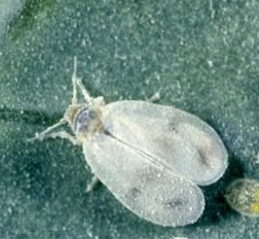
The Cabbage Whitefly (Aleyrodes proletella) is a small, sap-feeding insect that attacks cabbage, kale, Brussels sprouts, and several other plants in the mustard family. Although its name suggests a true fly, the cabbage whitefly belongs to the order Hemiptera and is more closely related to aphids and scale insects than to house flies.
Both adult and immature cabbage whiteflies feed by extracting plant sap, weakening heavily infested plants and producing sticky honeydew. This sugary secretion can support the development of black sooty mold on leaves, reducing the marketability and appearance of vegetables.
Cabbage whiteflies are particularly troublesome in crops with long growing seasons, where overlapping generations may produce large colonies on the undersides of leaves.
Taxonomy and Classification
- Common Name: Cabbage Whitefly
- Scientific Name: Aleyrodes proletella
- Order: Hemiptera
- Family: Aleyrodidae
- Genus: Aleyrodes
- Species: A. proletella
- Primary Hosts: Cabbage, kale, Brussels sprouts, and related brassicas
The family Aleyrodidae contains numerous whitefly species, including important greenhouse and agricultural pests. Unlike some highly polyphagous whiteflies, Aleyrodes proletella is especially associated with brassicaceous plants.
Physical Description and Identification
Adults: Adult cabbage whiteflies are approximately 1–2 millimeters long, with a pale yellowish body and white, powdery wings. Dark markings on the wings may help distinguish them from other whitefly species, although close examination is often necessary.
Eggs: Eggs are tiny, elongated, and deposited on the undersides of leaves. Females may arrange them in curved or circular patterns.
Immature Stages: Newly hatched crawlers move a short distance before settling onto a feeding site. Later immature stages are flattened, oval, and largely immobile, resembling small translucent scales attached to leaf surfaces.
Final Immature Stage: The last immature stage is commonly called a puparium, although whiteflies do not undergo true pupation like butterflies or beetles.
Key Identification Features
- Tiny white insects clustered beneath brassica leaves.
- Adults flying upward when infested foliage is disturbed.
- Flattened, oval immature stages attached to leaf undersides.
- Sticky honeydew deposits on foliage.
- Black sooty mold developing on honeydew-covered surfaces.
- Persistent colonies on older cabbage, kale, and Brussels sprout leaves.
Distribution and Habitat
The Cabbage Whitefly is established in parts of Europe and other temperate regions, with records from additional areas where suitable host plants are cultivated. Its local distribution should be checked against regional agricultural and pest-monitoring resources.
It commonly inhabits vegetable gardens, commercial brassica fields, allotments, and areas where cultivated or wild mustard-family plants provide suitable feeding and reproductive sites.
Cool-season brassica crops may support populations for extended periods, especially where host plants remain available throughout much of the year.
Life Cycle and Reproduction
The Cabbage Whitefly develops through eggs and several immature stages before becoming an adult. Its development is described as incomplete metamorphosis.
Egg Stage
Females deposit eggs on leaf undersides, often in characteristic curved arrangements. Hatching time varies with temperature.
Crawler Stage
Newly emerged nymphs move briefly before selecting a suitable feeding location. They insert their piercing-sucking mouthparts into plant tissue and begin extracting sap.
Sessile Nymphal Stages
Subsequent immature stages remain attached to the plant and continue feeding. As populations increase, multiple developmental stages may occur together on the same leaf.
Adult Stage
Adults emerge from the final immature stage, disperse to nearby host plants, and reproduce. Several generations can develop during favorable growing conditions.
Damage and Signs of Infestation
Cabbage whiteflies primarily damage plants through sap feeding and honeydew production.
- Leaf Yellowing: Heavy feeding may cause chlorosis and reduced leaf vigor.
- Honeydew Accumulation: Sticky deposits coat leaves and surrounding plant surfaces.
- Sooty Mold: Dark fungal growth develops on honeydew and interferes with the appearance of harvested produce.
- Reduced Crop Quality: Insects, shed skins, and contaminated foliage can make leafy vegetables difficult to market.
- Plant Stress: Severe infestations may contribute to reduced growth and productivity.
Although the insects themselves are small, persistent infestations can become economically significant because contamination may affect a large proportion of marketable foliage.
Management and Integrated Pest Management (IPM)
1. Inspect Leaf Undersides
Regularly examine lower and older leaves for adults, eggs, and nymphs. Monitoring should begin before populations become established throughout the crop.
2. Remove Heavily Infested Leaves
When practical, remove older leaves carrying large whitefly colonies. Dispose of infested material appropriately to reduce the number of insects remaining in the planting.
3. Encourage Natural Enemies
Predatory insects and parasitoid wasps can help suppress whitefly populations. Species of Encarsia and other natural enemies may contribute to biological control, depending on local conditions.
4. Use Insect-Exclusion Netting
Fine mesh covers installed before infestation can help prevent adult whiteflies from colonizing susceptible crops.
5. Manage Host Plants and Crop Residues
Remove unnecessary volunteer brassicas and infested crop residues that may support populations between planting cycles.
6. Apply Targeted Treatments
Insecticidal soaps and horticultural oils may reduce whitefly populations when registered for the crop and applied with thorough coverage of leaf undersides. Repeat applications may be needed because eggs and concealed immature stages can survive individual treatments.
Follow label directions carefully, especially for edible crops and applications during hot or sunny weather.
Conclusion
The Cabbage Whitefly (Aleyrodes proletella) is a persistent sap-feeding pest that can reduce the quality of cabbage, kale, Brussels sprouts, and other brassicas. Its tendency to colonize leaf undersides and produce honeydew makes early monitoring essential. Good crop sanitation, physical exclusion, natural enemies, and selective treatments provide a practical foundation for long-term management.