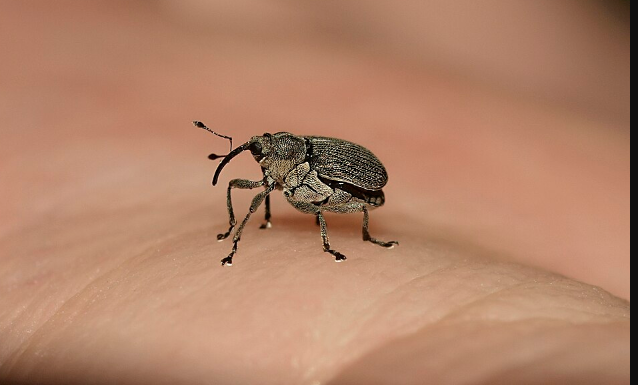
Cabbage seedpod weevils (Ceutorhynchus obstrictus) are small, gray weevils that attack canola, rapeseed, mustard, and other plants in the cabbage family. Adults damage flower buds and developing pods, while larvae feed directly on seeds inside the pods. Infestations can reduce crop yields and cause pods to split open before harvest.
This insect is primarily an agricultural pest rather than a household or structural pest. It is especially important in commercial canola-growing regions and fields used to produce seeds from cabbage-family crops.
Taxonomy and Classification
- Scientific name: Ceutorhynchus obstrictus
- Order: Coleoptera
- Family: Curculionidae
- Common name: Cabbage seedpod weevil
- Primary hosts: Canola, rapeseed, mustard, and other plants in the family Brassicaceae
The cabbage seedpod weevil is native to Europe and was introduced into North America. It has become an economically important pest in parts of Canada and the northern and western United States. Older publications may refer to this insect as Ceutorhynchus assimilis, but Ceutorhynchus obstrictus is the name generally used for the North American pest.
Identification
Adult cabbage seedpod weevils are approximately 3 to 4 millimeters long. They have small, oval bodies covered with grayish scales. Like other weevils, the head extends into a curved snout called a rostrum. The elbowed antennae arise from the sides of this snout.
The beetles may appear ash-gray, charcoal, or nearly black depending on lighting and the condition of their scales. Their small size and tendency to drop from plants when disturbed can make them difficult to see without a sweep net.
Larvae are creamy white, legless grubs with brown head capsules. They are usually found concealed inside developing seedpods. The eggs are extremely small and are deposited individually inside holes that females chew into young pods.
Distribution and Habitat
Cabbage seedpod weevils occur throughout much of Europe and have established populations in several North American canola-producing areas. In the United States, they are most often associated with agricultural regions in the Pacific Northwest, northern Great Plains, and neighboring areas.
The beetles inhabit canola fields, mustard plantings, crucifer seed-production fields, roadsides, and areas containing volunteer or wild mustard plants. Adults can move between fields and may concentrate first along crop borders before spreading throughout a planting.
Host Plants
The principal commercial hosts are canola and rapeseed, particularly Brassica napus and Brassica rapa. Other potential hosts include:
- Mustard
- Cabbage grown for seed
- Broccoli and cauliflower seed crops
- Turnips and rutabagas
- Radishes
- Volunteer canola
- Wild mustard and related weeds
Home vegetable gardeners rarely experience serious losses unless cabbage-family plants are allowed to flower and form seedpods. The insect does not normally cause significant injury to cabbage heads or edible leaves.
Life Cycle
Cabbage seedpod weevils generally complete one generation per year. Adults overwinter in leaf litter, field margins, wooded areas, and other protected locations. They become active in spring and feed on wild mustard or early-flowering cruciferous plants before entering crop fields.
Adult movement into canola fields usually increases between the bud and early-flowering stages. Females feed on developing pods and chew small openings through the pod walls. An egg is then deposited inside a pod, where it is protected from weather and many surface treatments.
After hatching, each larva feeds on several developing seeds. Mature larvae chew circular exit holes through the pods, fall to the ground, and enter the soil. They form earthen cells and pupate below the surface. New adults emerge later in the season, feed for a short period, and eventually seek protected overwintering sites.
Damage to Canola and Seed Crops
Both adults and larvae can cause crop injury. Adults chew holes in flower buds, stems, flowers, and young pods. Feeding on unopened buds can result in bud blasting, in which damaged buds fail to open and eventually drop from the plant.
Larval feeding is usually more economically important because the larvae consume developing seeds inside the pods. Infested pods may become bent, swollen, or misshapen. Exit holes created by mature larvae also weaken the pod walls.
Damaged pods are more susceptible to premature shattering, particularly during windy weather or when crops become dry. Seeds that fall before harvest cannot be collected, increasing the overall yield loss. Openings in pods may also allow moisture and disease organisms to enter.
Signs of an Infestation
- Small gray weevils on buds and flowers
- Chewed or aborted flower buds
- Puncture marks on developing pods
- Bent, swollen, or misshapen seedpods
- Missing or partially consumed seeds
- Small circular larval exit holes
- Pods splitting before harvest
- Unusual numbers of seeds scattered beneath plants
Monitoring Cabbage Seedpod Weevils
Begin scouting when canola plants enter the bud stage and continue through flowering. A sweep net is the most common monitoring tool. Walk well into the field and collect multiple sweep samples because field-edge counts may not represent the entire crop.
Record the number of adult weevils collected and compare the result with the treatment threshold recommended for the crop and region. Economic thresholds vary according to crop value, plant development, weather, sampling method, and local production practices. A local extension service can provide the most appropriate threshold.
Management and Control
An integrated pest management program combines field monitoring, cultural practices, natural enemies, and selective insecticide use.
- Scout before treating: Do not apply insecticides based only on the presence of a few adults. Use sweep-net counts and regional thresholds.
- Control volunteer hosts: Manage volunteer canola and wild mustard that can provide food before cultivated crops flower.
- Maintain crop health: Proper fertility, planting density, and moisture management help plants compensate for limited bud injury.
- Consider border patterns: Adults often enter along field edges, although border treatment should only be used when scouting confirms a concentrated infestation.
- Preserve natural enemies: Parasitic wasps can attack cabbage seedpod weevil larvae and contribute to long-term suppression.
- Harvest promptly: Properly timed harvesting can reduce losses caused by weakened pods and premature shattering.
If an insecticide is justified, timing is critical because treatments must target exposed adults before substantial egg laying occurs. Applications made during flowering can expose bees and other pollinators to pesticides. Always follow the product label, observe preharvest intervals, and use pollinator-protection practices. Product registrations and treatment recommendations vary by location.
Conclusion
Cabbage seedpod weevils are invasive agricultural pests capable of damaging canola and other crucifer seed crops. Adults injure buds and pods, while hidden larvae consume developing seeds and increase pod shattering. Accurate identification, sweep-net monitoring, preservation of natural enemies, and carefully timed control measures can reduce losses while avoiding unnecessary pesticide use.