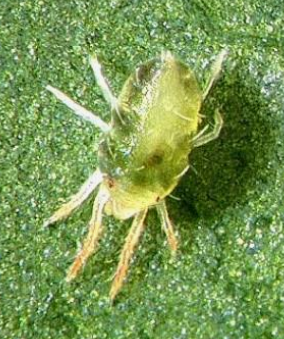
The Cassava Green Mite (Mononychellus tanajoa) is a microscopic plant-feeding mite and one of the most important arthropod pests affecting cassava (Manihot esculenta). Native to the Americas, this species became a major agricultural pest following its introduction into Africa, where cassava serves as an essential food and income crop.
Cassava green mites feed on young leaves and developing shoots, puncturing plant cells and extracting their contents. Their feeding causes yellowish stippling, leaf distortion, reduced photosynthetic activity, and premature leaf loss. Severe infestations can stunt plants and substantially reduce root yields, particularly during prolonged dry periods.
Unlike many insects, cassava green mites are arachnids belonging to the family Tetranychidae. Their small size and rapid reproduction make early detection important for effective management.
Taxonomy and Classification
- Common Name: Cassava Green Mite
- Scientific Name: Mononychellus tanajoa
- Class: Arachnida
- Order: Trombidiformes
- Family: Tetranychidae
- Genus: Mononychellus
- Species: M. tanajoa
- Primary Host: Cassava (Manihot esculenta)
The Cassava Green Mite belongs to the spider mite family Tetranychidae. Members of this family use specialized mouthparts to pierce plant cells and remove their contents. Mononychellus tanajoa is particularly adapted to cassava and commonly attacks young foliage.
Physical Description and Identification
Adults: Adult cassava green mites are extremely small, generally less than 0.5 millimeters long. Their bodies are oval and greenish to yellowish-green. Adults possess four pairs of legs and may be difficult to see without magnification.
Eggs: Eggs are tiny, rounded, and deposited on leaf surfaces. Their coloration may change as development progresses.
Larvae: Newly hatched mites have three pairs of legs and begin feeding on plant tissues soon after emergence.
Nymphs: Later immature stages develop four pairs of legs and increasingly resemble adults.
Key Identification Features
- Minute greenish mites concentrated on young cassava foliage.
- Yellow or pale stippling on developing leaves.
- Distorted, narrowed, or irregularly shaped leaf lobes.
- Reduced expansion of young leaves.
- Premature leaf shedding during severe infestations.
- Limited visible webbing compared with some other spider mite species.
Distribution and Habitat
The Cassava Green Mite originated in the Americas and subsequently spread to cassava-growing regions of Africa. It is now established in numerous tropical production areas where cassava is cultivated.
The species thrives in warm environments and frequently becomes more damaging during dry seasons. Heavy rainfall can reduce exposed mite populations, while drought-stressed cassava plants may experience increased damage.
Cassava fields, smallholder farms, and agricultural areas with continuous host availability provide suitable habitats.
Life Cycle and Reproduction
Cassava green mites develop through egg, larval, protonymph, deutonymph, and adult stages.
Egg Stage
Females deposit eggs on suitable cassava leaves. Hatching occurs relatively quickly under warm conditions.
Larval Stage
Newly emerged larvae possess six legs and begin feeding on plant cells.
Nymphal Stages
The mites pass through two eight-legged nymphal stages, feeding and molting as they develop.
Adult Stage
Adult females reproduce and establish additional colonies. Development may be completed rapidly under favorable conditions, allowing multiple overlapping generations.
Damage and Signs of Infestation
Cassava green mite feeding affects the plant’s ability to produce healthy foliage and store energy in its roots.
- Leaf Stippling: Small yellowish feeding spots appear on foliage.
- Leaf Distortion: Young leaves become narrowed, deformed, or unevenly expanded.
- Reduced Photosynthesis: Damaged leaves produce less energy for root development.
- Premature Defoliation: Severe infestations can cause significant leaf loss.
- Stunted Growth: Persistent feeding reduces shoot development.
- Root Yield Loss: Heavy infestations may reduce cassava root production.
Management and Integrated Pest Management (IPM)
1. Plant Resistant Varieties
Use cassava cultivars with documented tolerance or resistance where locally available. Resistant varieties can substantially reduce damage.
2. Encourage Predatory Mites
Predatory mites, particularly Typhlodromalus aripo and other phytoseiid species, are important biological control agents. Biological control programs have successfully reduced cassava green mite populations in parts of Africa.
3. Use Healthy Planting Material
Select healthy cassava cuttings and avoid transferring heavily infested material into uninfested fields.
4. Monitor Young Leaves
Inspect newly emerging foliage regularly, especially during dry periods when populations may increase rapidly.
5. Maintain Plant Health
Use appropriate soil fertility and moisture management practices to reduce crop stress.
6. Avoid Disruptive Insecticides
Broad-spectrum pesticides can eliminate beneficial predatory mites and contribute to pest resurgence. Chemical treatments should be considered only when locally recommended and registered.
Conclusion
The Cassava Green Mite (Mononychellus tanajoa) is a significant agricultural pest capable of reducing cassava growth and root yields. Its rapid reproduction and preference for young foliage make early monitoring essential. Resistant cassava varieties, conservation of predatory mites, healthy planting material, and sound crop management provide an effective foundation for long-term control.