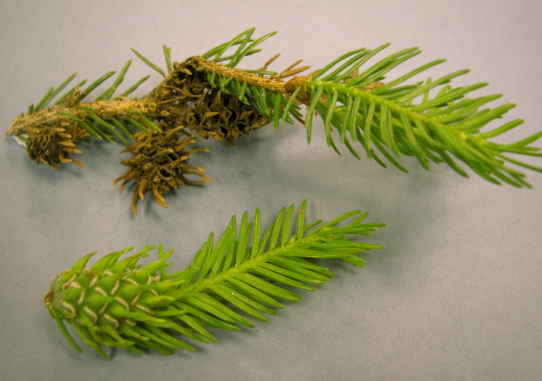
The Eastern Spruce Gall Adelgid (Adelges abietis) is a small sap-feeding insect that causes distinctive pineapple-shaped galls on spruce trees. These abnormal growths form near the bases of developing shoots and may interfere with normal branch development.
Although the insects themselves are tiny and often difficult to observe, the galls they produce are conspicuous. Fresh galls are generally green and resemble miniature pineapples, while older galls become brown and woody after the insects emerge.
Eastern spruce gall adelgids are especially important in ornamental spruce plantings, nurseries, and Christmas tree production, where abnormal shoot growth can reduce appearance and marketability. Heavy, repeated infestations may weaken young trees and cause branch distortion.
Taxonomy and Classification
- Common Name: Eastern Spruce Gall Adelgid
- Scientific Name: Adelges abietis
- Order: Hemiptera
- Family: Adelgidae
- Genus: Adelges
- Species: A. abietis
- Primary Hosts: Spruce trees (Picea species)
- Pest Type: Gall-forming sap-feeding insect
Adelgids are closely related to aphids but belong to a separate family. Many species feed on conifers and produce waxy secretions or induce distinctive plant galls.
Physical Description and Identification
Adults: Adelgids are tiny, dark-bodied insects often covered with white waxy material. Winged forms may develop during the seasonal life cycle.
Eggs: Eggs are deposited in clusters protected by waxy secretions near developing buds.
Nymphs: Young adelgids are minute, soft-bodied insects that settle near spruce buds and feed on plant sap.
Galls: The most distinctive structures are compact, pineapple-like swellings at the bases of new shoots. They contain chambers in which developing adelgids feed.
Key Identification Features
- Small green pineapple-shaped galls on spruce shoots.
- Galls positioned near the base of new growth.
- Brown, woody old galls remaining on branches.
- Distorted or shortened affected shoots.
- Tiny adelgids inside gall chambers.
- Occasional branch dieback following repeated infestations.
Distribution and Habitat
Eastern spruce gall adelgid is associated with spruce-growing regions of Europe and North America. It occurs on ornamental spruce trees, nursery stock, Christmas tree plantations, and other managed conifer plantings.
Norway spruce and other susceptible Picea species may be attacked. Infestation intensity varies among host species and individual trees.
Open ornamental plantings may make gall damage particularly noticeable, while natural enemies and local environmental conditions influence population levels.
Life Cycle and Reproduction
The Eastern Spruce Gall Adelgid has a seasonal life cycle associated with spruce bud development. It generally produces one gall-forming generation annually.
Overwintering
Immature adelgids overwinter near spruce buds, often protected by waxy material.
Spring Activity
As buds begin expanding, overwintered insects mature and reproduce. Feeding by developing adelgids stimulates gall formation.
Gall Development
New shoot tissues expand around the insects, producing chambers inside the pineapple-shaped gall.
Winged Adult Emergence
As galls mature, their chambers open and winged adelgids emerge to disperse and continue the life cycle.
Late-Season Development
Newly established insects settle near buds and eventually produce overwintering stages.
Damage and Signs of Infestation
Most injury results from abnormal gall formation rather than extensive sap removal.
- Gall Formation: Pineapple-like swellings develop near shoot bases.
- Growth Distortion: Affected shoots may become shortened or misshapen.
- Reduced Ornamental Value: Numerous galls can make trees appear unhealthy.
- Branch Dieback: Severe or repeated attacks may damage small branches.
- Reduced Growth: Young trees may experience slower shoot development.
- Persistent Old Galls: Brown galls remain visible after insects have departed.
Old, brown galls generally indicate previous activity rather than active infestations. Correctly distinguishing new and old galls helps avoid unnecessary treatments.
Management and Integrated Pest Management (IPM)
1. Inspect Spruce Buds
Examine developing shoots in spring for swelling and early gall formation.
2. Remove Green Galls
On small trees, prune and destroy green galls before they open and release winged adults.
3. Avoid Removing Old Galls Unnecessarily
Brown, opened galls no longer contain the developing insects responsible for the original damage.
4. Encourage Natural Enemies
Predatory insects and other beneficial organisms may contribute to adelgid suppression.
5. Select Suitable Spruce Species
Where practical, choose spruce varieties with lower susceptibility to gall-forming adelgids.
6. Consider Dormant or Early-Season Treatments
Where severe infestations justify intervention, use locally registered products timed to exposed overwintering or early developmental stages. Once galls close, insects are difficult to reach.
Conclusion
The Eastern Spruce Gall Adelgid (Adelges abietis) is a gall-forming insect that can distort spruce growth and reduce ornamental value. The characteristic pineapple-shaped galls provide an important identification clue. Early inspection, removal of developing galls, appropriate host selection, and selective management can prevent significant damage.