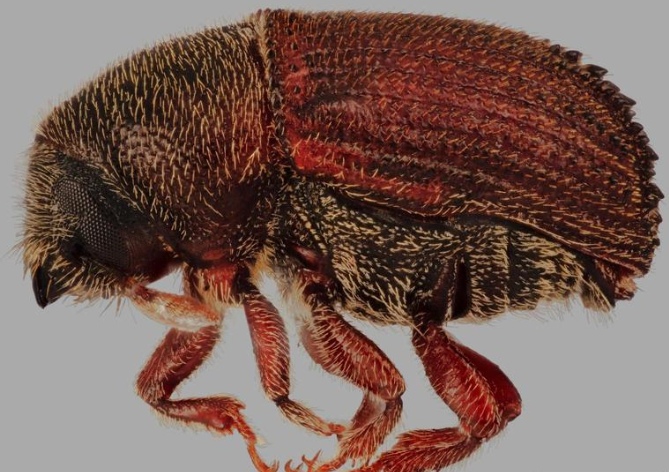
Cedar bark beetles are small, wood-boring beetles primarily belonging to the genus Phloeosinus. They develop beneath the bark of cedars, junipers, cypresses, arborvitae, and related conifers. Most species prefer trees that are already weakened by drought, disease, transplant stress, storm damage, overcrowding, or improper care. During favorable conditions, however, populations may increase and contribute to branch dieback or tree mortality.
Taxonomy and Classification
- Order: Coleoptera
- Family: Curculionidae
- Subfamily: Scolytinae
- Common genus: Phloeosinus
- Common names: Cedar bark beetles and cypress bark beetles
Numerous Phloeosinus species occur in North America. The species present and the trees attacked vary by region, making identification by host, gallery pattern, and adult characteristics important.
Identification
Adult cedar bark beetles are small, cylindrical insects generally comparable in size to a grain of rice. Depending on the species, they may be reddish brown, dark brown, or nearly black. Their heads are partly concealed beneath the pronotum when viewed from above, and their elbowed antennae end in enlarged clubs.
Larvae are small, legless, creamy-white grubs with darker head capsules. They remain beneath the bark, where they feed in the nutrient-conducting inner tissues. Removing loose bark from an infested branch may reveal adults, larvae, pupae, or distinctive branching galleries.
Host Trees and Distribution
Cedar bark beetles occur in forests, windbreaks, nurseries, parks, and residential landscapes across much of the United States. Depending on the beetle species, hosts may include junipers, arborvitae, Arizona cypress, Leyland cypress, false cypress, western redcedar, incense cedar, redwood, and other members of the cypress family.
Life Cycle and Behavior
Adult females bore through the bark of weakened, dying, or recently cut trees. Beneath the bark, each female excavates a gallery and deposits small eggs along its sides. Newly hatched larvae create separate tunnels extending away from the original gallery. These expanding patterns may resemble a centipede on the exposed wood.
Larvae pupate in enlarged chambers at the ends of their tunnels. New adults chew through the bark, leaving small, round exit holes. Many cedar bark beetles produce one or two generations annually, although development depends on species, elevation, and temperature. Adults may also mine tender twigs before reproducing.
Signs and Damage
- Numerous pin-sized holes in bark
- Fine boring dust caught in bark crevices or spider webs
- Branch tips turning yellow, red, or brown
- Scattered dead shoots known as “flags”
- Branch or crown dieback during drought
- Branching galleries visible beneath loose bark
Adults may mine several inches into twigs, causing tips to die and remain hanging on the tree. Larval feeding beneath the bark interrupts the transport of water and nutrients. Extensive trunk attacks can girdle an already weakened tree and accelerate its death.
Management and Control
Prevention is the most effective management strategy. Select trees suited to the location, water deeply during prolonged drought, apply mulch without piling it against the trunk, and avoid injuring bark or roots. Thin overcrowded plantings when appropriate so the remaining trees have adequate water and growing space.
Prune infested branches and promptly chip, solarize, or otherwise dispose of them. Do not stack freshly cut or beetle-infested wood beside healthy host trees. Trees with extensive trunk infestations usually cannot be saved and may require removal by a qualified arborist. Avoid transporting infested firewood because emerging beetles can colonize trees in new locations.
Insecticides cannot reach beetles already protected beneath the bark, and UC IPM does not recommend insecticide sprays for cedar or cypress bark beetles. Before considering any treatment, obtain a diagnosis from an Extension specialist, certified arborist, or licensed pest-management professional.
Conclusion
Cedar bark beetles are often indicators of underlying tree stress rather than the original cause of decline. Maintaining healthy trees, recognizing flagging and exit holes early, and removing infested material promptly offer the best protection for nearby cedars, junipers, cypresses, and arborvitae.