Overview
Bark Beetles are among the most important and destructive forest pests in the world. Belonging to the subfamily Scolytinae within the weevil family Curculionidae, these small beetles spend most of their lives beneath the bark of trees where they feed, reproduce, and develop. While many bark beetle species naturally help recycle dead and dying trees, certain species can attack healthy trees and trigger widespread forest mortality.
Species such as the Mountain Pine Beetle (Dendroctonus ponderosae), Southern Pine Beetle (Dendroctonus frontalis), and various Ips engraver beetles have caused some of the largest insect outbreaks ever recorded in North America. Their ability to overwhelm tree defenses through mass attacks, combined with their association with fungal pathogens, allows them to kill millions of acres of forest during outbreak years.
Bark beetles play a complex ecological role. In healthy forests they help remove weakened trees and promote nutrient cycling. However, under favorable conditions such as drought, overcrowding, or storm damage, populations can explode and transform entire landscapes.
Taxonomy and Classification
Bark beetles belong to the following classification:
- Kingdom: Animalia
- Phylum: Arthropoda
- Class: Insecta
- Order: Coleoptera
- Family: Curculionidae
- Subfamily: Scolytinae
Important bark beetle genera include:
- Dendroctonus – Mountain Pine Beetle, Southern Pine Beetle, Spruce Beetle
- Ips – Engraver Beetles
- Scolytus – Elm Bark Beetles
- Pityophthorus – Twig Beetles
Many species maintain symbiotic relationships with fungi. These fungi assist beetle development while helping overcome tree defenses and contributing to tree death.
Identification
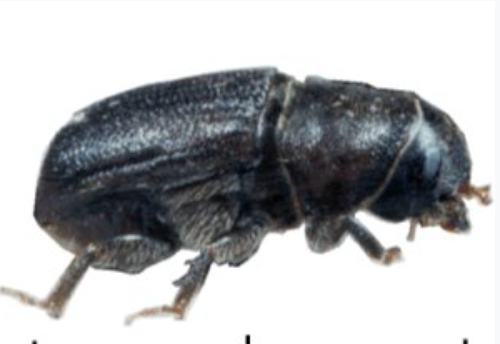
Adult bark beetles are tiny insects ranging from approximately 1 to 9 millimeters long. They possess a cylindrical body shape specifically adapted for boring beneath tree bark.
Common identification characteristics include:
- Dark brown, reddish-brown, or black coloration
- Cylindrical, compact body
- Short legs and antennae
- Strong mandibles for boring into bark
- Small round emergence holes on tree trunks
The larvae are white, legless, C-shaped grubs that remain hidden beneath the bark throughout development.
The most reliable signs of infestation are often not the beetles themselves but the damage they create, including:
- Pitch tubes (resin masses on bark)
- Fine sawdust-like frass
- Small entrance and exit holes
- Distinctive gallery patterns beneath bark
- Yellowing, reddening, or browning tree crowns
Distribution and Habitat
Bark beetles occur throughout the world in nearly every forested ecosystem. Different species specialize on different host trees.
Common hosts include:
- Pine trees
- Spruce trees
- Fir trees
- Elm trees
- Cedar trees
- Hardwood species
Their preferred habitat is the phloem and cambium layers located beneath the bark. These tissues transport nutrients throughout the tree and provide the ideal environment for feeding and reproduction.
Outbreaks are frequently associated with:
- Drought stress
- Storm-damaged forests
- Wildfire-damaged trees
- Overcrowded stands
- Aging forests
- Climate-related stress
Life Cycle and Behavior
Host Location
Adult beetles locate suitable host trees using chemical signals released by stressed or injured trees. Once a beetle successfully penetrates the bark, it releases aggregation pheromones that attract additional beetles.
Mass Attack Strategy
Healthy trees often defend themselves by producing resin that can trap or kill individual beetles. Bark beetles overcome this defense through coordinated mass attacks involving hundreds or thousands of individuals.
This overwhelming assault exhausts the tree’s defensive capabilities and allows successful colonization.
Gallery Construction
After entering the tree, adults excavate galleries within the phloem layer.
Female beetles create maternal galleries where eggs are deposited. These galleries vary by species and are often useful for identification.
Larval Development
Larvae hatch and tunnel away from the maternal gallery, feeding on phloem tissues. Their feeding creates characteristic larval galleries that radiate outward beneath the bark.
As development progresses, these galleries expand and eventually disrupt nutrient transport throughout the tree.
Pupation and Emergence
Pupation occurs within chambers beneath the bark. Newly emerged adults chew small exit holes and disperse to locate new hosts.
Depending on species and climate, bark beetles may complete one or multiple generations annually.
Damage and Economic Importance
Bark beetles kill trees through a combination of direct feeding damage and fungal introduction.
Vascular Disruption
Adult and larval tunneling destroys the phloem and cambium tissues responsible for transporting nutrients. Extensive gallery formation effectively girdles the tree.
Fungal Transmission
Many bark beetles carry blue-stain fungi and other pathogens. These fungi colonize the sapwood and interfere with water movement within the tree.
The combined effects of fungal infection and vascular damage rapidly weaken and kill the host.
Forest Mortality
Large outbreaks can kill millions of trees across vast regions.
Consequences include:
- Loss of timber resources
- Reduced wildlife habitat
- Increased wildfire risk
- Changes in watershed function
- Declines in recreational value
- Economic losses to forestry industries
Signs of Infestation
Early detection is critical for management.
Common symptoms include:
- Pitch tubes on bark surfaces
- Accumulations of frass around tree bases
- Woodpecker activity on trunks
- Yellowing needles
- Red or brown foliage
- Small round exit holes
- Loose or peeling bark
- Visible galleries beneath removed bark
Management and Control (IPM)
Forest Thinning
Reducing stand density improves tree vigor and resistance to attack. Healthy trees are better able to produce defensive resin and withstand infestations.
Sanitation Removal
Infested trees should be removed and destroyed before new adults emerge.
Common disposal methods include:
- Chipping
- Burning
- Debarking
- Solarization
Preventative Insecticides
High-value landscape trees can be protected with preventative bark sprays applied before beetle flight periods.
Once beetles are inside the tree, insecticides are generally ineffective.
Pheromone Monitoring
Pheromone traps are widely used to monitor populations and detect outbreaks early.
Some management programs also use anti-aggregation pheromones to discourage attacks on valuable trees.
Maintain Tree Health
Proper irrigation, avoidance of root damage, and reducing environmental stress help improve resistance.
Healthy trees are far less susceptible than drought-stressed or injured trees.
Ecological Importance
Although often viewed solely as destructive pests, bark beetles play important ecological roles. They help remove weakened trees, accelerate decomposition, recycle nutrients, and create habitat for many wildlife species.
Woodpeckers, predatory beetles, parasitoid wasps, and fungi all benefit from bark beetle activity. In natural ecosystems, these insects contribute to forest renewal and biodiversity.
Problems arise when environmental conditions allow populations to reach epidemic levels.
Conclusion
Bark Beetles are among the most influential forest insects on Earth. Their ability to coordinate mass attacks, disrupt tree vascular systems, and introduce pathogenic fungi makes them formidable pests of both natural and managed forests. While they serve important ecological functions under normal conditions, outbreaks can result in catastrophic tree mortality and significant economic losses. Effective management relies on maintaining healthy forests, monitoring populations, promptly removing infested trees, and protecting high-value specimens before attacks occur.