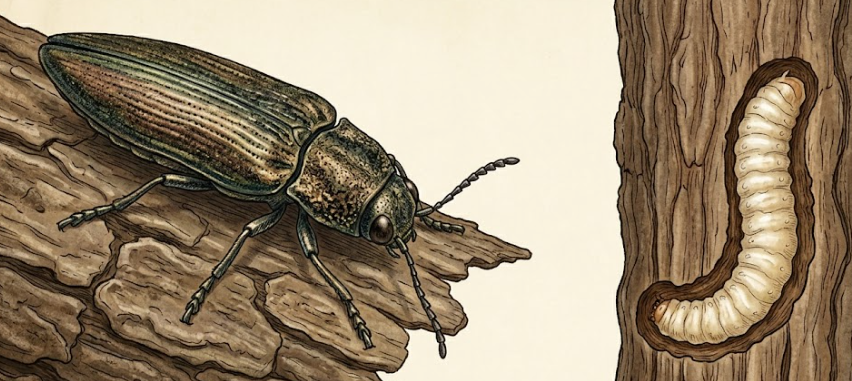
Tree Borers is a broad common name used for the larvae of numerous beetles and moths that tunnel into the bark, cambium, phloem, and wood of living trees. These insects are among the most destructive forest and landscape pests in the world because their feeding activity disrupts the movement of water and nutrients throughout the tree. As larvae tunnel beneath the bark or deep within the wood, they weaken structural integrity, cause branch dieback, reduce tree vigor, and may eventually kill the host tree. Tree Borers include notorious pests such as the Emerald Ash Borer, Asian Longhorned Beetle, Bronze Birch Borer, Flatheaded Appletree Borer, and various Clearwing Moths. While some native species primarily attack stressed trees, invasive borers can rapidly kill healthy trees and cause widespread ecological and economic damage.
Taxonomy and Classification
Tree Borers are not a single insect species but rather a group of insects whose larvae develop within woody plant tissues. Most belong to two major insect orders:
- Coleoptera (Beetles)
- Lepidoptera (Moths)
Important beetle families include:
- Buprestidae (Metallic Wood-Boring Beetles)
- Cerambycidae (Longhorned Beetles)
- Curculionidae (Bark Beetles and Weevils)
Important moth families include:
- Sesiidae (Clearwing Borers)
- Cossidae (Carpenter Moths)
- Pyralidae (Certain Wood-Boring Species)
The destructive stage is always the larva. Depending on species, larvae may remain protected inside trees for several months or even multiple years before emerging as adults.
Identification
Tree Borer larvae vary considerably among species but generally share adaptations for tunneling through wood and bark.
Beetle Larvae
- Appearance: White or cream-colored grubs.
- Shape: Cylindrical, flattened, or elongated.
- Legs: Often legless or with highly reduced legs.
- Mouthparts: Strong mandibles capable of chewing wood fibers.
- Size: Usually 1/4 to 2 inches long.
Examples include:
- Emerald Ash Borer
- Asian Longhorned Beetle
- Bronze Birch Borer
- Flatheaded Appletree Borer
Moth Larvae
- Appearance: Cream-colored caterpillars.
- Body: Soft-bodied with small legs.
- Behavior: Bore deeply into trunks, branches, and root collars.
Examples include Clearwing Borers and Carpenter Moths.
Signs of Infestation
Because Tree Borers spend most of their lives hidden inside trees, the insects themselves are rarely seen. Instead, homeowners and arborists rely on characteristic signs of damage.
- Exit Holes: Small openings where adult insects emerge from the tree.
- D-Shaped Exit Holes: Characteristic of flatheaded borers such as Emerald Ash Borer.
- Round Exit Holes: Common among longhorned beetles and moth borers.
- Frass: Sawdust-like waste material accumulating on bark, branches, or around the base of the tree.
- Sap Flow: Excessive sap or resin oozing from infested areas.
- Bark Splitting: Cracks developing above feeding galleries.
- Woodpecker Activity: Increased bird feeding on larvae beneath the bark.
- Canopy Thinning: Progressive loss of foliage.
- Branch Dieback: Dead or declining limbs appearing in the crown.
Distribution and Habitat
Tree Borers occur worldwide and occupy nearly every forested region on Earth. Most species specialize in particular groups of host trees.
Common hosts include:
- Ash Trees
- Oak Trees
- Maple Trees
- Birch Trees
- Pine Trees
- Spruce Trees
- Willow Trees
- Fruit Trees
Their habitat is located within:
- Cambium tissue
- Phloem layers
- Sapwood
- Heartwood
- Major branches
- Root collars
- Tree trunks
The protected environment inside the tree shields larvae from predators and environmental extremes.
Life Cycle
Although life cycles vary among species, most Tree Borers follow a similar pattern.
- Egg Stage: Adult females lay eggs on bark, cracks, wounds, or branch surfaces.
- Larval Stage: Newly hatched larvae tunnel into the tree and begin feeding.
- Pupal Stage: Mature larvae construct pupal chambers within the wood.
- Adult Stage: Adults emerge through exit holes and reproduce.
Depending on species, development may take one year or several years.
Damage and Economic Importance
Tree Borers are among the most economically significant tree pests because their feeding directly damages vascular tissues responsible for transporting water and nutrients.
Common impacts include:
- Girdling: Destruction of cambium tissues around the trunk.
- Reduced Water Movement: Interference with water transport.
- Nutrient Blockage: Reduced movement of sugars and nutrients.
- Structural Weakening: Internal tunnels compromise wood strength.
- Branch Failure: Increased risk of breakage during storms.
- Tree Mortality: Severe infestations may kill entire trees.
Urban landscapes, orchards, timber industries, and natural forests can all experience significant losses from Tree Borer infestations.
Behavior and Conflict
The greatest challenge in managing Tree Borers is their concealed feeding behavior.
- Protected Feeding: Larvae remain hidden beneath bark or inside wood.
- Difficult Detection: Symptoms often appear after significant damage has occurred.
- Stress Targeting: Many native species preferentially attack weakened trees.
- Invasive Threats: Some introduced species attack healthy trees with devastating efficiency.
Examples of highly destructive invasive borers include the Emerald Ash Borer and Asian Longhorned Beetle.
Management and Prevention
Effective Tree Borer management requires prevention, early detection, and maintaining tree health.
Tree Health Management
- Proper Watering: Reduce drought stress.
- Mulching: Protect root systems and conserve moisture.
- Fertilization: Maintain vigor when needed.
- Avoid Mechanical Injury: Prevent lawnmower and string-trimmer damage.
Systemic Treatments
- Trunk Injections: Deliver insecticides directly into vascular tissues.
- Soil Drenches: Allow roots to absorb protective compounds.
- Professional Applications: Often required for valuable trees.
Products containing active ingredients such as emamectin benzoate and dinotefuran are commonly used against certain borer species.
Monitoring
- Inspect trees regularly.
- Watch for exit holes and frass.
- Monitor canopy health.
- Respond quickly to early symptoms.
Biological Control
Researchers have introduced and evaluated several biological control agents for invasive Tree Borers.
Natural enemies include:
- Parasitic Wasps
- Predatory Beetles
- Woodpeckers
- Entomopathogenic Fungi
- Nematodes
Biological control programs have become particularly important in the management of Emerald Ash Borer populations.
Conservation and Research
Tree Borers are among the most heavily studied forest pests worldwide. Current research focuses on host resistance, improved systemic treatments, biological control agents, pheromone monitoring systems, and early detection technologies.
Scientists are also developing sustainable management strategies that protect valuable urban trees and natural forests while minimizing environmental impacts.