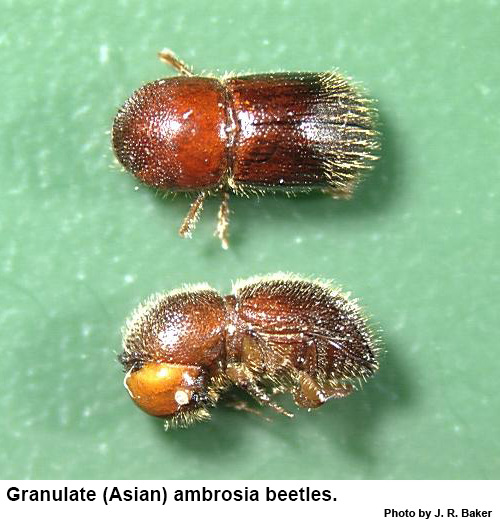
Quadrate ambrosia beetles are a group of wood-boring insects known for their unique symbiotic relationship with fungi. Rather than feeding directly on wood, these beetles cultivate specialized fungal gardens inside the galleries they bore into trees. This behavior makes them particularly damaging to both hardwood and softwood species, especially when trees are stressed, injured, or weakened.
Ambrosia beetles, including quadrate types, are considered serious pests in forestry, landscaping, and orchard systems. Once inside a tree, they are difficult to control because they are protected within the wood. Their fungal cultivation can further compromise tree health by disrupting vascular systems and accelerating decline.
The Fungus Farmer: Quadrate Ambrosia Beetles
The Quadrate Ambrosia Beetle (Euwallacea quadriperperus or related Euwallacea species) is a member of a highly specialized group of wood-boring insects. Unlike most “pests” that eat wood, these beetles are mycophagous—they don’t actually digest the timber. Instead, they “farm” a specific strain of ambrosia fungus inside the tree, which serves as the sole food source for both the adults and their larvae. In the United States, they are a significant concern for the timber and nursery industries because they can introduce pathogenic fungi that lead to Fusarium Dieback.
Identification: The “Toothpick” Sign
Adult Quadrate Ambrosia Beetles are tiny (2–3mm), cylindrical, and dark brown to black. Because they spend almost their entire lives deep inside the heartwood, they are rarely seen. Identification for a Pestipedia.com user relies almost entirely on the “frass” they push out of their tunnels:
- The Toothpicks: As the beetle bores into the tree, it pushes out a mixture of sawdust and excrement. This debris often sticks together, forming fragile, white, “toothpick-like” protrusions from the bark. This is the #1 diagnostic sign of an active infestation.
- Perfectly Circular Holes: The entry holes are tiny (about the size of a pencil lead) and perfectly round, unlike the oval or jagged holes made by other wood-borers.
- The “Quadrate” Shape: Under a microscope, the rear end of the beetle’s wing covers (the declivity) is somewhat steep and squared-off, which gives the species its “quadrate” name.
The Symbiotic Kill: Ambrosia Fungus
The relationship between the beetle and its fungus is one of nature’s most efficient partnerships, but it is deadly for the host tree:
- The Mycangia: The female beetle possesses specialized “pockets” in her head or thorax called mycangia, where she carries fungal spores from her birth tree to a new host.
- Vascular Clogging: Once inside the tree, the fungus grows rapidly along the tunnel walls. The tree’s immune response to this fungus often results in the clogging of its vascular system (xylem), leading to wilting and “dieback” of the branches.
- Staining: If an infested branch is cut, you will see dark brown or black staining around the beetle galleries—this is the “garden” where the fungus is growing.
U.S. Agricultural and Forest Management
In the United States, particularly in California, Florida, and the Pacific Northwest, management of these beetles is a race against time. Once the fungus is established, the tree’s health declines rapidly.
- Stress Management: Ambrosia beetles are “secondary” pests; they are chemically attracted to ethanol, which is released by trees under stress (drought, flooding, or mechanical injury). Keeping trees healthy and well-watered is the best prevention.
- Pheromone Traps: In U.S. orchards and nurseries, ethanol-baited traps are used to monitor beetle flight. When “toothpicks” are found, it indicates that the local population is high and immediate action is needed.
- Sanitation: Infested branches should be pruned and chipped or burned immediately. Leaving infested wood on the ground creates a “beetle factory” that will produce thousands of new adults to attack surrounding healthy trees.
- Trunk Sprays: Because the beetles spend so little time on the surface, traditional sprays must be applied to the trunk before the beetles arrive, creating a toxic barrier that kills them as they attempt to bore in.
Identification
Quadrate ambrosia beetles are small, typically ranging from 2–5 mm in length. They are cylindrical and dark brown to black in color. The term “quadrate” refers to certain structural characteristics of their body shape or pronotum. Entry holes on tree bark, often accompanied by sawdust-like frass or “toothpick” projections, are key signs of infestation.
Life Cycle
Females initiate infestations by boring into host trees and creating galleries. Eggs are laid within these galleries, and larvae develop while feeding on cultivated fungi rather than wood. Pupation occurs inside the tree, and new adults emerge to colonize additional hosts. Multiple generations can occur annually in warm climates.
Damage and Impact
Damage includes structural weakening, dieback, and eventual tree mortality. The introduction of fungi can clog vascular tissue, reducing water and nutrient flow. Infested trees often exhibit wilting, discoloration, and reduced growth.
Prevention and Control
Prevention focuses on maintaining tree health, as stressed trees are more susceptible. Monitoring with ethanol-baited traps can help detect activity. Chemical treatments are most effective when applied preventatively, as beetles are protected once inside the wood.