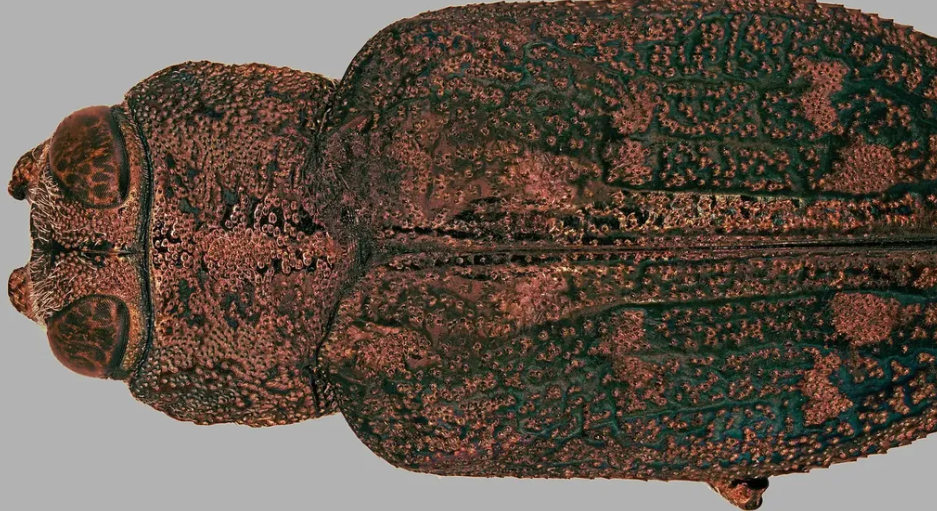
Flatheaded Borers are destructive wood-boring beetle larvae belonging to the family Buprestidae, commonly known as metallic wood-boring beetles or jewel beetles. These insects attack a wide variety of hardwood and conifer trees, especially those weakened by drought, transplant shock, sunscald, disease, or mechanical injury. The larval stage tunnels beneath the bark and within the cambium layer, disrupting the movement of water and nutrients throughout the tree.
Although the adult beetles are often strikingly metallic and colorful, the larvae are responsible for nearly all structural and physiological damage. Flatheaded Borers are particularly important pests in:
- Urban landscapes
- Orchards
- Nurseries
- Forests
- Christmas tree plantations
Infestations are frequently hidden beneath the bark, allowing severe internal injury to develop before external symptoms become obvious. By the time canopy decline appears, significant damage may already have occurred.
Many Flatheaded Borers preferentially attack stressed or injured trees, making tree health and proper cultural care the most important components of prevention.
Taxonomy and Classification
- Kingdom: Animalia
- Phylum: Arthropoda
- Class: Insecta
- Order: Coleoptera
- Family: Buprestidae
- Common Name: Flatheaded Borers
Flatheaded Borers belong to the beetle family Buprestidae, a large group commonly referred to as metallic wood-boring beetles because many adults possess brilliant iridescent coloration.
Important species include:
- Flatheaded Apple Tree Borer
- Bronze Birch Borer
- Emerald Ash Borer
- Pacific Flatheaded Borer
- Goldspotted Oak Borer
These insects undergo complete metamorphosis with four developmental stages:
- Egg
- Larva
- Pupa
- Adult beetle
The larval stage is the destructive phase responsible for tree injury.
Physical Description
Adult Flatheaded Borer beetles are typically elongated, hard-bodied beetles with metallic or iridescent coloration.
Adult characteristics commonly include:
- Metallic green, bronze, blue, or black coloration
- Bullet-shaped body
- Hardened wing covers
- Short antennae
- Fast flight
Many adults are highly attractive in appearance despite their destructive larvae.
The larvae possess the distinctive traits that give the group its name.
Larval characteristics include:
- Creamy white coloration
- Flattened widened segment behind the head
- Legless body
- Strong chewing mouthparts
- Segmented elongated appearance
The enlarged flattened thoracic region creates the characteristic “flatheaded” appearance.
Identification Signs
Several signs strongly indicate Flatheaded Borer infestation.
- D-shaped adult exit holes
- Winding serpentine galleries beneath bark
- Cracked or splitting bark
- Canopy dieback
- Sap weeping from bark
- Woodpecker activity
- Branch decline
The distinctive D-shaped exit holes are one of the most reliable identification features separating Flatheaded Borers from other wood-boring insects.
The larval tunnels are flattened and winding rather than deep circular galleries.
Distribution and Habitat
Flatheaded Borers occur throughout forests, orchards, nurseries, and urban environments worldwide.
They are particularly common in:
- Drought-prone regions
- Urban landscapes
- Heat-stressed environments
- Damaged forest stands
- Recently transplanted trees
Host plants vary by species but commonly include:
- Ash trees
- Birch trees
- Oak trees
- Apple trees
- Maples
- Pines
- Fir trees
- Fruit trees
Flatheaded Borers are especially attracted to weakened trees suffering from:
- Drought stress
- Sunscald
- Mechanical injury
- Root disturbance
- Poor soil conditions
- Transplant shock
Life Cycle
The life cycle of Flatheaded Borers varies depending on species and environmental conditions, but most follow a similar pattern.
Egg Stage
Adult females lay eggs within bark crevices or on stressed sections of host trees.
Eggs are often deposited on:
- Sun-exposed bark
- Damaged bark areas
- Fresh wounds
- Recently transplanted trees
Larval Stage
After hatching, larvae tunnel beneath the bark and feed within the cambium layer.
This feeding destroys tissues responsible for transporting:
- Water
- Nutrients
- Sugars
Larvae create flattened winding galleries that expand as they grow.
Heavy infestations may girdle branches or entire trunks.
Pupal Stage
Mature larvae pupate within chambers constructed beneath the bark or slightly inside the wood.
The pupal stage eventually transforms into the adult beetle.
Adult Stage
Adults emerge through characteristic D-shaped exit holes and begin searching for stressed host trees.
Many species complete one generation annually, though development may take longer in cooler climates.
Behavior and Feeding
Flatheaded Borer larvae are concealed feeders that remain hidden beneath bark throughout most of their development.
Unlike Roundheaded Borers that tunnel deeply into heartwood, Flatheaded Borers feed mainly within:
- Cambium tissue
- Phloem layers
- Outer sapwood
This shallow feeding pattern makes them especially dangerous because it directly disrupts vascular transport systems.
Adults feed little compared to larvae and are often active during warm sunny weather.
Damage and Impact
Flatheaded Borers are serious pests of ornamental, forest, and fruit trees.
Common symptoms include:
- Branch dieback
- Sparse canopy growth
- Yellowing foliage
- Reduced vigor
- Cracked bark
- Sap flow from wounds
- Tree mortality
Because the larvae feed beneath bark, extensive internal damage may occur before symptoms become visible externally.
Repeated or severe infestations may:
- Kill young trees
- Weaken mature trees
- Reduce fruit production
- Increase vulnerability to disease
- Invite secondary bark beetle infestations
Newly planted trees are particularly vulnerable because transplant stress reduces their natural defenses.
Signs of Infestation
- D-shaped exit holes
- Serpentine galleries beneath bark
- Bark splitting or cracking
- Sap leakage
- Dead branches
- Woodpecker feeding activity
- Sudden canopy thinning
Woodpeckers frequently target infested trees because the larvae provide a rich food source.
Prevention and Control
Management of Flatheaded Borers focuses heavily on prevention and maintaining tree health.
Maintain Tree Vigor
Healthy trees are far less attractive to Flatheaded Borers.
Proper care includes:
- Deep watering during drought
- Mulching
- Balanced fertilization
- Avoiding soil compaction
- Reducing transplant stress
Prevent Bark Injury
Avoid trunk wounds caused by:
- Lawnmowers
- String trimmers
- Construction equipment
- Sunscald damage
Adult beetles are strongly attracted to stressed or injured bark.
Prune and Remove Infested Wood
Remove heavily infested branches or trees promptly to reduce larval populations and prevent adult emergence.
Destroyed material should not be stored near healthy trees.
Monitoring
Inspect vulnerable trees regularly for:
- Exit holes
- Bark cracks
- Canopy decline
- Sap flow
Early detection improves treatment success.
Chemical Control
For high-value ornamental or orchard trees, systemic insecticides may sometimes protect trees or kill developing larvae.
Treatments are usually most effective when applied preventively or early during infestation development.
Ecological Importance
Despite their destructive role in stressed trees, Flatheaded Borers contribute to natural forest ecology.
They help decompose weakened or dying trees and serve as food for:
- Woodpeckers
- Predatory beetles
- Parasitic wasps
- Small mammals
Their activity accelerates nutrient recycling in forest ecosystems.
Research and Scientific Interest
Researchers study Flatheaded Borers extensively because of their impact on forestry, urban trees, and agriculture.
Research areas include:
- Tree stress physiology
- Biological control
- Systemic insecticides
- Pheromone trapping
- Climate-related outbreak patterns
- Host tree resistance
Modern integrated pest management focuses heavily on prevention through proper tree care and stress reduction.
Conclusion
Flatheaded Borers are destructive wood-boring beetle larvae belonging to the family Buprestidae. These pests attack weakened or stressed trees by tunneling beneath the bark and disrupting the flow of water and nutrients. Their hidden feeding behavior can lead to severe internal damage, canopy decline, branch dieback, and eventual tree death. Maintaining healthy vigorous trees through proper watering, avoiding bark injuries, and removing infested wood remain the most effective strategies for preventing serious Flatheaded Borer infestations.