Overview
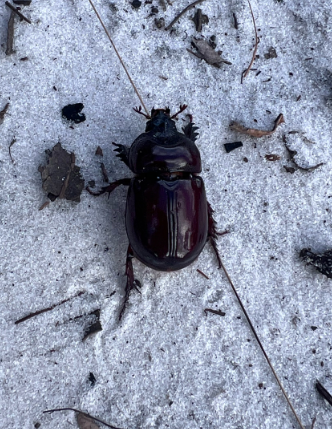
The Smooth Ox Beetle (Strategus antaeus) is a large, powerful scarab beetle native to the eastern and central United States. Its glossy body and the impressive horns of larger males give it a formidable appearance. However, finding one near a porch light or in a garden usually calls for observation rather than pest control.
This species belongs to the rhinoceros beetle subfamily, a group known for its robust bodies and elaborate male horns. Smooth Ox Beetles are associated with sandy soils and wooded habitats. Although their underground stages can raise concerns about plant roots, an isolated adult does not demonstrate a damaging infestation.
Taxonomy and Classification
- Kingdom: Animalia
- Phylum: Arthropoda
- Class: Insecta
- Order: Coleoptera
- Family: Scarabaeidae
- Subfamily: Dynastinae
- Tribe: Oryctini
- Genus: Strategus
- Species: Strategus antaeus (Drury, 1773)
The common name “ox beetle” is also applied to related Strategus species. Consequently, photographs and care information labeled simply “ox beetle” may describe a different species. Reliable identification requires examining physical features alongside the location where the beetle was found.
Identification and Physical Description
Adult Smooth Ox Beetles generally measure approximately 18–41 millimeters long. Their bodies are stout and oval, with coloration ranging from brown to very dark brown. The hardened wing covers, called elytra, protect the flight wings underneath.
Larger males develop three conspicuous horns on the pronotum, the shieldlike section immediately behind the head. These horns project around a depressed area of the pronotum. Smaller males have less developed armature, while females lack the prominent three-horned appearance. Horn size alone therefore cannot reliably identify the species.
A useful distinguishing feature is the absence of a complete sutural stria: a narrow groove running beside the seam where the wing covers meet. Related ox beetles possess this groove. Because this feature can be difficult to see in a casual photograph, clear images from above and from the side are helpful.
The larvae are white grubs with a curved body, a hardened brownish head, and three pairs of legs near the front. Many scarab larvae look similar, so identifying a grub as a Smooth Ox Beetle generally requires specialist examination.
Distribution and Habitat
The Smooth Ox Beetle occurs across parts of the eastern and central United States, with its reported range extending from Massachusetts south to Florida and westward to Kansas and Texas. Its presence within that broad range depends on suitable local habitat.
Sandy woodland soils, coastal plain environments, and wooded landscapes are characteristic habitats. Adults may also appear in yards bordering these areas. A beetle found on a driveway or patio may have flown in from nearby habitat, particularly when outdoor lighting attracts it.
Life Cycle and Behavior
Smooth Ox Beetles undergo complete metamorphosis, developing through egg, larval, pupal, and adult stages. Eggs are laid underground, and the immature stages develop below the surface before adults emerge.
Species-specific field information remains limited, so fixed claims about development time or annual generation numbers should be treated cautiously. Accounts of other ox beetles should not automatically be applied to Strategus antaeus.
Adults are primarily nocturnal and may fly toward artificial lights. University of Florida guidance describes males using their pronotal horns during territorial combat with other males. That guidance also notes that adults can be maintained on soft fruits and leaves in captivity; this does not establish them as significant fruit or foliage pests outdoors.
Damage and Human Conflict
The Smooth Ox Beetle is generally an occasional wildlife encounter rather than a household pest. It does not sting, and seeing an adult near a building does not indicate that it is attacking structural wood or breeding indoors.
Larval feeding accounts include roots and plant material, but the relationship between a particular grub and observed plant injury must be established before treatment. Brown grass, wilting plants, or damaged roots can have many causes. The presence of a large white grub alone is insufficient evidence that Smooth Ox Beetles are responsible.
Adults can create a minor nuisance when attracted to illuminated entrances or when they become stranded on smooth surfaces. Their strong legs and claws may feel prickly during handling, so moving them with a container is usually easiest.
Management and Control (IPM)
Integrated Pest Management begins with identification and evidence of damage. Routine insecticide treatment is generally unnecessary for an isolated Smooth Ox Beetle.
- Relocate occasional visitors: Guide the beetle into a container and release it in a sheltered outdoor location near where it was found.
- Reduce unnecessary lighting: Switch off unused exterior lights and limit illumination around open doors.
- Maintain exclusion: Repair damaged screens and close gaps around doors to reduce accidental entry.
- Investigate plant symptoms: Examine affected roots and soil before assuming grubs are causing the problem.
- Confirm larval identity: Ask a local extension office or insect diagnostic service to identify suspicious specimens.
- Use targeted treatment only when justified: If damaging root-feeding insects are confirmed, follow local recommendations and the product label.
Conclusion
The Smooth Ox Beetle is a distinctive native scarab recognized by its robust body, relatively smooth wing covers, and the three pronotal horns of larger males. Most encounters require little intervention. Accurate identification, sensible lighting practices, and confirmation of actual plant damage provide a practical approach to managing concerns while avoiding unnecessary pesticide use.