Overview
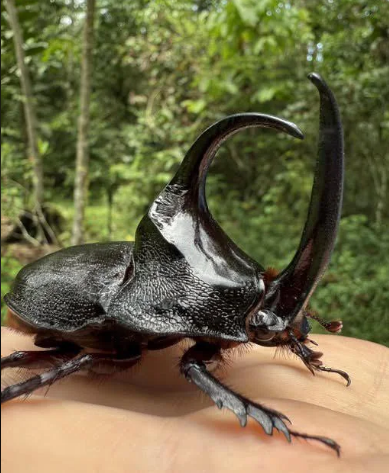
Rhinoceros Beetles are robust scarab beetles best known for the impressive horns carried by males of many species. These projections resemble the horns of a rhinoceros and help males compete for access to mates. Despite their intimidating appearance, many rhinoceros beetles are harmless woodland insects whose larvae help break down decaying organic material.
The name describes a diverse group rather than one species. It includes Hercules beetles, ox beetles, and several other members of the subfamily Dynastinae. Their importance varies considerably: many native species require no control, while certain species, particularly the Coconut Rhinoceros Beetle (Oryctes rhinoceros), can seriously damage palms.
Taxonomy and Classification
- Kingdom: Animalia
- Phylum: Arthropoda
- Class: Insecta
- Order: Coleoptera
- Family: Scarabaeidae
- Subfamily: Dynastinae
- Representative genera: Dynastes, Strategus, Oryctes, and Xyloryctes
Examples include the Eastern Hercules Beetle (Dynastes tityus), Smooth Ox Beetle (Strategus antaeus), European Rhinoceros Beetle (Oryctes nasicornis), and Coconut Rhinoceros Beetle (Oryctes rhinoceros). These beetles share a general family resemblance, but their feeding habits, habitats, and management needs differ.
Identification and Physical Description
Adult rhinoceros beetles typically have a thick, rounded body, strong legs, and hardened forewings called elytra. Color varies with species and may be black, reddish brown, or olive to yellowish with darker markings. Size also varies widely, making body length alone an unreliable identification feature.
The most recognizable characteristic is the horn arrangement. Depending on the species, males may have a single horn on the head, opposing head and thoracic horns, or several projections on the pronotum—the shieldlike structure behind the head. Females generally have smaller horns or lack the elaborate projections seen in males. Smaller males may also have reduced horns.
The larvae are large, creamy-white, C-shaped grubs with a brown head and three pairs of legs near the front. They resemble other scarab larvae, including lawn grubs. A grub found in compost cannot be reliably identified as a damaging turf pest based solely on its shape.
Stag beetles are another potential source of confusion. Their prominent “antlers” are enlarged jaws, whereas rhinoceros beetle horns arise from the head or thorax.
Distribution and Habitat
Rhinoceros beetles occur in many parts of the world, including tropical, subtropical, and temperate regions. Each species has its own geographic range. North American representatives include Hercules beetles and ox beetles, while other species inhabit Europe, Asia, Africa, and the Pacific region.
Many species occupy woodlands and landscapes containing decaying logs, old stumps, leaf litter, or organic-rich soil. Some develop in compost or other accumulations of decomposing vegetation. Adults may appear around homes bordering suitable habitat, especially when exterior lights attract them at night.
Habitat alone does not establish whether a beetle is beneficial or harmful. For example, Coconut Rhinoceros Beetle larvae develop in decomposing material, while the adults damage living palms.
Life Cycle and Behavior
Rhinoceros beetles undergo complete metamorphosis, passing through egg, larval, pupal, and adult stages. Females place eggs in suitable developmental material, which may include decaying wood, compost, or soil, depending on the species.
After hatching, larvae feed and grow through successive stages before forming pupae. The adult develops inside the pupal covering and later emerges. Development time varies with species, temperature, moisture, and food quality, so one timetable cannot describe the entire group.
Many adults are nocturnal and spend daylight hours concealed in vegetation, soil, or woody debris. Males of horned species use their projections to push, lift, or displace rivals. Adult diets vary and can include sap, fruit, foliage, or living plant tissues. Larval diets likewise range from decomposing organic material to roots in certain species.
Damage and Human Conflict
Many native rhinoceros beetles are occasional visitors that do not warrant treatment. Species that consume decomposing material contribute to nutrient recycling. Their presence in an old stump or compost pile does not automatically indicate a threat to healthy trees, lawns, or buildings.
The Coconut Rhinoceros Beetle is an important exception. Adults bore into palm crowns and feed on developing tissues. Injured leaves may show characteristic V-shaped cuts after unfolding. Repeated attacks can weaken palms, damage the growing point, and kill trees.
Rhinoceros beetles do not sting. Their strong legs and claws can grip firmly, however, so a container is useful for moving an occasional native beetle. Suspected invasive specimens should be contained and reported rather than relocated.
Management and Control (IPM)
Integrated Pest Management starts with identifying the beetle and determining whether it is causing damage. Management should match the species and the situation.
- Confirm identification: Photograph the beetle from above and from the side, record its location, and consult an extension office or insect diagnostic service when necessary.
- Leave harmless native species undisturbed: An isolated beetle or decomposer grub generally does not justify pesticide use.
- Reduce accidental entry: Repair screens, close gaps around doors, and switch off unnecessary exterior lighting.
- Investigate plant damage: Confirm the cause of declining turf or injured trees before treating nearby grubs.
- Report suspected invasive beetles: Contact the appropriate agriculture or plant-health agency if Coconut Rhinoceros Beetle is suspected.
- Follow local sanitation guidance: In affected areas, manage potential breeding material as directed and avoid moving suspect mulch, compost, or plant debris.
- Use coordinated control: Trapping, sanitation, biological methods, and labeled pesticides may be combined under an approved management program for damaging species.
Conclusion
Rhinoceros beetles combine remarkable horns with diverse ecological roles. Many are harmless native insects associated with decomposition, while a few are serious plant pests. Identifying the species and checking for actual damage helps homeowners protect useful insects while responding appropriately to destructive or invasive beetles.
Related Articles
- Ox Beetles – Learn about closely related horned scarabs and their underground larvae.
- Lawn Grubs – Understand root-feeding scarab larvae, turf damage, and management options.