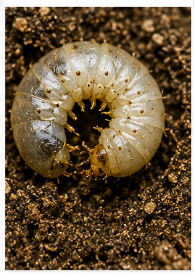
Lawn Grubs are the underground larvae of several scarab beetle species that feed on the roots of turfgrass. They are among the most destructive lawn pests in temperate regions and can damage residential lawns, golf courses, parks, athletic fields, cemeteries, sod farms, and other managed turf areas. The term “lawn grub” does not refer to one species but to a group of beetle larvae with similar appearance and feeding habits.
Common lawn-grub species in North America include the Japanese Beetle (Popillia japonica), European Chafer (Amphimallon majale), Oriental Beetle, Masked Chafers, and several May and June Beetles. Their larvae live below the soil surface and consume grass roots, weakening the turf and reducing its ability to absorb water and nutrients.
Early damage may resemble drought stress, but heavily infested grass eventually turns brown, dies, and separates easily from the soil. Grubs may also attract skunks, raccoons, birds, and other animals that tear apart the lawn while searching for food.
Taxonomy and Classification
Lawn Grubs belong to the order Coleoptera and are primarily members of the family Scarabaeidae. They undergo complete metamorphosis through egg, larval, pupal, and adult stages.
- Kingdom: Animalia
- Phylum: Arthropoda
- Class: Insecta
- Order: Coleoptera
- Family: Scarabaeidae
- Common Group: White Grubs or Lawn Grubs
Adult beetles vary greatly in appearance and behavior. Japanese Beetles feed on flowers and foliage, while many May and June Beetles are active at night and attracted to lights. Their larvae, however, share a similar C-shaped appearance and root-feeding lifestyle.
Physical Description
Mature Lawn Grubs usually measure approximately 1/2 to 1 inch long. Their bodies are soft, pale, and curved into a C-shape when disturbed.
- Color: Creamy white to pale yellow
- Head: Distinct brown or reddish-brown head capsule
- Legs: Three pairs of short legs near the head
- Body: Thick, segmented, and usually C-shaped
- Rear End: Swollen and sometimes dark from ingested soil
The presence of legs helps distinguish scarab grubs from legless billbug larvae. Species identification may require examination of the hair pattern on the underside of the final abdominal segment, known as the raster.
Distribution and Habitat
Lawn Grubs occur in many temperate regions where turfgrass and suitable beetle hosts are present. They are especially common in irrigated, healthy lawns because moist soil and dense grass provide favorable conditions for egg laying and larval survival.
Common habitats include:
- Residential lawns
- Golf courses
- Athletic fields
- Parks
- Sod farms
- School grounds
- Cemeteries
- Commercial landscapes
Grubs usually remain within the upper 2 to 4 inches of soil while actively feeding. They may move deeper during cold weather, drought, or other unfavorable conditions.
Life Cycle
Most Lawn Grubs complete their life cycle in one year, although some May and June Beetle species require two or three years.
Egg Stage
Adult female beetles deposit eggs in moist soil during late spring or summer. Well-watered turf is often attractive because the soil is easier to enter and supports young larvae.
Larval Stage
After hatching, young grubs begin feeding on fine grass roots. They pass through several growth stages and become increasingly destructive as they enlarge.
Feeding is often greatest from late summer through early fall. In colder areas, mature grubs move deeper into the soil for winter and return toward the root zone in spring.
Pupal and Adult Stages
Fully grown larvae pupate in the soil. Adult beetles later emerge, mate, feed when appropriate, and return to suitable turf to lay eggs.
Root Feeding and Turf Damage
Lawn Grubs feed on the roots that anchor grass plants and carry water and nutrients from the soil. As roots are removed, the grass becomes increasingly vulnerable to heat and drought.
Common symptoms include:
- Wilting despite irrigation
- Yellow or pale turf
- Irregular brown patches
- Thinning grass
- Dead turf that pulls up easily
- Reduced rooting beneath damaged areas
When injury is severe, the turf may peel back like loose carpet because the roots have been cut away. Grubs are often visible immediately beneath the damaged sod.
Secondary Damage from Animals
Grubs are a rich food source for many animals. Skunks, raccoons, birds, armadillos, and other wildlife may dig through turf while searching for them.
Signs of animal foraging include:
- Rolled-back sod
- Small cone-shaped holes
- Shredded turf
- Disturbed soil
- Damage appearing overnight
Animal damage can sometimes be more visually severe than the original root injury. However, wildlife activity alone does not confirm that treatment is necessary because animals may dig for earthworms or other soil organisms.
Inspection and Monitoring
Before treating a lawn, confirm that grubs are present and determine their approximate density.
Cut several small sections of turf from the boundary between healthy and damaged grass. Lift the sod and examine the upper soil and root zone. Count the grubs within each sampled area.
Treatment thresholds vary according to species, turf condition, irrigation, and management goals. A healthy lawn may tolerate several grubs per square foot, while stressed or high-value turf may show damage at lower densities. A fixed threshold of 10 grubs per square foot is sometimes used as a general guide, but local recommendations are more reliable.
Integrated Pest Management
Lawn Grub control is most successful when monitoring, healthy turf care, biological methods, and accurately timed insecticide applications are combined.
Maintain Healthy Turf
- Mow at the recommended height.
- Irrigate deeply and less frequently.
- Avoid excessive nitrogen fertilization.
- Reduce soil compaction when necessary.
- Encourage deep root development.
- Repair thin or damaged turf promptly.
Strong turf may tolerate moderate feeding better than shallow-rooted or drought-stressed grass.
Manage Summer Irrigation
Beetles often prefer moist turf for egg laying. Where appropriate for the grass species and climate, allowing the soil surface to dry moderately during peak egg-laying periods may reduce survival. The lawn should not be stressed so severely that it suffers permanent injury.
Preventive Insecticide Treatments
Preventive products are applied before serious damage occurs and target newly hatched or very small larvae. Depending on the active ingredient and local beetle activity, applications may be made during late spring or early summer.
Preventive treatments generally provide the best results when:
- The property has a history of grub damage.
- Adult beetle activity indicates likely egg laying.
- The product is applied at the recommended time.
- The lawn is irrigated according to label directions.
Applying preventive insecticides too early, too late, or without adequate irrigation may reduce effectiveness.
Curative Treatments
Curative insecticides target active grubs after an infestation has been detected. They are commonly used during late summer or early fall when grubs are feeding near the surface.
These products may act faster than preventive treatments but can become less reliable as grubs grow larger. Irrigation is usually necessary to move the active ingredient through the thatch and into the root zone.
Insecticides should not be applied solely because brown patches are present. Drought, disease, billbugs, chinch bugs, poor soil, and fertilizer injury can produce similar symptoms.
Biological Control
Beneficial nematodes are microscopic organisms that can infect and kill certain Lawn Grubs. Species in the genus Heterorhabditis are commonly used against soil-dwelling beetle larvae.
For best results:
- Use a nematode species recommended for the target grub.
- Apply during suitable soil temperatures.
- Keep the soil moist before and after treatment.
- Apply during evening or cloudy conditions.
- Follow storage and mixing instructions carefully.
Entomopathogenic fungi may also suppress some grub populations, although performance varies with moisture, temperature, soil conditions, and formulation.
Milky Spore
Milky Spore products contain Paenibacillus popilliae, a bacterium associated specifically with Japanese Beetle grubs. It is not a universal treatment for every Lawn Grub species.
Performance can be slow and inconsistent, particularly in areas with low Japanese Beetle densities or unsuitable soil temperatures. Accurate species identification is important before relying on Milky Spore.
Repairing Damaged Turf
Lightly injured lawns may recover when irrigation and root growth improve. Dead sections with severely damaged roots may require repair.
- Remove loose dead turf.
- Rake and loosen the soil.
- Reseed or install sod.
- Maintain consistent moisture during establishment.
- Avoid excessive fertilizer on new grass.
Repair should be combined with monitoring so developing grubs do not damage replacement turf.
Conservation and Research
Lawn Grubs are managed as important turfgrass pests, but scarab beetles also have ecological roles as decomposers and wildlife food. Control should therefore target confirmed damaging populations rather than every grub found in soil.
Research focuses on improved biological controls, resistant turfgrass, better monitoring methods, reduced-risk insecticides, and more accurate application timing. These advances help protect turf while reducing unnecessary environmental impact.
Conclusion
Lawn Grubs are the root-feeding larvae of Japanese Beetles, chafers, May Beetles, June Beetles, and other scarab beetles. Their feeding weakens turf, produces irregular brown patches, and may allow damaged sod to peel away easily from the soil.
Effective management begins with proper diagnosis and soil sampling. Healthy lawn care, careful irrigation, biological control, and correctly timed preventive or curative treatments can reduce damage. Because treatment thresholds and timing vary by species and region, insecticides should be used only after active grubs have been confirmed or when a documented history indicates a high risk of recurring damage.