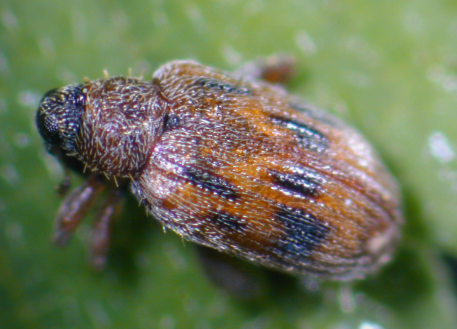
The Elm Flea Weevil (Orchestes steppensis) is a small leaf-feeding beetle associated with elm trees. It belongs to a group of jumping weevils whose adults feed externally on leaves while their larvae develop within leaf tissues.
The species has attracted attention as an elm pest because its feeding can produce small holes, leaf mines, and premature foliage discoloration. The combination of adult feeding and larval mining can make affected leaves appear spotted, perforated, or partially blighted.
Although individual beetles are tiny, large populations may cause noticeable ornamental damage. Young elms, nursery stock, and trees already experiencing environmental stress may be more sensitive to repeated feeding.
Elm flea weevils can be confused with other leaf-mining beetles or insects that create similar symptoms. Identification of the adult beetle or larval stage is important before making management decisions.
Taxonomy and Classification
- Common Name: Elm Flea Weevil
- Scientific Name: Orchestes steppensis
- Order: Coleoptera
- Family: Curculionidae
- Genus: Orchestes
- Species: O. steppensis
- Primary Hosts: Elm trees (Ulmus species)
- Pest Type: Jumping leaf-mining weevil
Orchestes weevils are notable for their enlarged hind legs, which allow adults to jump when disturbed. Their larvae develop within leaves rather than feeding on roots or boring into wood.
Physical Description and Identification
Adults: Adult elm flea weevils are small, compact beetles with a short snout and enlarged hind femora. Their coloration is generally dark brown to blackish, sometimes with contrasting markings.
Eggs: Females insert small eggs into elm leaf tissues.
Larvae: Larvae are pale, legless grubs that develop inside leaves and create feeding mines.
Pupae: Pupation occurs in association with the larval feeding site, often within leaf tissue.
Key Identification Features
- Tiny weevils that jump when disturbed.
- Small feeding holes or pits in elm foliage.
- Blotch-like leaf mines containing pale larvae.
- Yellowing or browning around damaged areas.
- Prematurely discolored leaves.
- Feeding damage concentrated on elm trees.
Distribution and Habitat
Orchestes steppensis is associated with Eurasian elm-growing regions. Reports of elm flea weevils in other locations require careful species identification because related Orchestes species can produce similar damage.
The species inhabits elm woodlands, ornamental landscapes, urban parks, roadside plantings, and other environments containing suitable Ulmus hosts.
Populations may become noticeable during periods of active leaf growth, when adult beetles feed and females deposit eggs.
Life Cycle and Reproduction
The Elm Flea Weevil undergoes complete metamorphosis through egg, larval, pupal, and adult stages.
Adult Feeding
Adult beetles feed on elm foliage, producing small feeding marks.
Egg Stage
Females deposit eggs within suitable leaf tissues.
Larval Stage
Larvae feed internally, creating mines that expand as development progresses.
Pupal Stage
Fully developed larvae pupate within protected locations associated with the leaf.
Adult Emergence
New adults emerge and continue feeding or seek protected overwintering locations, depending on seasonal conditions.
Local temperature and climate influence the timing of development and the number of generations.
Damage and Signs of Infestation
- Adult Feeding Holes: Small pits or perforations develop in leaves.
- Larval Mines: Internal feeding creates pale or brownish blotches.
- Leaf Discoloration: Damaged tissues become yellow or brown.
- Premature Leaf Drop: Heavy infestations may contribute to early defoliation.
- Reduced Ornamental Value: Repeated injury affects tree appearance.
- Tree Stress: Severe feeding may weaken young or already stressed trees.
Management and Integrated Pest Management (IPM)
1. Inspect Elm Leaves
Monitor foliage for small feeding holes, mines, and adult beetles.
2. Confirm Identification
Distinguish Orchestes steppensis from related elm flea weevils and other leafminers before selecting control measures.
3. Remove Infested Leaves
On small ornamental trees, collect heavily mined leaves where practical.
4. Encourage Natural Enemies
Parasitoids and predatory insects may help suppress leaf-mining beetles.
5. Maintain Tree Health
Provide adequate moisture and protect roots from compaction or mechanical damage.
6. Avoid Unnecessary Chemical Treatments
Healthy established elms often tolerate moderate feeding. Insecticides should be considered only when justified by local pest pressure and management recommendations.
Conclusion
The Elm Flea Weevil (Orchestes steppensis) is a small jumping beetle whose adults feed on elm foliage and whose larvae develop inside leaves. Monitoring, accurate identification, natural enemy conservation, and appropriate tree care are the principal management strategies.