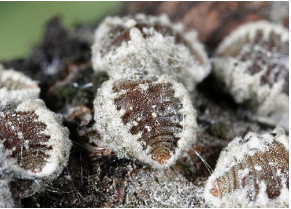
The European Elm Scale (Gossyparia spuria) is a sap-feeding insect that attacks elm trees and can cause honeydew accumulation, leaf discoloration, reduced vigor, and branch decline. Despite its common name, the species is established in parts of North America as well as Europe and other regions.
European elm scale is recognizable by its oval, reddish-brown body surrounded by a conspicuous white waxy fringe. Colonies frequently occur along branches, in bark crevices, and around branch junctions.
Heavy infestations can produce substantial quantities of sticky honeydew, which supports black sooty mold growth on leaves and nearby surfaces. The resulting contamination may be particularly troublesome on street trees and ornamental elms.
Established trees often tolerate low populations, but repeated heavy infestations can contribute to decline, especially when combined with drought, root injury, or other stress factors.
Taxonomy and Classification
- Common Name: European Elm Scale
- Scientific Name: Gossyparia spuria
- Order: Hemiptera
- Family: Eriococcidae
- Genus: Gossyparia
- Species: G. spuria
- Primary Hosts: Elm trees (Ulmus species)
- Pest Type: Felt scale insect
European elm scale belongs to the felt scale group, whose members produce waxy secretions and feed on plant sap. Unlike armored scales, this species produces honeydew.
Physical Description and Identification
Adult Females: Females are oval, reddish-brown insects, commonly several millimeters long. Their bodies are surrounded by white waxy filaments that form a conspicuous fringe.
Eggs: Eggs are produced in association with protective waxy material around mature females.
Crawlers: Newly hatched nymphs are tiny, mobile insects that disperse to suitable feeding sites.
Immature Stages: Young scales are smaller and less conspicuous than mature females.
Key Identification Features
- Reddish-brown oval scales with white waxy margins.
- Colonies in elm bark crevices and branch junctions.
- Sticky honeydew on leaves and nearby surfaces.
- Black sooty mold associated with heavy infestations.
- Leaf yellowing or reduced vigor.
- Occasional branch decline in stressed trees.
Distribution and Habitat
European elm scale occurs in Europe and parts of North America where suitable elm hosts are available.
It inhabits urban street trees, residential landscapes, parks, shelterbelts, and natural elm-growing areas.
Infestations may become especially noticeable on mature ornamental elms because honeydew can accumulate on sidewalks, vehicles, and outdoor furnishings beneath the canopy.
Population abundance is influenced by local weather, host condition, and natural enemy activity.
Life Cycle and Reproduction
European elm scale generally produces one generation annually in temperate regions.
Overwintering
Immature scales overwinter in protected locations on the host tree.
Spring Development
Overwintered insects resume feeding and mature as temperatures increase.
Egg Production
Females produce eggs within protective waxy material.
Crawler Emergence
Newly hatched crawlers disperse to suitable feeding sites, often on leaves.
Late-Season Development
Developing scales feed and eventually move to protected overwintering sites on the tree.
Damage and Signs of Infestation
- Honeydew: Sticky secretions coat leaves, bark, and objects beneath trees.
- Sooty Mold: Black fungal growth develops on honeydew.
- Leaf Yellowing: Heavy feeding may cause chlorosis.
- Reduced Photosynthesis: Extensive mold coverage can interfere with light absorption.
- Tree Weakening: Persistent infestations can reduce vigor.
- Landscape Nuisance: Honeydew and mold contaminate sidewalks, vehicles, and furniture.
Management and Integrated Pest Management (IPM)
1. Inspect Elm Branches
Check bark crevices and branch junctions for reddish scales with white waxy margins.
2. Monitor Crawler Activity
Identify crawler emergence to improve treatment timing.
3. Encourage Natural Enemies
Predatory insects and parasitoid wasps can contribute to scale suppression.
4. Manage Ant Activity
Where ants protect honeydew-producing scales, ant management may improve biological control.
5. Maintain Tree Health
Provide appropriate irrigation and protect roots from compaction or construction damage.
6. Use Registered Horticultural Oils
Properly timed oils may suppress vulnerable stages when applied according to label directions.
7. Avoid Unnecessary Insecticides
Broad-spectrum sprays may eliminate beneficial insects and contribute to future scale outbreaks.
Conclusion
The European Elm Scale (Gossyparia spuria) is a honeydew-producing scale insect recognized by its reddish-brown body and white waxy fringe. Heavy infestations can cause sooty mold, nuisance conditions, and reduced elm vigor. Monitoring, natural enemy conservation, ant management, and selective treatments provide practical control options.