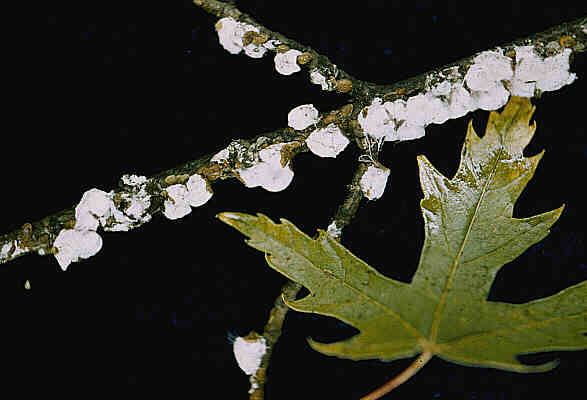
The Cottony Maple Scale (Pulvinaria innumerabilis) is a soft scale insect that commonly attacks maple trees and several other deciduous woody plants. It is particularly noticeable during late spring and early summer, when mature females produce conspicuous white, cottony egg sacs along twigs and branches.
These egg sacs may appear in large clusters, making infested branches look as though they are covered with small pieces of cotton. Although cottony maple scale populations are often kept under control by natural enemies, occasional outbreaks can cause heavy honeydew production, leaf discoloration, reduced vigor, and nuisance conditions beneath infested trees.
The insect is most frequently associated with ornamental shade trees in residential neighborhoods, parks, streetscapes, and landscaped properties.
Taxonomy and Classification
- Common Name: Cottony Maple Scale
- Scientific Name: Pulvinaria innumerabilis
- Order: Hemiptera
- Family: Coccidae
- Genus: Pulvinaria
- Species: P. innumerabilis
- Primary Hosts: Maple trees and other deciduous woody plants
- Pest Type: Soft scale insect
Cottony maple scale belongs to the soft scale family Coccidae. Unlike armored scales, soft scales produce honeydew while feeding on plant sap. The genus Pulvinaria includes several species that develop prominent cottony egg masses.
Physical Description and Identification
Adult Females: Mature females are oval, flattened to slightly convex, and generally brownish. They commonly measure several millimeters long before producing their cottony egg sacs.
Egg Sacs: Females produce elongated white, cotton-like ovisacs that may reach approximately 5–10 millimeters in length. These structures contain numerous eggs.
Eggs: Eggs are small and sheltered inside the white waxy mass.
Crawlers: Newly hatched nymphs are minute, yellowish, and mobile. They move onto leaves and other suitable feeding surfaces.
Immature Scales: Young scales are small, flattened, and relatively inconspicuous on leaf undersides.
Key Identification Features
- White cottony egg masses attached to maple twigs.
- Brownish female scales at one end of the egg sacs.
- Numerous scales clustered along small branches.
- Sticky honeydew dripping onto surfaces beneath trees.
- Black sooty mold on leaves, branches, or nearby objects.
- Occasional leaf yellowing during heavy infestations.
Distribution and Habitat
Cottony maple scale is widely distributed in North America, particularly in regions where suitable deciduous host trees are abundant.
Common habitats include urban shade trees, residential landscapes, parks, ornamental plantings, and woodland edges.
Maples are important hosts, but infestations may also occur on other hardwood trees and shrubs, including certain ash, elm, and related ornamental species.
Population levels vary from year to year. Natural enemies, seasonal weather, and tree condition strongly influence the likelihood of outbreaks.
Life Cycle and Reproduction
Cottony maple scale generally completes one generation per year in much of its range.
Overwintering Stage
Immature scales typically overwinter on twigs and branches, where they remain attached during colder months.
Spring Development
As temperatures rise, surviving scales resume development and mature into reproductive females.
Egg Production
Females produce conspicuous cottony egg sacs during late spring or early summer.
Crawler Emergence
Newly hatched crawlers disperse to foliage, where they settle and begin feeding.
Late-Season Development
Developing scales feed on leaves before moving to twigs or branches as seasonal conditions change.
Damage and Signs of Infestation
Cottony maple scale primarily causes damage through sap feeding and honeydew production.
- Honeydew Accumulation: Sticky deposits may coat leaves, sidewalks, vehicles, and outdoor furniture.
- Sooty Mold: Black fungal growth develops on honeydew-covered surfaces.
- Leaf Yellowing: Heavy infestations may reduce foliage quality.
- Reduced Vigor: Persistent feeding can weaken stressed trees.
- Premature Leaf Drop: Severe infestations may contribute to early defoliation.
- Landscape Nuisance: Cottony egg masses and honeydew reduce ornamental appearance.
Established trees usually tolerate light infestations without serious injury. Treatment decisions should be based on actual pest abundance and tree condition rather than the presence of egg sacs alone.
Management and Integrated Pest Management (IPM)
1. Inspect Twigs in Spring
Check branches for developing females and cottony egg sacs. Monitoring helps determine whether populations are increasing.
2. Encourage Natural Enemies
Lady beetles, parasitoid wasps, and other beneficial insects often provide substantial natural control.
3. Monitor Crawler Emergence
Use visual inspection or crawler-monitoring tape to identify periods when young scales are active.
4. Prune Small Infestations
Remove heavily infested twigs from small trees or shrubs when practical.
5. Avoid Unnecessary Insecticides
Broad-spectrum products can eliminate beneficial insects and contribute to recurring outbreaks.
6. Use Horticultural Oils When Appropriate
Registered horticultural oils may suppress vulnerable stages. Follow host plant and temperature restrictions on the product label.
7. Maintain Tree Health
Provide appropriate watering, mulching, and protection from root damage to reduce stress.
Conclusion
The Cottony Maple Scale (Pulvinaria innumerabilis) is a common soft scale insect recognized by white cottony egg sacs on deciduous trees. Although heavy infestations can cause honeydew, sooty mold, and reduced tree vigor, natural enemies frequently keep populations below damaging levels. Regular monitoring, crawler-timed management, and healthy tree maintenance are the most effective long-term strategies.