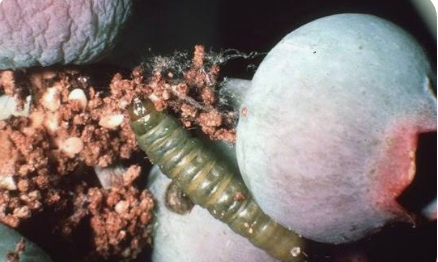
The Cranberry Fruitworm (Acrobasis vaccinii) is an economically important moth pest of cranberries and blueberries. Its larvae feed inside developing berries, consuming seeds and fruit tissues while contaminating fruit with frass and webbing.
Although adult moths are relatively inconspicuous, their larvae can cause significant losses in commercial cranberry bogs and blueberry fields. Infested berries may ripen prematurely, become discolored, shrivel, or fall from plants before harvest.
The Cranberry Fruitworm is especially challenging because larvae feed within fruit, where they are protected from many contact insecticides. Effective management requires careful monitoring of adult activity, crop development, and egg-laying periods.
Taxonomy and Classification
- Common Name: Cranberry Fruitworm
- Scientific Name: Acrobasis vaccinii
- Order: Lepidoptera
- Family: Pyralidae
- Genus: Acrobasis
- Species: A. vaccinii
- Primary Hosts: Cranberries and blueberries
- Pest Type: Fruit-feeding moth
The Cranberry Fruitworm belongs to the family Pyralidae, which includes numerous moths whose larvae feed on agricultural crops and stored plant materials. It should not be confused with the cherry fruitworm, another moth that damages blueberries.
Physical Description and Identification
Adult Moths: Adults are small grayish-brown moths with a wingspan commonly around 15–20 millimeters. Their forewings have darker markings that provide camouflage against vegetation.
Eggs: Eggs are tiny, pale, and deposited individually on developing berries, often near the calyx.
Larvae: Newly hatched caterpillars are small and pale. Older larvae may become greenish or pinkish, with a darker head capsule.
Pupae: Pupation occurs within protective cocoons associated with plant debris or sheltered locations near the crop.
Key Identification Features
- Small grayish-brown moths active around berry crops.
- Tiny eggs on developing fruit.
- Larvae feeding inside cranberries or blueberries.
- Frass near berry entry holes.
- Webbing connecting adjacent berries.
- Prematurely colored, shriveled, or damaged fruit.
Distribution and Habitat
Cranberry fruitworm occurs in North American regions where cranberries, blueberries, and related host plants grow.
It is particularly important in commercial cranberry production areas and blueberry-growing regions of the northeastern and north-central United States and Canada.
Suitable habitats include cranberry bogs, blueberry plantations, wild Vaccinium stands, and nearby vegetation that supports pest survival.
Seasonal development is closely associated with berry formation and the availability of suitable fruit for larval feeding.
Life Cycle and Reproduction
Cranberry fruitworm undergoes complete metamorphosis, passing through egg, larval, pupal, and adult stages.
Overwintering
The insect generally overwinters as a mature larva in a protective cocoon associated with soil or plant debris.
Pupal Stage
Overwintered larvae pupate as seasonal temperatures increase.
Adult Emergence
Adult moths emerge during the growing season and mate. Female moths locate developing berries for egg deposition.
Egg Stage
Eggs are deposited on suitable fruit and hatch after a temperature-dependent developmental period.
Larval Stage
Newly hatched larvae enter berries and feed internally. A larva may damage multiple berries as it develops.
The species generally produces one generation annually in major cranberry-growing regions.
Damage and Signs of Infestation
Cranberry fruitworm larvae cause direct fruit damage and reduce marketable yield.
- Internal Feeding: Larvae consume seeds and berry tissues.
- Frass Contamination: Feeding produces waste material inside or around fruit.
- Webbing: Larvae may connect berries with silk.
- Premature Color Change: Infested fruit may become red or otherwise discolored earlier than healthy berries.
- Berry Shriveling: Damaged fruit may dry, collapse, or drop.
- Reduced Marketability: Infested berries may be rejected during grading and processing.
Fruit damage may resemble injury caused by other berry-feeding caterpillars. Identification of larvae and the pattern of feeding helps distinguish cranberry fruitworm infestations.
Management and Integrated Pest Management (IPM)
1. Monitor Adult Moths
Use species-specific pheromone traps where available to monitor adult flight activity.
2. Inspect Developing Berries
Examine fruit for eggs, entry holes, frass, and webbing. Regular inspection is important during susceptible crop stages.
3. Time Treatments Carefully
When insecticides are justified, applications should target eggs or newly hatched larvae before they enter berries. Follow regional extension recommendations.
4. Remove Infested Fruit
In small plantings, collect and destroy visibly infested berries to reduce local pest development.
5. Encourage Natural Enemies
Parasitoids and predators may contribute to suppression. Avoid unnecessary broad-spectrum insecticides.
6. Maintain Crop Sanitation
Manage discarded fruit and crop residues where practical, while following production-specific recommendations for cranberry bogs and blueberry fields.
7. Use Regional IPM Programs
Follow locally validated degree-day models, monitoring thresholds, and spray timing recommendations when available.
Conclusion
The Cranberry Fruitworm (Acrobasis vaccinii) is a significant pest of cranberries and blueberries because its larvae feed inside developing fruit. Early monitoring and treatment timing are essential for preventing damage. Pheromone trapping, fruit inspection, sanitation, biological control, and regionally appropriate IPM programs can help protect berry yields and quality.