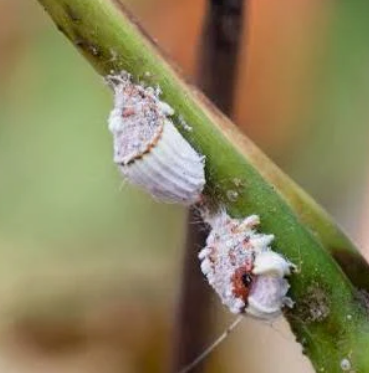
The Cottony Cushion Scale (Icerya purchasi) is a distinctive sap-feeding insect that attacks citrus trees, ornamental shrubs, and numerous woody plants. It is best recognized by the large, white, ribbed egg sac produced by mature individuals. This cottony structure can be considerably larger than the insect itself, making established infestations conspicuous on leaves, twigs, and branches.
Originally associated with Australia and surrounding regions, cottony cushion scale became a historically important invasive pest of California citrus during the nineteenth century. Its successful control through the introduction of the vedalia beetle, Novius cardinalis, formerly known as Rodolia cardinalis, became one of the most celebrated examples of classical biological control.
Cottony cushion scales feed by extracting plant sap. Heavy infestations can weaken plants, cause leaf yellowing and premature leaf drop, and produce substantial quantities of honeydew. The honeydew encourages black sooty mold, reducing photosynthesis and ornamental appearance.
Although severe outbreaks can occur, established populations of natural enemies often provide excellent suppression when they are protected from disruptive pesticide applications.
Taxonomy and Classification
- Common Name: Cottony Cushion Scale
- Scientific Name: Icerya purchasi
- Order: Hemiptera
- Family: Monophlebidae
- Genus: Icerya
- Species: I. purchasi
- Primary Hosts: Citrus trees, ornamental shrubs, and numerous woody plants
- Pest Type: Sap-feeding scale insect
The Cottony Cushion Scale belongs to the family Monophlebidae, a group of scale insects characterized by distinctive wax secretions. Unlike armored scales, cottony cushion scales produce honeydew and do not remain permanently enclosed beneath a detachable protective shield.
Physical Description and Identification
Adult Females: Mature reproductive individuals have oval, reddish-orange to brownish bodies, often partially covered with white wax. They produce a conspicuous, elongated, white egg sac marked by parallel ridges. The combined body and egg sac may reach approximately 10 millimeters or more in length.
Eggs: Numerous reddish eggs are deposited inside the cottony, ribbed egg sac.
Crawlers: Newly hatched nymphs are small, reddish, and mobile. They disperse to suitable feeding sites on leaves and stems.
Immature Stages: Developing scales are smaller than adults and may have white waxy projections around their bodies.
Key Identification Features
- Large, white, ribbed egg sacs attached to stems and leaves.
- Reddish-orange or brownish scale bodies.
- Small, mobile reddish crawlers.
- Sticky honeydew on infested foliage.
- Black sooty mold on leaves and branches.
- Leaf yellowing and reduced plant vigor during heavy infestations.
Distribution and Habitat
Cottony cushion scale occurs in many tropical, subtropical, and mild temperate regions. It has become established in citrus-growing areas and ornamental landscapes worldwide.
Suitable habitats include commercial citrus orchards, residential gardens, parks, ornamental nurseries, and urban landscapes containing susceptible trees and shrubs.
The insect may infest citrus, pittosporum, acacia, and other broadleaf plants. Its broad host range allows populations to persist outside commercial agricultural settings.
Warm conditions favor development, while the presence of natural enemies often determines whether populations remain low or increase to damaging levels.
Life Cycle and Reproduction
Cottony cushion scale develops through egg, nymphal, and adult stages. The species is unusual because most reproductive individuals are hermaphroditic and can produce offspring without mating with a separate male.
Egg Stage
Reproductive adults produce numerous eggs inside their distinctive cottony egg sacs. These sacs protect developing eggs from environmental exposure.
Crawler Stage
Newly hatched crawlers leave the egg sac and disperse across the host plant. They are the principal stage responsible for establishing new feeding locations.
Nymphal Development
Immature scales settle and feed on plant sap, gradually increasing in size and producing additional waxy secretions.
Adult Stage
Mature individuals continue feeding and produce large egg sacs. Several generations may develop annually in favorable climates.
Damage and Signs of Infestation
Cottony cushion scale damages plants through sap removal and honeydew production. Heavy populations can affect both plant health and ornamental appearance.
- Leaf Yellowing: Feeding may cause chlorosis and reduced foliage quality.
- Premature Leaf Drop: Severely infested plants may shed leaves.
- Honeydew Production: Sticky secretions accumulate on foliage and nearby surfaces.
- Sooty Mold: Black fungal growth develops on honeydew and reduces light reaching leaves.
- Reduced Plant Vigor: Heavy feeding can weaken shoots and branches.
- Ornamental Damage: Visible egg sacs and blackened foliage reduce landscape appearance.
Management and Integrated Pest Management (IPM)
1. Encourage Vedalia Beetles
The vedalia beetle (Novius cardinalis) is a highly effective predator of cottony cushion scale. Both adults and larvae feed on the pest and can rapidly reduce established populations.
2. Protect Parasitic Flies
The parasitic fly Cryptochaetum iceryae is another important natural enemy that contributes to suppression in suitable regions.
3. Avoid Broad-Spectrum Insecticides
Unnecessary insecticide applications can eliminate vedalia beetles and other natural enemies, allowing cottony cushion scale populations to rebound.
4. Inspect Plants Regularly
Examine stems, leaf undersides, and branch junctions for early colonies and developing egg sacs.
5. Remove Small Infestations
On small ornamental plants, heavily infested twigs may be pruned or individual scales removed manually.
6. Use Selective Treatments When Necessary
Horticultural oils or insecticidal soaps labeled for the host plant may suppress exposed scales. Applications should be carefully timed to minimize harm to beneficial insects.
7. Maintain Plant Health
Provide appropriate irrigation, nutrition, and pruning to help plants tolerate limited feeding damage.
Conclusion
The Cottony Cushion Scale (Icerya purchasi) is a distinctive scale insect recognized by its large, ribbed white egg sac. Although heavy infestations can damage citrus and ornamental plants, biological control is often remarkably effective. Protecting vedalia beetles, monitoring infestations, and avoiding unnecessary pesticide applications are central to sustainable management.