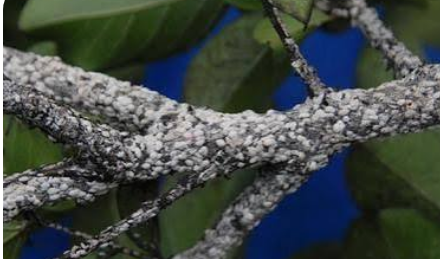
The Crape Myrtle Bark Scale (Acanthococcus lagerstroemiae) is an invasive sap-feeding insect that attacks crape myrtle trees and shrubs. Originally described from Asia, the species has spread through parts of the United States and become an increasingly important pest of ornamental landscapes.
Infestations are recognizable by clusters of small, white or grayish felt-covered scales on trunks, branches, and twigs. When crushed, living scales may release a pinkish or reddish fluid.
Crape myrtle bark scale produces honeydew, which supports the development of black sooty mold. Heavy infestations can leave trunks and branches coated in dark fungal growth, reducing the ornamental appearance of crape myrtles and potentially affecting plant vigor.
Because crape myrtles are widely planted as flowering landscape trees, bark scale infestations can create substantial maintenance concerns for homeowners, municipalities, and landscape professionals.
Taxonomy and Classification
- Common Name: Crape Myrtle Bark Scale
- Scientific Name: Acanthococcus lagerstroemiae
- Former Scientific Name: Eriococcus lagerstroemiae
- Order: Hemiptera
- Family: Eriococcidae
- Genus: Acanthococcus
- Species: A. lagerstroemiae
- Primary Host: Crape myrtle (Lagerstroemia species)
- Pest Type: Felt scale insect
Crape myrtle bark scale belongs to a group of scale insects that produce protective felt-like wax coverings. Unlike armored scales, these insects produce honeydew while feeding.
Physical Description and Identification
Adult Females: Mature females are small, oval insects covered by white to grayish felt-like wax. The protective covering may measure approximately 2 millimeters or more across.
Body Color: Living females are often pinkish or reddish beneath their wax coverings.
Eggs: Eggs are produced beneath protective waxy material.
Crawlers: Newly hatched nymphs are minute, mobile insects that disperse across bark and other plant surfaces.
Male Scales: Male developmental stages may appear as elongated white waxy coverings on infested bark.
Key Identification Features
- White or gray felt-covered scales on crape myrtle bark.
- Pinkish or reddish fluid when living scales are crushed.
- Colonies in bark crevices and branch junctions.
- Sticky honeydew on branches and foliage.
- Black sooty mold covering trunks and limbs.
- Reduced ornamental appearance and possible plant weakening.
Distribution and Habitat
Crape myrtle bark scale is native to Asia and was first detected in the United States in Texas. It has subsequently spread through numerous southeastern and south-central states and into other regions where suitable host plants are cultivated.
The pest is associated primarily with ornamental crape myrtles in residential landscapes, commercial properties, parks, streetscapes, and nurseries.
Infestations frequently begin in protected bark crevices, around branch collars, and beneath loose bark. Dense plantings and movement of infested nursery stock may contribute to spread.
The insect can survive across a range of environmental conditions, although seasonal development and generation numbers vary by region.
Life Cycle and Reproduction
Crape myrtle bark scale develops through eggs, mobile crawlers, settled immature stages, and adults.
Overwintering
Populations may overwinter as immature or adult scales on bark, depending on climate.
Egg Stage
Females produce eggs beneath their protective wax coverings.
Crawler Stage
Newly hatched crawlers disperse to suitable feeding sites on bark and other plant surfaces. This mobile stage is especially important for treatment timing.
Settled Development
After settling, immature scales feed and produce protective wax coverings.
Adult Stage
Mature females remain attached to host plants and reproduce. Multiple generations may occur annually in warmer climates.
Damage and Signs of Infestation
The most visible damage associated with crape myrtle bark scale is often the accumulation of honeydew and sooty mold.
- Honeydew Production: Sticky secretions accumulate on foliage, bark, and nearby surfaces.
- Sooty Mold: Black fungal growth may cover trunks, branches, and leaves.
- Reduced Ornamental Value: White scale colonies and dark mold reduce the appearance of flowering trees.
- Leaf Discoloration: Heavy infestations may contribute to yellowing foliage.
- Reduced Vigor: Persistent feeding can stress susceptible plants.
- Flowering Effects: Severe infestations may interfere with normal plant performance.
Sooty mold grows on honeydew rather than directly invading healthy bark. It is primarily a secondary symptom of the scale infestation.
Management and Integrated Pest Management (IPM)
1. Inspect Bark Regularly
Examine trunks, branch junctions, and sheltered bark surfaces for white scale coverings.
2. Confirm Active Infestations
Gently crush a suspected living scale. Pinkish or reddish fluid can help distinguish active scales from old wax coverings.
3. Use Mechanical Removal
On accessible branches, gently scrub scale colonies with a soft brush and water. Avoid damaging bark.
4. Encourage Natural Enemies
Lady beetles and other predators can contribute to suppression. Preserve beneficial insects whenever possible.
5. Monitor Crawler Emergence
Use inspection or crawler-monitoring tape to identify vulnerable periods for contact treatments.
6. Apply Horticultural Oils
Registered horticultural oils may suppress exposed scale stages when applied thoroughly and according to label directions.
7. Consider Systemic Treatments Carefully
Where severe infestations justify intervention, locally registered systemic insecticides may be considered. Follow label requirements and take precautions to protect pollinators, especially when trees are flowering.
8. Inspect New Nursery Plants
Avoid introducing infested crape myrtles into uninfested landscapes.
Conclusion
The Crape Myrtle Bark Scale (Acanthococcus lagerstroemiae) is an invasive ornamental pest recognized by white felt-covered scales and extensive sooty mold on crape myrtle bark. Early detection, mechanical removal, conservation of natural enemies, crawler monitoring, and carefully selected treatments can help reduce infestations and preserve the appearance of landscape trees.