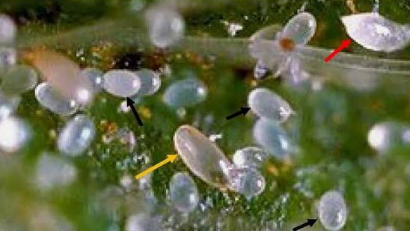
The Cyclamen Mite (Phytonemus pallidus) is a microscopic plant-feeding mite that attacks cyclamen, strawberries, African violets, begonias, and numerous other ornamental and horticultural crops. Despite its common name, the species is not restricted to cyclamen plants.
Cyclamen mites feed primarily on young, developing plant tissues, including buds, folded leaves, and growing points. Their feeding can cause severe leaf distortion, stunted growth, malformed flowers, and reduced crop quality.
Because the mites are extremely small and occupy protected plant locations, infestations are often difficult to detect until noticeable symptoms develop. Their ability to reproduce rapidly under suitable conditions makes them particularly troublesome in greenhouses, nurseries, and strawberry production systems.
Accurate identification and early management are important because cyclamen mite injury can resemble damage caused by herbicides, nutrient disorders, or certain plant diseases.
Taxonomy and Classification
- Common Name: Cyclamen Mite
- Scientific Name: Phytonemus pallidus
- Class: Arachnida
- Order: Trombidiformes
- Family: Tarsonemidae
- Genus: Phytonemus
- Species: P. pallidus
- Primary Hosts: Cyclamen, strawberries, African violets, begonias, and other plants
- Pest Type: Microscopic plant-feeding mite
Cyclamen mites belong to the family Tarsonemidae, which includes several economically important plant-feeding mites. They are much smaller than most spider mites and typically remain hidden in moist, protected plant tissues.
Physical Description and Identification
Adult Females: Adult females are extremely small, generally around 0.2–0.3 millimeters long. Their bodies are oval, translucent, and pale yellowish to brownish.
Adult Males: Males are slightly smaller and possess modified hind legs used during reproductive behavior.
Eggs: Eggs are relatively large compared with the adult mite’s body and are deposited in protected plant locations.
Larvae: Newly hatched larvae are small, translucent, and possess three pairs of legs.
Resting Stage: Cyclamen mites pass through a relatively inactive developmental stage before becoming adults.
Key Identification Features
- Severe distortion of young leaves and growing points.
- Thickened, brittle, or tightly curled foliage.
- Stunted plant crowns.
- Malformed flowers and buds.
- Bronzed or darkened young tissues.
- Microscopic mites hidden within folded leaves and buds.
Distribution and Habitat
Cyclamen mites occur in many temperate and subtropical growing regions worldwide.
They are especially important in greenhouses, ornamental nurseries, strawberry fields, indoor plant collections, and other environments containing susceptible host plants.
The mites prefer humid, sheltered conditions and commonly inhabit developing buds, tightly folded leaves, and protected growing points.
Movement of infested nursery stock is an important pathway for introducing the pest into new production areas. Mites may also spread through direct plant contact and contaminated equipment or handling.
Life Cycle and Reproduction
Cyclamen mites develop through egg, larval, resting, and adult stages.
Egg Stage
Females deposit eggs in protected plant tissues, particularly around developing buds and young leaves.
Larval Stage
Newly hatched larvae begin feeding on tender tissues and develop rapidly under favorable conditions.
Resting Stage
Larvae enter a relatively inactive stage before emerging as adults.
Adult Stage
Adults continue feeding and reproducing. Warm, humid conditions can support rapid population growth and overlapping generations.
Because cyclamen mites remain concealed in protected tissues, populations may increase substantially before they are discovered.
Damage and Signs of Infestation
Cyclamen mite feeding is concentrated on actively growing tissues, making even relatively small infestations capable of causing severe visible damage.
- Leaf Distortion: Young leaves become curled, wrinkled, or misshapen.
- Stunted Growth: Feeding damages growing points and reduces normal development.
- Flower Deformation: Buds and blossoms may become malformed or fail to open.
- Bronzing: Young tissues may develop brownish or bronze discoloration.
- Strawberry Damage: Infested strawberry plants may develop compact crowns, distorted foliage, and reduced fruit production.
- Reduced Marketability: Ornamental plants with distorted foliage or flowers may become unsuitable for sale.
Symptoms may persist after the mites are controlled because previously damaged tissues cannot return to their original shape. Successful treatment is usually indicated by the development of healthy new growth.
Management and Integrated Pest Management (IPM)
1. Inspect Growing Points
Examine developing buds, young leaves, and plant crowns for distortion. Magnification may be necessary to confirm mite activity.
2. Isolate Infested Plants
Separate infested ornamental plants from healthy stock to reduce spread.
3. Remove Severely Infested Plants
In small collections or greenhouse production, discarding heavily infested plants may be more effective than attempting repeated treatments.
4. Use Clean Nursery Stock
Purchase plants from reputable suppliers and inspect incoming material before introducing it into production areas.
5. Maintain Sanitation
Clean tools, benches, and handling equipment. Avoid moving between infested and uninfested plants without appropriate precautions.
6. Encourage Predatory Mites
Selected predatory mite species may help suppress cyclamen mite populations in protected production systems. Effectiveness depends on crop conditions and the predator species used.
7. Apply Registered Miticides
Where necessary, use products specifically registered for cyclamen mites on the host crop. Thorough coverage is challenging because the mites remain concealed in buds and folded leaves.
8. Consider Approved Hot-Water Treatments
Commercial propagation programs may use carefully controlled hot-water treatments for certain planting materials. Temperature and exposure must follow crop-specific, validated protocols to avoid plant injury.
Conclusion
The Cyclamen Mite (Phytonemus pallidus) is a microscopic pest capable of causing severe distortion of leaves, buds, and flowers. Its preference for protected growing points makes early detection difficult and management challenging. Clean planting material, sanitation, isolation of infested plants, biological control, and appropriately selected treatments provide the best foundation for long-term prevention and control.