Overview
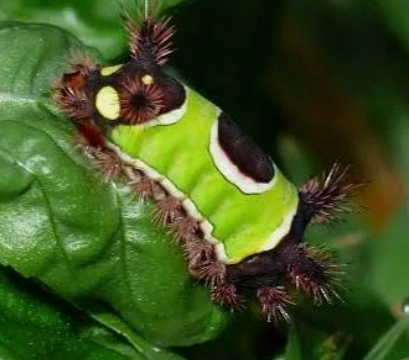
The Saddleback Caterpillar (Acharia stimulea) is a distinctive native moth larva recognized by its bright green back, brown saddle-shaped marking, and clusters of sharp defensive spines. Although small, it can deliver a painful sting when its spines contact exposed skin. Encounters commonly occur when someone brushes against an occupied leaf while gardening, pruning, or working around ornamental plants.
Saddleback caterpillars consume foliage, but occasional individuals usually present a greater concern because of accidental contact than because of plant damage. Their striking appearance makes identification relatively straightforward once the characteristic saddle develops. Observing them without touching, checking vegetation before handling it, and using tools for necessary removal are the foundations of practical management.
Taxonomy and Classification
- Kingdom: Animalia
- Phylum: Arthropoda
- Class: Insecta
- Order: Lepidoptera
- Family: Limacodidae
- Genus: Acharia
- Species: Acharia stimulea (Clemens, 1860)
- Older scientific name: Sibine stimulea
The family Limacodidae includes the slug caterpillar moths. Their larvae have a compact appearance and move differently from the familiar elongated caterpillars found on many garden plants. The saddleback is a moth caterpillar, rather than a butterfly caterpillar.
Identification and Key Features
A mature saddleback caterpillar measures approximately ¾–1 inch long. Its front and rear portions are brown, while a vivid green patch covers much of the middle. Within this green area is a brown oval surrounded by a pale border, creating the appearance of a saddle resting on a blanket.
Four prominent fleshy projections—two toward the front and two toward the rear—carry dense clusters of spines. Additional smaller spiny projections occur along the body margins. These structures are defensive and should never be used as handling points.
Key identification features include:
- A short, broad, sluglike body.
- A bright green central patch with a pale-bordered brown saddle.
- Brown coloration at both ends.
- Large, spiny projections near the front and rear.
- Smaller spine-bearing projections along the sides.
Young caterpillars may lack the fully developed appearance of mature larvae, making identification more difficult. Photograph suspected specimens where they are resting rather than picking them up. The adult is a small brown moth with pale markings and lacks the caterpillar’s conspicuous green saddle.
Distribution and Habitat
Saddleback caterpillars occur across much of the eastern United States, including the Southeast. They inhabit wooded areas, gardens, orchards, parks, and residential landscapes containing suitable host plants.
They feed on a broad range of trees, shrubs, and other plants. Documented hosts include oak, cherry, plum, basswood, maple, dogwood, and corn. They may also occur on ornamental plants such as hibiscus and palms. Finding one does not necessarily indicate that nearby plants are heavily infested.
Contact is particularly easy when caterpillars rest beneath foliage or on leaves within dense plantings. Gardeners may overlook them while reaching through shrubs, gathering produce, or carrying cut branches.
Life Cycle and Behavior
Saddleback caterpillars undergo complete metamorphosis, passing through egg, larval, pupal, and adult stages. Female moths deposit eggs on host foliage. After hatching, the larvae begin feeding and grow through successive stages, shedding their outer skin as they develop.
Young larvae can feed together, while older caterpillars are often encountered individually. Their feeding removes leaf tissue, producing scraped areas or holes as the caterpillars grow. Timing varies geographically; larvae are commonly noticed during summer and into fall in portions of their range.
Mature caterpillars form tough cocoons before pupation. Cocoons may incorporate defensive spines, so they should also be handled with tools rather than bare hands. In colder portions of the range, the insect passes winter within its cocoon. Adult moths later emerge, mate, and continue the cycle.
Damage, Stings, and Signs of Activity
Plant injury appears as missing leaf tissue, irregular holes, or localized skeletonizing. A few caterpillars seldom justify treating an otherwise healthy mature plant. Greater attention may be warranted when caterpillars occur on small plants or vegetation beside frequently used paths and work areas.
The main human hazard comes from venom-bearing spines. These can penetrate skin and break off during contact, producing burning pain, redness, swelling, itching, or welts. Blistering and more extensive reactions are possible. The caterpillar does not chase people or deliberately attack; brushing against it can be enough to cause exposure.
What to Do After Contact
- Move away from the plant and avoid rubbing the affected skin.
- If the caterpillar remains on the skin, remove it with a tool rather than bare fingers.
- Gently apply adhesive tape to the affected skin and lift it away to remove spines. Use fresh pieces as needed.
- Wash gently with soap and water.
- Apply a cold pack wrapped in cloth for discomfort.
- Contact Poison Control at 1-800-222-1222 in the United States for individualized guidance, particularly for severe pain, blistering, or eye exposure.
Call 911 for trouble breathing, throat swelling, collapse, or other signs of a severe allergic reaction. Do not apply adhesive tape to the eyes.
Management and Control (IPM)
Integrated Pest Management emphasizes preventing contact and responding to confirmed activity. Broad treatment of the landscape is generally unnecessary for an isolated caterpillar.
- Inspect before working: Examine both leaf surfaces before pruning, harvesting, or reaching into vegetation.
- Reduce exposed skin: Wear long sleeves and suitable gloves, while remembering that protective clothing does not make direct handling safe.
- Use tools for removal: Long-handled forceps or pruners can remove an occupied leaf without touching the caterpillar. Avoid crushing or brushing it.
- Prevent repeat contact: Keep removed caterpillars and cocoons away from children, pets, paths, and frequently handled materials.
- Monitor nearby foliage: Check surrounding leaves for additional larvae before reopening a work area.
- Preserve natural controls: Predators and parasitoids help regulate populations, supporting restraint with broad-spectrum insecticides.
- Seek targeted advice: For numerous caterpillars or repeated encounters in busy areas, consult a local extension office or pest professional. Any pesticide must be labeled for the plant and intended use.
Conclusion
The saddleback caterpillar’s green blanket and brown saddle make it memorable, while its defensive spines make careful handling essential. Most encounters can be managed through inspection, avoidance, and targeted removal with tools. Recognizing the caterpillar and its potentially irritating cocoon helps prevent painful contact without unnecessary landscape treatment.
Related Articles
- Caterpillars – Explore caterpillar identification, feeding damage, and management.
- Browntail Moth Caterpillar – Learn about another caterpillar associated with irritating hairs.
- Euproctis Caterpillars (Tussock Moth Group) – Compare hairy caterpillars and their potential health effects.
- Eastern Tent Caterpillars – Identify tent-building caterpillars and distinguish their activity.