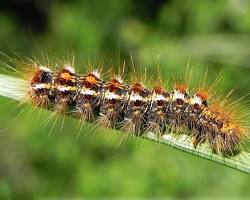
The Browntail Moth Caterpillar (Euproctis chrysorrhoea) is the larval stage of the invasive browntail moth, a destructive insect capable of damaging trees and causing health problems for humans. Native to Europe and parts of Asia, this species was accidentally introduced into North America in the late 1800s and has since become established in portions of the northeastern United States and Canada. The caterpillars are especially notorious for their toxic hairs, which can trigger severe skin irritation and respiratory discomfort.
Unlike many native caterpillar species that cause only occasional plant damage, browntail moth caterpillars may appear in extremely large populations capable of stripping leaves from entire trees. Their feeding activity weakens host plants and stresses forest ecosystems, particularly during repeated infestations.
Quick Facts
- Family: Erebidae
- Common Habitat: Forests, orchards, suburban trees, coastal woodlands
- Diet: Leaves of hardwood trees and shrubs
- Status: Invasive pest species
- Main Concern: Toxic hairs that irritate humans
Identification
Browntail moth caterpillars are dark brown to black and covered with numerous tiny barbed hairs. Mature caterpillars typically grow to about 1.5 inches long.
The most recognizable identifying features include:
- Two bright orange or reddish spots near the rear end
- Broken white stripes running along the sides
- Dense hair covering across the body
- Dark body coloration
These irritating hairs are microscopic and easily become airborne.
Contact with the hairs may result in:
- Painful skin rashes
- Itching
- Eye irritation
- Breathing discomfort
- Allergic reactions in sensitive individuals
The adult Brown Tail Moth is a small white moth with a tuft of brown hairs at the tip of the abdomen.
Distribution and Habitat
Browntail moth caterpillars are primarily found in the northeastern United States and parts of eastern Canada.
Established populations are especially common in:
- Maine
- Coastal New England
- Maritime Canada
- Suburban forest edges
- Orchards and residential landscapes
The species thrives in areas containing abundant hardwood trees and shrubs.
Common host plants include:
- Oak trees
- Apple trees
- Cherry trees
- Birch trees
- Rose bushes
- Hawthorn
- Maples
Caterpillars are frequently observed feeding in groups during spring and early summer.
Life Cycle
The browntail moth undergoes complete metamorphosis consisting of four stages:
- Egg
- Caterpillar
- Pupa
- Adult moth
Females lay egg masses on leaves during summer and cover them with protective hairs from the abdomen.
Young caterpillars hatch and begin feeding before constructing silken winter webs at branch tips.
These winter webs serve as protected overwintering shelters.
In spring:
- Caterpillars emerge from the webs
- Feeding activity resumes aggressively
- Defoliation intensifies
- Caterpillars mature and pupate
Adult moths emerge during summer to mate and continue the cycle.
Behavior
Browntail moth caterpillars are social feeders and often feed in groups during early development.
Their feeding behavior includes:
- Chewing leaves from tree canopies
- Skeletonizing foliage
- Creating silken protective webs
- Moving between branches in large numbers
The caterpillars are most active during spring when trees begin producing fresh foliage.
The toxic hairs serve as an important defense mechanism against predators.
Unfortunately, these hairs remain dangerous even after the caterpillars molt or die.
Detached hairs may accumulate on:
- Outdoor furniture
- Clothing
- Tree bark
- Grass
- Structures
Wind can spread the hairs considerable distances from infestation sites.
Pest Status
The browntail moth caterpillar is considered both an environmental pest and a public health concern.
Heavy infestations may:
- Defoliate entire trees
- Stress forest ecosystems
- Reduce tree vigor
- Increase vulnerability to disease and drought
- Create nuisance conditions in residential areas
Repeated defoliation weakens trees over time and may contribute to branch dieback or secondary pest infestations.
Human health impacts make this species especially problematic in populated areas.
Signs of Infestation
Common signs of browntail moth caterpillar activity include:
- Silken winter webs at branch tips
- Defoliated tree branches
- Clusters of hairy caterpillars
- Leaf skeletonization
- Skin irritation after outdoor exposure
Winter webs are often one of the easiest ways to detect infestations before spring feeding begins.
Prevention
Preventing large infestations usually involves early detection and physical removal of overwintering webs.
Recommended prevention methods include:
- Inspect trees during winter months
- Prune and destroy winter webs
- Avoid direct contact with caterpillars
- Wear protective clothing when working near infestations
- Reduce outdoor exposure during severe outbreaks
Property owners should avoid mowing or using leaf blowers near active infestations because these activities may spread irritating hairs into the air.
Control
Control strategies vary depending on infestation severity.
Common management approaches include:
- Winter web removal
- Targeted biological insecticides
- Professional arborist treatment
- Integrated pest management programs
- Monitoring during spring emergence
Biological insecticides containing Bacillus thuringiensis (Bt) are sometimes used against young caterpillars.
Professional pest management may be necessary during major regional outbreaks.
Human Health Concerns
The toxic hairs of browntail moth caterpillars are one of the species’ most serious concerns.
Exposure may occur through:
- Direct skin contact
- Airborne hairs
- Contaminated surfaces
- Outdoor yard work
Symptoms often include:
- Red itchy rashes
- Burning sensations
- Respiratory irritation
- Sneezing or coughing
- Eye discomfort
Some individuals are more sensitive than others and may require medical attention after exposure.
Interesting Facts
- The caterpillar’s toxic hairs can remain irritating for years.
- Browntail moths were accidentally introduced to North America in the 1800s.
- The species overwinters as caterpillars inside silken webs.
- Heavy infestations may completely defoliate trees.
- Natural predators include birds, parasitic flies, and predatory insects.
- The species is considered one of the most problematic invasive caterpillars in parts of New England.