Overview
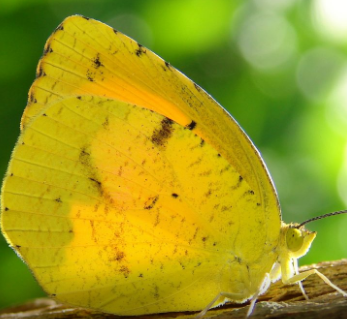
The Sleepy Orange (Abaeis nicippe, also known as Eurema nicippe) is a small, brightly colored butterfly found in gardens, fields, roadsides, and other open habitats. Its orange upper wings contrast with dark borders, while its closed wings reveal a more subdued underside that changes with the season.
Although its caterpillars chew host-plant leaves, the Sleepy Orange is generally a welcome garden visitor rather than a significant pest. Adults visit flowers for nectar, and the caterpillars form part of the food web. The main conflict occurs when larvae feed on ornamental sennas that gardeners want to keep free of chewing damage. In butterfly gardens, this feeding is usually an expected part of supporting the species.
Taxonomy and Classification
- Kingdom: Animalia
- Phylum: Arthropoda
- Class: Insecta
- Order: Lepidoptera
- Family: Pieridae
- Subfamily: Coliadinae
- Genus: Abaeis
- Species: Abaeis nicippe (Cramer, 1779)
- Alternate scientific name: Eurema nicippe
The family Pieridae includes the white and sulphur butterflies. Scientific references use both Abaeis nicippe and Eurema nicippe for the Sleepy Orange. It should not be confused with the Orange Sulphur (Colias eurytheme), a different butterfly whose caterpillars commonly feed on alfalfa and related plants.
Identification and Key Features
Adult Sleepy Oranges have a wingspan of approximately 1⅜–2¼ inches (3.5–5.7 centimeters). The upper wings are orange to yellow-orange, with dark outer margins and a small black spot on each forewing. Males generally have more sharply defined borders, while female borders are less distinct.
Seasonal variation is especially useful to recognize. Warm-season butterflies typically have yellow to orange-yellow undersides with darker markings. Cool-season individuals can have tan, brown, or brick-red hindwing undersides. Consequently, two individuals of the same species may look surprisingly different when resting with their wings closed.
Mature caterpillars are green with a narrow, pale stripe along each side. Their coloring helps them blend into host-plant foliage. Eggs are pale whitish-yellow, elongated, and laid individually on host leaves. The chrysalis can range from green to dark, nearly black coloration.
For identification, photograph both the underside and the upper wings when possible. A closed-wing photograph alone may be difficult to interpret, particularly when distinguishing seasonal forms from other small sulphur butterflies.
Distribution and Habitat
The Sleepy Orange occurs from Central America and Mexico into the southern United States, with seasonal dispersal farther north. Northern observations often represent wandering butterflies rather than populations that survive locally throughout the winter.
Suitable habitats include sunny fields, woodland edges, pine flatwoods, roadsides, vacant lots, gardens, and desert washes. Host-plant availability and nectar sources help determine where butterflies remain and reproduce.
In warm southern locations, adults may be observed throughout the year. Farther north, sightings are more likely during summer and early fall. Local abundance varies with weather, seasonal movement, and the availability of suitable plants.
Life Cycle and Behavior
Sleepy Oranges undergo complete metamorphosis, passing through egg, caterpillar, chrysalis, and adult stages. Females lay eggs singly on host leaves, often on the underside. After hatching, the larvae feed on foliage and grow through several molts before pupating.
Host plants belong to the pea family, Fabaceae, particularly sennas and related plants historically grouped under Cassia. Documented examples include sicklepod senna (Senna obtusifolia) and coffee senna (Senna occidentalis). A plant’s membership in the pea family alone does not establish that it is a suitable host.
Adults obtain nectar from flowers rather than chewing leaves. Males patrol suitable habitat while searching for females. Several generations can develop during favorable weather, and adults can overwinter in reproductive diapause in suitable portions of the range. Development speed and flight periods depend on local conditions.
Damage and Signs of Activity
The principal sign of caterpillar activity is chewed host-plant foliage. Feeding may produce missing leaf sections, irregular edges, or reduced foliage on small plants. Caterpillars can be difficult to locate because their green bodies blend into the leaves.
This butterfly is not ordinarily treated as a major crop or household pest. Adults do not damage buildings, infest stored food, or sting. On established host plants, modest feeding is usually compatible with maintaining a butterfly-friendly landscape.
Young or container-grown plants deserve closer observation because they have less foliage available. Before taking action, confirm that the caterpillar is a Sleepy Orange; several butterflies can use similar host plants, and unrelated insects may also cause chewing damage.
Management and Control (IPM)
Integrated Pest Management for Sleepy Oranges generally emphasizes tolerance, accurate identification, and plant care. Routine insecticide treatment is usually unnecessary.
- Inspect affected plants: Check leaves for eggs, green caterpillars, and fresh chewing before assigning a cause.
- Accept limited feeding: In a butterfly garden, host plants supply caterpillar food as well as ornamental interest.
- Provide sufficient host foliage: Where appropriate, grow several locally suitable host plants to distribute feeding pressure.
- Support plant health: Provide suitable growing conditions and appropriate watering so plants can replace lost foliage.
- Protect vulnerable specimens: If necessary, move caterpillars a short distance onto a confirmed suitable, pesticide-free host plant on the same property.
- Avoid unnecessary sprays: Broad-spectrum insecticides can kill butterflies and other beneficial insects. Caterpillar products containing Btk can also kill desirable butterfly larvae.
- Choose plants carefully: Use locally appropriate host plants and check their growing habits before planting; some sennas can be weedy or unsuitable for particular settings.
Conclusion
The Sleepy Orange is a distinctive butterfly whose vivid upper wings and seasonally changing undersides make it an interesting garden visitor. Its caterpillars consume host foliage, but most encounters call for tolerance rather than control. Providing appropriate host plants, nectar flowers, and protection from unnecessary pesticides supports its complete life cycle while keeping occasional plant damage manageable.
Related Articles
- Butterfly – Explore butterfly biology, ecological roles, and garden habitat.
- Imported Cabbage Worms – Identify another member of the Pieridae family whose larvae damage brassica crops.
- Large Cabbage White Butterflies – Compare white butterflies and their leaf-feeding caterpillars.