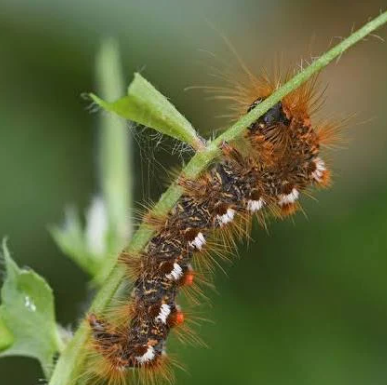
Euproctis caterpillars are the larval stages of moths belonging to the genus Euproctis. This group includes numerous hairy caterpillars distributed across Europe, Africa, Asia, Australia, and parts of North America. Some species are important tree defoliators, while others are best known for microscopic hairs that can irritate human skin and airways.
In the United States, the most medically and economically important member of the genus is the invasive browntail moth, Euproctis chrysorrhoea. Its caterpillars feed on hardwood trees and produce detachable hairs capable of causing an intensely itchy rash or respiratory symptoms. Because health effects and management requirements differ among species, an unidentified hairy caterpillar should not automatically be assumed to be a browntail moth.
Taxonomy and Classification
- Kingdom: Animalia
- Phylum: Arthropoda
- Class: Insecta
- Order: Lepidoptera
- Family: Erebidae
- Subfamily: Lymantriinae
- Genus: Euproctis
- Important U.S. species: Euproctis chrysorrhoea, the browntail moth
Members of Lymantriinae are often broadly called tussock moths. However, Euproctis is only one genus within this larger group. The common name “Euproctis caterpillar” therefore describes multiple related species rather than a single insect with a uniform appearance or distribution.
Identification
Euproctis caterpillars are generally covered with conspicuous hairs, but color and pattern vary considerably among species and growth stages. Positive identification should consider location, host plant, season, web structure, and the caterpillar’s markings.
Browntail Moth Caterpillars
Young browntail moth caterpillars are pale yellowish with black heads and dark markings near the front of the body. Mature caterpillars become predominantly dark brown and may grow to approximately 1.5 inches long. They have broken white lines extending along the sides of the back, dense brown hairs, and two distinctive orange-red spots near the rear. These paired spots are among the most useful field characteristics.
Identification should not be based on hairiness alone. Spongy moth caterpillars have paired blue and red spots along the back, while eastern tent caterpillars have a continuous pale stripe. Fall webworms produce large webs that may cover entire branches during late summer. Browntail moth winter webs are compact, often approximately the size of a person’s palm, and consist of leaves tightly bound with white silk at branch tips.
Adult browntail moths are predominantly white. The common name comes from the brown tuft at the end of the abdomen rather than the color of the wings. Adults may carry residual hairs from contaminated cocoons, but the brown abdominal hairs themselves are not the toxic hairs responsible for the characteristic rash.
Distribution and Habitat
The genus Euproctis has a broad global distribution, although individual species occupy much smaller ranges. Browntail moths are native to portions of Europe, northern Africa, and western and central Asia. The species was accidentally introduced into Somerville, Massachusetts, from Europe in 1897.
By the early twentieth century, browntail moths had spread throughout New England and into neighboring parts of Canada. Natural controls later caused the North American range to contract. Persistent populations remained on outer Cape Cod and islands in Maine’s Casco Bay. The species subsequently resurged in Maine, where current infestations occur primarily in coastal and inland areas of the southern and central portions of the state.
Browntail caterpillars favor hardwood trees and shrubs. Common hosts include oak, apple, crabapple, pear, cherry, birch, elm, shadbush, beach plum, and rugosa rose. Infestations are especially troublesome when host trees grow near homes, schools, sidewalks, playgrounds, parks, campgrounds, and outdoor work areas.
Life Cycle and Behavior
Browntail moths generally complete one generation per year in the northeastern United States. Adults emerge and mate during summer. Females deposit egg masses on the undersides of leaves near the outer ends of host-tree branches. The eggs hatch after several weeks, and the small caterpillars feed together, skeletonizing leaf surfaces.
During late summer and early fall, the young larvae bind leaves together with silk and construct communal winter webs. They remain dormant inside these webs through the coldest months. Each web may contain numerous caterpillars.
The larvae become active again around April as temperatures rise and tree buds begin opening. They leave their webs to feed on expanding foliage and grow through several stages. Older caterpillars wander more widely and may appear on building walls, decks, vehicles, outdoor furniture, and low vegetation. They eventually pupate in silk cocoons containing shed larval hairs. Adult moths emerge in late June or July, although timing varies with location and weather.
Tree and Shrub Damage
Euproctis caterpillars damage plants by consuming or skeletonizing foliage. A single episode of defoliation may cause temporary stress, but repeated heavy feeding can reduce growth, weaken branches, and make trees more vulnerable to drought, disease, and secondary pests. Valued ornamental and fruit trees may lose much of their spring foliage during an outbreak.
Large, healthy trees can sometimes produce replacement leaves, but this requires stored energy. Recently planted, drought-stressed, diseased, or repeatedly defoliated trees face a greater risk of decline. Adequate watering during dry conditions and protection from additional injury can help affected trees recover.
Human Health Risks
Older browntail moth caterpillars develop microscopic, barbed hairs containing an irritating toxin. These hairs detach easily and can become airborne or settle on grass, leaves, clothing, outdoor furniture, vehicles, and other surfaces. Directly touching a caterpillar is not necessary to experience a reaction.
Exposure may cause a red, raised, intensely itchy rash resembling poison ivy. Symptoms may last from several hours to several weeks. Inhaling airborne hairs can cause coughing, throat irritation, wheezing, or breathing difficulty, especially in sensitive individuals. Shed skins and pupal cocoons also contain irritating hairs.
The hairs can remain active in the environment for one to three years. Mowing dry grass, raking leaves, sweeping decks, using leaf blowers, or cutting infested branches can stir old hairs into the air long after the caterpillars have disappeared.
People experiencing a mild rash should avoid further exposure and consult a healthcare professional or pharmacist about appropriate symptom relief. Anyone with difficulty breathing or swallowing, or swelling of the mouth, tongue, or throat, should seek emergency medical care immediately.
Preventing Exposure
- Do not touch hairy caterpillars, shed skins, cocoons, or winter webs.
- Wear long sleeves, long pants, gloves, closed shoes, eye protection, and a well-fitting mask when working in infested areas.
- Perform yardwork on damp or windless days to reduce airborne hairs.
- Avoid using leaf blowers or dry sweeping where caterpillars have been abundant.
- Take a cool shower and change clothing after outdoor exposure.
- Wash work clothing separately to avoid transferring hairs.
- Keep windows closed when caterpillars or airborne hairs are abundant near a home.
- Dry laundry indoors during periods of high exposure risk.
Pets can carry hairs indoors on their coats. Avoid allowing animals to investigate caterpillars or contaminated webs, and consult a veterinarian if a pet develops significant skin, eye, or respiratory irritation.
Management and Control
Remove Winter Webs
Winter web removal is one of the most targeted management options for accessible trees. Inspect branch tips after leaves have fallen. In Maine, webs can generally be removed from October through March, before larvae emerge in spring. Clip webs that can be reached safely from the ground and place them directly into soapy water for several days before disposal.
Do not leave clipped webs on the ground because live caterpillars may emerge and return to host plants. Never climb trees, work near electrical lines, or use unsafe cutting equipment. A licensed arborist should handle webs that cannot be reached safely.
Protect High-Use Areas
Prioritize trees next to homes, playgrounds, parking areas, schools, patios, and other locations where people regularly spend time. Eliminating every caterpillar across a wooded property is usually unrealistic. Concentrating management around high-use areas can reduce both defoliation and human exposure.
Pesticide Treatment
When chemical or biological treatment is warranted, correct timing is essential. Products must act while caterpillars are still young and before large quantities of irritating hairs accumulate. Maine guidance generally recommends completing effective treatments before the end of May. Applications made later may kill caterpillars but do little to eliminate hairs already released into the environment.
Large-tree treatment should be performed by a licensed pesticide applicator familiar with browntail moth management. The product must be labeled for the plant, site, and intended application. Treatments should minimize drift and unnecessary exposure to pollinators, beneficial insects, people, pets, and water. Local rules may impose additional restrictions near coastal waters, schools, or public properties.
Caterpillars on Buildings
Avoid crushing or dry sweeping wandering caterpillars. Where recommended by local authorities, a wet-dry vacuum fitted with a HEPA filter and containing several inches of soapy water can collect caterpillars from exterior surfaces. Wear appropriate protective equipment and avoid actions that send hairs into the air.
Conclusion
Euproctis caterpillars include numerous hairy moth larvae, but the browntail moth is the species of greatest concern in the northeastern United States. Its caterpillars combine damaging defoliation with persistent hairs capable of producing serious skin and respiratory reactions. Recognizing the paired orange-red spots and small winter webs, preventing contact, removing accessible webs during dormancy, and arranging properly timed professional treatment can substantially reduce risk.