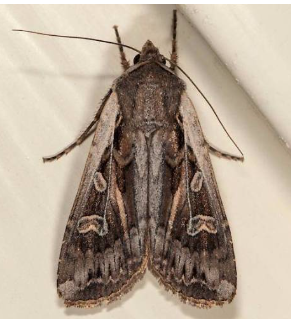
The Euxoa Auxiliary Cutworm (Army Cutworm) (Euxoa auxiliaris) is a widespread and economically significant agricultural pest in North America. This species is particularly notable for its unusual life cycle, overwintering as an active larva and resuming feeding earlier than most crop pests in late winter and early spring. It affects a wide range of crops including wheat, alfalfa, barley, and various vegetables, and is especially problematic across the Great Plains and Intermountain West.
Taxonomy and Classification
The Army Cutworm belongs to the order Lepidoptera and the family Noctuidae, a large group of moths commonly associated with agricultural pests. Like other moths, it undergoes complete metamorphosis consisting of egg, larva, pupa, and adult stages.
The adult stage is commonly referred to as the Miller Moth, which is widely known for its seasonal migrations and tendency to enter homes during peak activity periods.
Identification
The larvae are smooth-bodied caterpillars measuring approximately 35–45 mm in length. Their coloration ranges from pale grayish-green to brown, often with faint longitudinal striping and a distinctive dark head capsule. A key identifying trait is their tendency to curl tightly into a C-shape when disturbed.
The adult moth is mottled gray or brown with subtle kidney-shaped and circular markings on the forewings. These moths are strong fliers and are well known for their seasonal migrations into mountainous regions.
Distribution and Habitat
This species is widely distributed across the United States, particularly in the western and central regions. It thrives in agricultural landscapes, grasslands, and gardens where host plants are abundant.
Larvae remain close to the soil surface, feeding on emerging plants, while adults migrate seasonally to higher elevations for aestivation during the summer months.
Life Cycle
The Army Cutworm has a unique life cycle compared to many agricultural pests. Eggs are laid in soil during late summer or early fall. After hatching, larvae begin feeding and then overwinter in the larval stage.
In late winter or early spring, larvae resume feeding aggressively, targeting young seedlings. After completing development, they pupate in the soil. Adult moths emerge and migrate to mountainous areas where they remain inactive during the summer before returning to lower elevations to reproduce.
Behavior and Feeding
Army Cutworm larvae are primarily nocturnal feeders and remain hidden in soil or debris during the day. Unlike climbing caterpillars, they feed at or just below the soil surface, cutting seedlings and consuming foliage.
When populations are high, they may move in large groups across fields and landscapes, consuming vegetation rapidly in a behavior similar to other armyworms.
Damage and Economic Importance
The Army Cutworm is considered a high-impact agricultural pest due to its ability to damage crops early in the growing season.
- Stand Reduction: Larvae sever seedlings at or below the soil line, creating bare patches in fields.
- Defoliation: Feeding on leaves reduces plant vigor and growth potential.
- Crop Loss: Heavy infestations can significantly reduce yields in wheat, barley, and alfalfa.
- Residential Nuisance: Adult Miller Moths frequently enter homes during migration, creating nuisance conditions.
Management and Control (IPM)
Effective management requires early detection and integrated pest management (IPM) strategies.
- Monitoring: Inspect fields in early spring; thresholds of 4–5 larvae per square foot may require action.
- Soil Sampling: Sifting soil to a depth of approximately 3 inches helps detect larval populations early.
- Cultural Control: Crop rotation and weed management reduce egg-laying sites.
- Biological Control: Encourage natural predators such as birds and ground beetles.
- Chemical Control: Apply insecticides when economic thresholds are exceeded.
- Light Management: Reducing outdoor lighting during migration can limit adult moth attraction to buildings.
Conclusion
The Euxoa Auxiliary Cutworm is a highly adaptable and damaging pest that requires proactive monitoring and timely intervention. Its early-season feeding behavior and migratory adult stage make it both an agricultural threat and a residential nuisance. Integrated management practices remain the most effective approach for minimizing its impact.