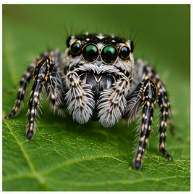
The Putnam Jumping Spider (Phidippus putnami) is one of North America’s most charismatic and visually impressive jumping spiders. Belonging to the family Salticidae, this agile predator relies on exceptional eyesight, remarkable jumping ability, and stealth rather than webs to capture prey. Found throughout much of the eastern and central United States, the Putnam Jumping Spider is a highly beneficial species that naturally controls flies, leafhoppers, caterpillars, and numerous other garden pests.
Unlike web-building spiders, Phidippus putnami actively stalks its prey with cat-like precision before launching an accurate leap to capture it. Its curious personality, excellent vision, and harmless nature have made it one of the most admired native spiders among both scientists and nature enthusiasts.
Taxonomy and Classification
The Putnam Jumping Spider belongs to the family Salticidae, the world’s largest family of spiders, containing more than 6,500 described species. Members of this family are famous for their outstanding vision, intelligence, and complex courtship behaviors.
- Class: Arachnida
- Order: Araneae
- Family: Salticidae
- Genus: Phidippus
- Species: Phidippus putnami
- Common Name: Putnam Jumping Spider
The species is closely related to other well-known North American jumping spiders, including the Bold Jumping Spider (Phidippus audax) and the Regal Jumping Spider (Phidippus regius).
Physical Description
The Putnam Jumping Spider is a medium-sized jumping spider with noticeable differences between males and females.
- Length: 8–15 mm
- Color: Black, brown, gray, and white with contrasting markings
- Eyes: Four large forward-facing primary eyes that provide exceptional depth perception
- Chelicerae: Metallic green, blue, or gold depending on lighting
- Legs: Strong, muscular legs adapted for powerful jumping
Males are especially striking, often displaying conspicuous white leg markings, iridescent mouthparts, and dense tufts of black hairs above the eyes. Females are generally larger and exhibit mottled gray or brown coloration that provides excellent camouflage while guarding egg sacs.
Distribution and Habitat
The Putnam Jumping Spider is widely distributed throughout eastern and central North America.
Common habitats include:
- Woodlands
- Forest edges
- Native prairies
- Gardens
- Shrublands
- Orchards
- Parks
- Residential landscapes
Unlike many spiders, this species spends much of its time climbing shrubs, tree trunks, fences, and walls where prey is abundant.
Life Cycle
The Putnam Jumping Spider develops through several molts before reaching adulthood.
- Egg: Females deposit eggs inside protective silk sacs attached beneath bark, leaves, or other sheltered locations.
- Spiderling: Young spiders remain within the silk retreat for a short period before dispersing.
- Juvenile: Immature spiders molt several times while gradually developing adult coloration.
- Adult: Mature spiders spend the warmer months actively hunting and reproducing.
Most individuals complete their life cycle within a single year.
Behavior and Ecology
The Putnam Jumping Spider is an active daytime hunter that depends almost entirely on vision rather than silk webs to locate prey.
Using its exceptional eyesight, the spider slowly stalks insects before suddenly leaping several times its own body length. Before every jump, it attaches a thin silk safety line that prevents accidental falls if the attack is unsuccessful.
Its diet commonly includes:
- Flies
- Mosquitoes
- Leafhoppers
- Aphids
- Small moths
- Caterpillars
- Beetles
- Other spiders
During courtship, males perform elaborate visual displays by raising their legs, vibrating their bodies, and displaying colorful mouthparts to attract females.
Ecological Importance
The Putnam Jumping Spider provides significant ecological benefits.
- Natural Pest Control: Consumes numerous insects that damage gardens and ornamental plants.
- Reduces Chemical Dependence: Helps suppress pest populations naturally.
- Food Source: Serves as prey for birds, reptiles, and larger predatory insects.
- Biodiversity Indicator: Healthy populations indicate diverse insect communities.
- Scientific Value: Frequently studied for vision, cognition, learning, and hunting behavior.
Because they hunt continuously throughout daylight hours, jumping spiders are among the most effective beneficial predators found in residential landscapes.
Management and Prevention
No control measures are recommended because the Putnam Jumping Spider is highly beneficial.
- Allow spiders to remain in gardens whenever possible.
- Avoid unnecessary broad-spectrum insecticides.
- Maintain native shrubs and flowering plants that support healthy insect diversity.
- Relocate indoor spiders outdoors rather than killing them.
- Encourage natural habitat with mulch, shrubs, and native vegetation.
Although capable of biting if trapped or handled roughly, this species is extremely reluctant to bite humans, and its venom is considered medically insignificant.
Conservation and Research
Jumping spiders are among the most intensively studied spiders in the world. Researchers use Phidippus species to investigate vision, depth perception, learning ability, courtship behavior, biomechanics, and jumping mechanics. Their remarkable eyesight rivals that of many vertebrates, making them important model organisms for both biological and robotics research.
Conclusion
The Putnam Jumping Spider (Phidippus putnami) is an intelligent, agile, and highly beneficial predator that contributes significantly to natural pest control throughout North American gardens and forests. Its impressive eyesight, remarkable jumping ability, and colorful appearance make it one of the most fascinating native spiders. Far from being a pest, this harmless hunter deserves appreciation for helping maintain healthy ecosystems while naturally controlling numerous insect pests.