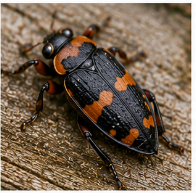
The Pustulated Carrion Beetle (Nicrophorus pustulatus) is a fascinating scavenger beetle native to North America that plays an essential role in recycling dead organic material within natural ecosystems. As one of the burying beetles in the family Silphidae, this species is best known for locating small animal carcasses, where it feeds, reproduces, and helps accelerate decomposition. Unlike many insects that are considered pests, the Pustulated Carrion Beetle provides valuable ecological services by returning nutrients to the soil and reducing the accumulation of decaying animal remains.
Although members of the genus Nicrophorus are famous for burying small vertebrate carcasses to provide food for their larvae, Nicrophorus pustulatus is unusual because it has also been documented utilizing reptile eggs, particularly snake eggs, as breeding sites. This unique reproductive behavior has made the species an important subject of scientific research in ecology, evolution, and forensic entomology.
Taxonomy and Classification
The Pustulated Carrion Beetle belongs to the family Silphidae, commonly known as carrion beetles or burying beetles. Members of this family are among nature’s most efficient recyclers, helping decompose dead animals before they become long-term sources of disease or odor.
- Order: Coleoptera
- Family: Silphidae
- Genus: Nicrophorus
- Species: Nicrophorus pustulatus
- Common Name: Pustulated Carrion Beetle
Its close relatives include the American Burying Beetle and several other Nicrophorus species that exhibit remarkable parental care.
Physical Description
The Pustulated Carrion Beetle is a medium-sized beetle with distinctive coloration that warns potential predators.
- Length: 12–20 mm
- Color: Glossy black wing covers marked with irregular orange or reddish-orange patches
- Body: Broad, flattened, and oval-shaped
- Antennae: Clubbed with orange tips specialized for detecting the odor of carrion
- Legs: Strong and adapted for digging beneath carcasses
Its coloration is similar to other burying beetles, although subtle differences in markings distinguish it from related species.
Distribution and Habitat
The Pustulated Carrion Beetle is widely distributed throughout much of North America.
Typical habitats include:
- Deciduous forests
- Mixed woodlands
- Grasslands
- Prairies
- Wetland edges
- Nature preserves
- Agricultural landscapes
- Areas where small vertebrates naturally occur
Adults are most active during the warmer months when decomposition rates are highest.
Life Cycle
The Pustulated Carrion Beetle undergoes complete metamorphosis, progressing through egg, larva, pupa, and adult stages.
- Egg: Females lay eggs near an animal carcass or other suitable food source.
- Larva: Newly hatched larvae feed on prepared carrion supplied by their parents.
- Pupa: Mature larvae burrow into the soil to pupate.
- Adult: Adults emerge to locate mates and new breeding sites.
Unlike many beetles, both male and female burying beetles participate in caring for their offspring by preparing food and protecting developing larvae.
Behavior and Ecology
The Pustulated Carrion Beetle possesses an extraordinary sense of smell, allowing it to locate freshly deceased animals from considerable distances. After discovering a suitable carcass, adults often work together to bury it beneath the soil. This protects the resource from competing scavengers while creating a safe nursery for their developing larvae.
Researchers have also discovered that Nicrophorus pustulatus frequently exploits snake eggs as an alternative breeding resource, making it one of the few burying beetles known to reproduce without relying exclusively on carrion.
Adults feed on:
- Small vertebrate carcasses
- Dead insects
- Decaying organic matter
- Occasionally reptile eggs
Ecological Importance
The Pustulated Carrion Beetle performs several essential ecological functions.
- Nutrient Recycling: Accelerates decomposition of dead animals.
- Soil Enrichment: Returns nutrients to the ecosystem.
- Population Regulation: Reduces the persistence of animal carcasses.
- Food Web Support: Serves as prey for birds, mammals, reptiles, and larger insects.
- Scientific Value: Important species in forensic entomology and ecological research.
These beetles help maintain healthy ecosystems by rapidly recycling organic material that would otherwise accumulate.
Management and Prevention
The Pustulated Carrion Beetle is considered highly beneficial and requires no control.
- Avoid unnecessary insecticide applications.
- Preserve natural woodland habitats.
- Allow beneficial scavengers to perform their ecological role.
- Recognize these beetles as important decomposers rather than pests.
- Maintain healthy ecosystems that support native insect diversity.
Encounters with this species are usually brief because adults spend most of their lives hidden beneath vegetation or soil.
Conservation and Research
The Pustulated Carrion Beetle has attracted considerable scientific attention because of its unusual reproductive strategy involving snake eggs, as well as its sophisticated parental care. Researchers also study the species in forensic investigations since burying beetles can provide valuable information about decomposition timelines and postmortem ecology. Ongoing research continues to improve our understanding of nutrient cycling and carrion ecology throughout North American ecosystems.
Conclusion
The Pustulated Carrion Beetle (Nicrophorus pustulatus) is an important native scavenger that quietly performs one of nature’s most essential cleanup services. By rapidly recycling dead animals and contributing to soil fertility, this remarkable beetle helps maintain healthy ecosystems while supporting countless other forms of wildlife. Although often overlooked, it represents one of North America’s most fascinating and beneficial decomposer insects.