Overview
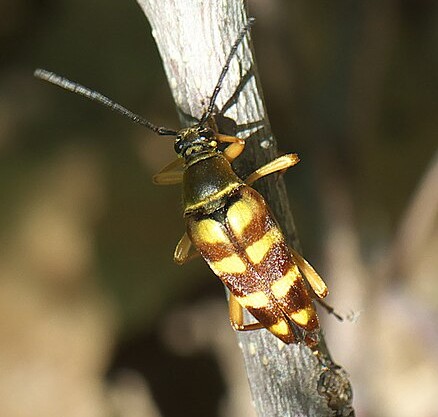
The Banded Longhorn Beetle is a common name used for several species of longhorn beetles within the family Cerambycidae that display distinctive banded markings across their bodies or wing covers. These beetles are best known for their extremely long antennae, wood-boring larvae, and striking coloration that often mimics wasps or bees. Many species are important decomposers in forest ecosystems, while a few may become occasional pests of weakened trees, lumber, or stored wood products.
Longhorn beetles are among the most recognizable wood-associated insects in North America and throughout the world. Their larvae tunnel through wood during development, helping break down dead or dying trees and contributing to nutrient recycling in forests. Because many species prefer stressed or decaying trees, they are usually considered secondary pests rather than primary killers of healthy trees.
Some banded longhorn beetles are highly beneficial in natural ecosystems, while others may occasionally damage:
- Fresh-cut timber
- Ornamental trees
- Fruit trees
- Hardwood lumber
- Stored firewood
Despite their intimidating appearance, banded longhorn beetles are harmless to humans and play an essential role in woodland ecology.
Quick Facts
- Family: Cerambycidae
- Common Name: Banded Longhorn Beetle
- Habitat: Forests, woodlands, dead trees, logs
- Diet: Wood tissue (larvae), sap or pollen (adults)
- Status: Mostly beneficial decomposer insects
- Primary Hosts: Hardwood and conifer trees
- Activity Period: Spring through summer
Taxonomy and Classification
- Kingdom: Animalia
- Phylum: Arthropoda
- Class: Insecta
- Order: Coleoptera
- Family: Cerambycidae
The Cerambycidae family contains thousands of species worldwide and includes:
- Longhorn beetles
- Roundheaded borers
- Wood-boring beetles
Many banded longhorn beetles belong to genera known for:
- Wasp mimicry
- Colorful wing patterns
- Large body size
- Long antennae
Several species are commonly confused with wasps because of their yellow and black striping.
Identification
Banded longhorn beetles vary by species, but most share several defining features.
Common identifying characteristics include:
- Elongated cylindrical body
- Very long antennae
- Distinct yellow, orange, or white bands
- Hard wing covers (elytra)
- Strong chewing mouthparts
Adults may range from 0.5 to 2 inches in length depending on the species.
Many species possess coloration that mimics:
- Wasps
- Hornets
- Bees
This protective mimicry helps deter predators.
The larvae are creamy white wood-boring grubs characterized by:
- Legless segmented bodies
- Brown head capsules
- Powerful jaws for tunneling
Larvae are rarely visible unless infested wood is split open.
Distribution and Habitat
Banded longhorn beetles occur throughout much of North America and many other parts of the world.
They are commonly found in:
- Hardwood forests
- Conifer forests
- Woodlots
- Parks
- Orchards
- Woodpiles
Preferred habitats include areas with:
- Dead trees
- Decaying logs
- Recently cut wood
- Storm-damaged trees
- Forest debris
Adults are frequently seen resting on:
- Tree bark
- Flowers
- Fresh logs
- Cut firewood
Some species prefer hardwood trees, while others specialize on conifers.
Life Cycle
Banded longhorn beetles undergo complete metamorphosis.
Egg Stage
Females deposit eggs in cracks, bark crevices, or damaged areas of wood.
Egg-laying sites commonly include:
- Dead branches
- Freshly cut logs
- Stressed trees
- Tree wounds
Larval Stage
After hatching, larvae tunnel beneath bark and into wood tissue.
The larval stage is the longest part of the life cycle and may last:
- Several months
- One year
- Multiple years in some species
Larvae create extensive galleries inside wood while feeding.
Signs of infestation include:
- Sawdust-like frass
- Loose bark
- Tunnels beneath bark
- Exit holes in wood
Larval tunneling contributes to wood decomposition.
Pupal Stage
Pupation occurs inside the wood within protected chambers.
During this stage, the larva transforms into an adult beetle.
Adult Stage
Adults emerge from wood through round or oval exit holes.
Adult beetles are most active during:
- Warm spring days
- Summer months
- Humid forest conditions
Many adults feed on:
- Tree sap
- Flower nectar
- Pollen
- Moist organic material
Behavior and Ecology
Banded longhorn beetles play an important ecological role as decomposers.
Their larval feeding helps:
- Break down dead wood
- Recycle nutrients
- Create habitats for fungi and microorganisms
- Accelerate forest decomposition processes
The beetles also support forest food webs.
Natural predators include:
- Woodpeckers
- Birds
- Parasitic wasps
- Predatory beetles
- Small mammals
Many species are active during daylight hours and may fly loudly around logs or trees.
Damage and Pest Status
Most banded longhorn beetles are considered secondary pests.
They usually attack:
- Dead trees
- Dying trees
- Storm-damaged wood
- Fresh-cut lumber
- Stored firewood
Healthy trees are rarely attacked unless stressed by:
- Drought
- Disease
- Mechanical injury
- Root damage
Potential problems caused by infestations include:
- Reduced lumber value
- Structural weakening of wood
- Wood discoloration
- Branch dieback in stressed trees
However, most species do not pose major threats to forest health.
Human Interaction
Banded longhorn beetles are harmless to humans.
They:
- Do not bite
- Do not sting
- Do not spread disease
- Do not infest food products
Because of their large size and wasp-like appearance, they are often mistaken for dangerous insects.
In reality, they are generally non-aggressive and beneficial components of forest ecosystems.
Prevention and Control
Control is rarely necessary in natural environments.
Management strategies focus on reducing stress in trees and properly handling wood materials.
Preventive measures include:
- Maintaining tree health
- Avoiding bark injuries
- Removing severely weakened trees
- Proper firewood storage
- Prompt removal of dead wood near structures
Infested firewood should be:
- Stored away from homes
- Burned promptly
- Covered when possible
Chemical treatments are rarely needed except in commercial timber operations or high-value ornamental plantings.
Interesting Facts
- Some longhorn beetle antennae can exceed twice the body length.
- Many species mimic stinging wasps to avoid predators.
- Larvae may live inside wood for several years before emerging.
- Longhorn beetles are among the most diverse beetle families in the world.
- Woodpeckers commonly feed on longhorn beetle larvae hidden beneath bark.
Conclusion
The Banded Longhorn Beetle is a visually striking wood-associated beetle known for its elongated antennae, banded coloration, and important ecological role in forest decomposition. Although some species may occasionally damage weakened trees or lumber, most function primarily as beneficial decomposers that recycle nutrients and help maintain healthy woodland ecosystems. Their wasp-like appearance may seem intimidating, but these beetles are harmless to humans and contribute significantly to natural forest processes.