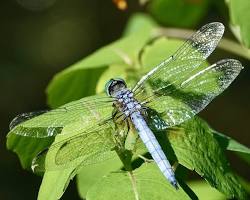
The Blue Dasher Dragonfly (Pachydiplax longipennis) is a small, active dragonfly commonly found around ponds, marshes, lakes, drainage ditches, and other slow-moving or standing bodies of water. It belongs to the skimmer family and is one of the most frequently observed dragonflies across much of the United States.
Despite its fast flight and intimidating appearance, the Blue Dasher is not dangerous to people, pets, buildings, or plants. It is a beneficial predator that captures mosquitoes, midges, flies, and other small insects. Its aquatic young also prey on mosquito larvae and other organisms living beneath the water’s surface.
Taxonomy and Classification
- Kingdom: Animalia
- Phylum: Arthropoda
- Class: Insecta
- Order: Odonata
- Family: Libellulidae
- Genus: Pachydiplax
- Species: Pachydiplax longipennis
The Blue Dasher is the only species commonly recognized in the genus Pachydiplax. The scientific name longipennis means “long-winged,” although its wings are not dramatically longer than those of related skimmer dragonflies. The species is native to North America.
Physical Description
Blue Dashers are relatively small dragonflies, generally measuring approximately one to one and three-quarter inches long. Like other dragonflies, they have large compound eyes, four independently controlled wings, six legs, and an elongated abdomen.
Mature males are the most recognizable. They have a powdery or dusty-blue abdomen with a dark tip. Their faces are white to pale blue, while their large eyes are usually turquoise or metallic green. The thorax is dark brown with yellow diagonal stripes, although the markings may become partly obscured as the male develops its blue, waxy coating.
Females and immature males are less blue. Their abdomens are brown or black with narrow yellow, greenish, or cream-colored stripes. Females may have reddish-brown eyes that become greener with age. Both sexes can have amber coloration and dark streaks near the bases of the hindwings.
The mature male’s pale face, green eyes, blue abdomen, dark abdominal tip, and striped thorax help separate the Blue Dasher from other blue skimmers. However, females and immature individuals can be more difficult to identify because several dragonfly species have similar yellow-and-brown markings.
Distribution and Habitat
Blue Dashers occur across much of the continental United States and extend into southern Canada, Mexico, and parts of the Caribbean. They are particularly common in warm, sunny areas with abundant aquatic vegetation.
Preferred habitats include ponds, small lakes, marshes, swamps, reservoirs, slow streams, roadside ditches, and constructed stormwater basins. They can tolerate human-altered environments and are often observed around golf-course ponds, urban parks, farm ponds, and backyard water gardens.
Adults frequently perch on the tips of sticks, reeds, plant stems, fences, or low branches. From these exposed locations, they watch for prey and competing dragonflies. After capturing an insect in flight, a Blue Dasher may return to the same perch.
Life Cycle
Blue Dashers undergo incomplete metamorphosis with three main stages: egg, aquatic nymph, and adult. Mating usually takes place near suitable water. Males defend territories and may chase away other male dragonflies that enter their breeding areas.
After mating, the female flies low over the water and repeatedly taps the surface with the end of her abdomen, releasing eggs into shallow water or among aquatic vegetation. A nearby male may guard her while she deposits the eggs.
The eggs hatch into wingless aquatic nymphs, also called naiads. These nymphs live underwater, where they feed on mosquito larvae, aquatic insects, small crustaceans, and other appropriately sized prey. A nymph captures prey with an extendable lower jaw that can shoot forward rapidly.
As the nymph develops, it molts repeatedly. When mature, it climbs out of the water onto a stem, rock, dock, or other exposed surface. Its skin splits, and the adult dragonfly slowly emerges. The empty skin, called an exuvia, may remain attached near the water after the adult’s wings have expanded and hardened.
Diet and Hunting Behavior
Adult Blue Dashers are aerial predators. They use their excellent vision to detect moving insects and their spiny legs to form a basket around prey during flight. Their diet can include mosquitoes, gnats, midges, small flies, winged ants, termites, and other small flying insects.
Blue Dashers are often described as perch-and-sally hunters. Instead of remaining constantly in flight, they wait from a favored perch, launch after passing prey, capture it in the air, and then land again. Both males and females may defend productive feeding locations.
Benefits to Gardens and Wetlands
Blue Dashers contribute to the natural control of flying insects and form an important part of wetland food webs. The adults consume numerous insects, while fish, frogs, birds, spiders, and larger dragonflies may prey on Blue Dashers. Their aquatic nymphs are predators but also provide food for fish and other wetland animals.
Dragonflies can also provide information about aquatic habitats. Because they depend on water during their immature stage, a diverse dragonfly community often indicates that an area contains suitable freshwater habitat. Blue Dashers are relatively adaptable and may occupy disturbed or urban wetlands that cannot support more specialized species.
Are Blue Dasher Dragonflies Dangerous?
Blue Dashers do not have stingers, do not transmit human diseases, and do not infest homes. They will normally fly away when approached. A dragonfly may attempt to bite defensively if trapped or handled roughly, but its mouthparts are intended for capturing small insects and it poses no meaningful threat to people.
Occasionally, an adult may enter a garage, porch, greenhouse, or home through an open door. It is an accidental visitor rather than an indoor pest. Open an exterior door or window and allow it to leave, or gently capture it in a container and release it outdoors.
Conservation and Management
No pest-control treatment is needed for Blue Dasher Dragonflies. Homeowners can support them by maintaining ponds with a mixture of open water and native aquatic plants. Emergent stems provide places for nymphs to leave the water and for adults to perch.
Avoid routinely applying broad-spectrum insecticides around ponds, gardens, and wetland margins. Prevent fertilizer, oil, and pesticide runoff from entering the water. Fish may consume large numbers of dragonfly nymphs, so a small fish-free water feature can provide additional breeding habitat where locally appropriate.
Conclusion
The Blue Dasher is a common and beneficial North American dragonfly recognized by the mature male’s powder-blue abdomen, pale face, green eyes, and dark abdominal tip. Females and immature males are generally brown with yellow or greenish stripes. Both the aquatic nymphs and flying adults are predators, making this dragonfly a welcome resident of ponds, wetlands, and gardens rather than a pest requiring control.