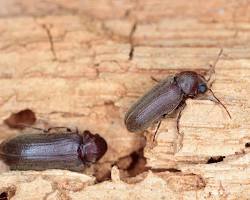
Wood-boring Beetles are a diverse group of insects whose larvae develop within wood, feeding on wood fibers, starches, fungi, or other organic materials. These beetles include some of the most destructive structural and furniture pests worldwide. Major groups include Powderpost Beetles (Lyctidae), Deathwatch Beetles (Anobiidae/Ptinidae), Longhorned Beetles (Cerambycidae), and Metallic Wood-boring Beetles (Buprestidae).
The greatest damage is caused by the larval stage, which tunnels through wood for months or even years before emerging as an adult beetle. Because feeding occurs entirely inside the wood, infestations often remain hidden until exit holes and frass become visible. By the time damage is detected, significant structural weakening may already have occurred.
Wood-boring beetles are responsible for extensive damage to homes, barns, historical structures, furniture, flooring, lumber, and wooden artifacts throughout the world.
Taxonomy and Classification
Wood-boring beetles belong to the Order Coleoptera and include several important families.
- Order: Coleoptera
- Family: Lyctidae (Powderpost Beetles)
- Family: Ptinidae (Deathwatch and Furniture Beetles)
- Family: Cerambycidae (Longhorned Beetles)
- Family: Buprestidae (Metallic Wood-borers)
- Family: Curculionidae (Some Wood-boring Weevils)
Although these beetles differ greatly in appearance, they share a common characteristic: larvae that develop inside wood.
Identification
Adult wood-boring beetles vary considerably in appearance depending on species.
- Length: 3 mm to 50 mm.
- Color: Brown, black, reddish, metallic green, or bronze.
- Body Shape: Elongated, cylindrical, or flattened.
- Antennae: Short or extremely long depending on species.
Key Adult Characteristics
- Powderpost beetles are small and slender.
- Deathwatch beetles are oval and brown.
- Longhorned beetles possess exceptionally long antennae.
- Metallic wood-borers often display iridescent coloration.
Larvae
The larval stage is responsible for nearly all damage.
- Creamy-white coloration.
- Soft-bodied appearance.
- Strong chewing mandibles.
- Typically legless or nearly legless.
- Found entirely within wood.
Larvae are often called wood grubs and may remain hidden inside wood for years.
Distribution and Habitat
Wood-boring beetles occur throughout the world.
Common habitats include:
- Homes.
- Historic buildings.
- Wooden furniture.
- Flooring.
- Wood framing.
- Firewood.
- Lumber yards.
- Dead trees.
- Forest ecosystems.
Some species infest only hardwoods, while others prefer softwoods.
Life Cycle
Wood-boring beetles undergo complete metamorphosis.
- Egg Stage: Females deposit eggs in cracks, pores, or exposed wood surfaces.
- Larval Stage: Larvae tunnel through wood while feeding.
- Pupal Stage: Pupation occurs inside the wood.
- Adult Stage: Adults emerge through exit holes and seek mates.
Depending on the species, development may take from one year to more than ten years.
Feeding Habits
Different groups feed on different wood components.
- Cellulose.
- Starches.
- Wood fibers.
- Fungi associated with wood.
- Decaying wood tissues.
The specific feeding habits vary significantly among species.
Damage and Economic Importance
Structural Damage
Wood-boring beetles can weaken structural components over time.
- Floor joists.
- Wall studs.
- Roof framing.
- Support beams.
- Wood paneling.
Severe infestations may compromise structural integrity.
Furniture Damage
Antique furniture and wooden artifacts are especially vulnerable.
- Decorative woodwork.
- Antique furniture.
- Cabinets.
- Wood carvings.
- Museum collections.
Even minor infestations can significantly reduce value.
Lumber Losses
Commercial lumber may become damaged before or after processing.
- Reduced product quality.
- Lower market value.
- Increased replacement costs.
The timber industry invests heavily in prevention and monitoring programs.
Signs of Infestation
Exit Holes
The most recognizable sign is the presence of emergence holes.
- Small circular holes.
- Oval holes in some species.
- Clean-cut openings.
Exit holes indicate adults have completed development and emerged.
Frass
Wood dust produced by larvae is called frass.
- Fine powder beneath holes.
- Flour-like texture.
- Accumulation near infested wood.
The appearance of frass often helps identify the specific beetle group involved.
Wood Weakness
- Hollow-sounding wood.
- Surface blistering.
- Structural sagging.
- Unexpected breakage.
Extensive internal tunneling can leave only a thin outer shell intact.
Behavior and Conflict
Cryptic Development
The primary challenge posed by wood-boring beetles is their hidden lifestyle.
- Larvae remain concealed.
- Damage progresses unnoticed.
- Adults emerge long after infestation begins.
Visible damage often appears only after years of feeding.
Long Life Cycles
Many species develop slowly.
- One-year cycles.
- Multi-year development.
- Extended feeding periods.
This prolonged development allows significant damage to accumulate.
Moisture Dependence
Many species require elevated moisture levels.
- Damp wood.
- Poor ventilation.
- Water-damaged structures.
Moisture problems often increase infestation risk.
Management and Prevention
Integrated Pest Management (IPM) provides the most effective long-term solution.
Inspection
- Identify beetle species.
- Locate infestation sources.
- Assess structural damage.
Accurate identification is critical because treatments vary among species.
Borate Treatments
- Protect exposed wood.
- Prevent larval development.
- Provide long-term protection.
Borate-based preservatives are widely used for prevention and control.
Moisture Management
- Repair leaks.
- Improve ventilation.
- Reduce crawlspace humidity.
- Maintain dry wood conditions.
Many infestations decline when moisture problems are corrected.
Fumigation
- Whole-structure treatment.
- Severe infestations.
- Inaccessible infestations.
Fumigation may be necessary when damage is extensive or widespread.
Heat Treatment
- Non-chemical option.
- Kills all life stages.
- Used for furniture and structures.
Heat treatment has become increasingly popular for sensitive environments.
Research and Future Studies
Researchers continue developing advanced detection technologies, including acoustic monitoring systems, thermal imaging, and moisture-based detection tools. Scientists are also exploring environmentally friendly wood preservatives, biological controls, and heat-treatment methods that reduce reliance on traditional fumigants.
Studies of ambrosia beetles and their fungal symbionts are providing new insights into wood decomposition and forest ecology.
Conclusion
Wood-boring beetles are among the most significant pests of wood structures, furniture, and lumber worldwide. Their hidden larval development allows damage to progress unnoticed for years before visible signs appear. Through proper inspection, moisture management, preventative treatments, and timely intervention, property owners can protect valuable wooden structures and prevent costly repairs caused by these destructive insects.