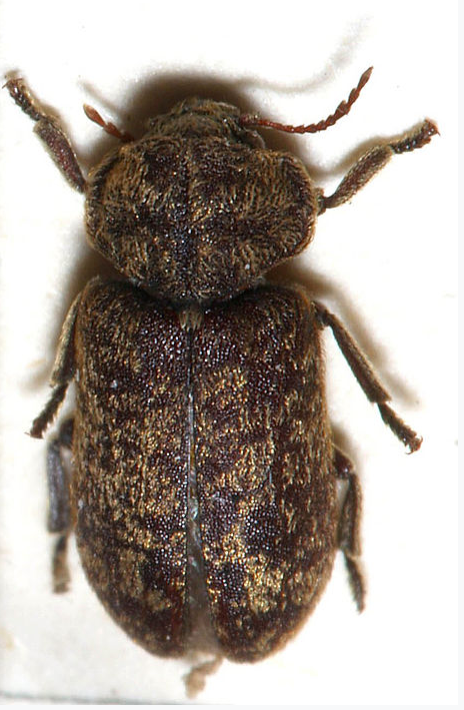
Deathwatch Beetles are wood-boring insects in the family Ptinidae that infest damp, decaying, or fungus-affected wood. They are best known for the faint tapping or ticking sound produced by adults, a behavior historically associated with superstition—hence the name “deathwatch.” In modern pest management, however, their importance lies in their ability to cause long-term structural damage to wood.
The most destructive stage is the larva, which tunnels inside wood for years, weakening beams, joists, and other structural components. These beetles are especially problematic in historic buildings, crawl spaces, basements, and any structure where moisture has softened wood.
Quick Facts
- Common Name: Deathwatch Beetles
- Family: Ptinidae
- Order: Coleoptera
- Habitat: Damp wood, crawl spaces, basements, historic buildings
- Diet: Seasoned wood associated with moisture and fungal decay
- Status: Wood-damaging structural pest
Taxonomy and Classification
Deathwatch beetles belong to the family Ptinidae, a group that includes several wood-boring species commonly found in buildings. They are closely related to other structural pests that attack seasoned timber.
They are part of the broader category of beetles that damage wood and structural materials, often referred to as wood-boring beetles.
Like all beetles, they undergo complete metamorphosis, developing through egg, larval, pupal, and adult stages.
Identification
Adult deathwatch beetles are small and somewhat inconspicuous.
- Size: Typically 5–10 mm long
- Color: Brown to reddish-brown
- Shape: Rounded, slightly cylindrical body
- Behavior: Nocturnal and rarely seen
The larvae are responsible for damage and have the following characteristics:
- Appearance: Pale, curved, grub-like
- Habitat: Hidden deep within wood galleries
- Behavior: Slow, continuous feeding
Common signs of infestation include:
- Small, round emergence holes in wood
- Fine powdery dust (frass) near holes
- Weakened or hollow-sounding timber
- Long-term structural deterioration
The distinctive ticking sound made by adults is produced by tapping their heads or bodies against wood, usually during mating.
Distribution and Habitat
Deathwatch beetles are found worldwide but are most commonly associated with older structures and environments where wood remains damp over long periods.
Typical habitats include:
- Historic buildings and heritage structures
- Churches, barns, and old homes
- Crawl spaces and basements
- Damp beams, joists, and timber framing
They are strongly associated with high moisture conditions and often infest wood that has been softened by fungal decay.
Behavior and Life Cycle
The life cycle of deathwatch beetles is slow and can span several years, depending on environmental conditions.
- Egg Stage: Eggs are laid in cracks or on wood surfaces
- Larval Stage: Larvae bore into wood and feed for 2–10 years
- Pupal Stage: Pupation occurs within the wood
- Adult Stage: Adults emerge through small exit holes
The extended larval stage is responsible for most structural damage, often occurring unnoticed for long periods.
Adults typically emerge in warmer months and are short-lived, focusing primarily on reproduction.
Feeding and Damage
Deathwatch beetle larvae feed on seasoned wood, especially timber affected by moisture and fungal activity.
- Internal Tunneling: Weakens structural wood
- Wood Degradation: Reduces strength of beams and joists
- Long-Term Damage: Can compromise entire structural systems
Damage is often most severe in areas where moisture problems persist, as dry wood is less suitable for larval development.
Over time, infested wood may become fragile, hollow, and structurally unsafe.
Pest Status
Deathwatch beetles are considered serious structural pests in situations where infestations are prolonged.
They are particularly problematic in:
- Historic and heritage buildings
- Poorly ventilated structures
- Moisture-damaged timber
Unlike some wood pests, their activity is closely tied to environmental conditions, especially moisture levels.
Management and Control
Effective management focuses on eliminating moisture, which is essential for larval survival.
| Strategy | Purpose | Benefit |
|---|---|---|
| Moisture Control | Fix leaks and reduce humidity | Creates unsuitable conditions for larvae |
| Ventilation | Improve airflow in enclosed spaces | Dries wood and prevents infestation |
| Inspection | Monitor for holes and frass | Early detection of activity |
| Wood Replacement | Remove heavily damaged timber | Restores structural integrity |
In severe cases, professional treatment may be required to protect valuable or historic structures.
Prevention
- Repair leaks and eliminate moisture sources
- Ensure proper ventilation in crawl spaces and attics
- Inspect wooden structures regularly
- Use treated or sealed wood where possible
Preventative maintenance is the most effective way to avoid long-term infestations.
Related Articles
Conclusion
Deathwatch beetles are specialized wood-boring insects that thrive in damp, decaying timber. While often unnoticed for years, their larvae can cause significant structural damage, particularly in older buildings.
By addressing moisture issues, improving ventilation, and maintaining structural wood, infestations can be prevented and managed effectively, helping preserve both modern and historic structures.