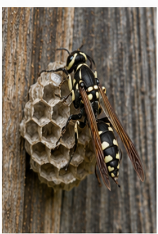
Potter Wasps in the genus Monobia are large, solitary hunting wasps that play an important role in naturally controlling caterpillar populations. Unlike social wasps such as yellowjackets or hornets, Monobia species live and nest alone, constructing mud partitions inside existing cavities where they provision their developing larvae with paralyzed caterpillars. The best-known North American species, the Four-toothed Mason Wasp (Monobia quadridens), is a valuable biological control agent found throughout much of the eastern United States. Although their large size and dark coloration can appear intimidating, these wasps are remarkably gentle and rarely sting unless directly handled.
Adult Monobia wasps feed on nectar and contribute to pollination while females actively hunt leaf-rolling caterpillars, cutworms, and other moth larvae that commonly damage ornamental plants, trees, shrubs, and vegetable gardens. Their combination of pollination and natural pest control makes them one of the most beneficial solitary wasps found in residential landscapes.
Taxonomy and Classification
Monobia wasps belong to the family Vespidae, which also includes hornets, yellowjackets, paper wasps, and other solitary mason wasps.
- Order: Hymenoptera
- Family: Vespidae
- Subfamily: Eumeninae
- Genus: Monobia
Several species occur in North America, with Monobia quadridens being the most widespread and frequently encountered.
Physical Description
Monobia wasps are among the largest members of the mason wasp group and possess several distinctive characteristics.
- Length: Approximately 15–25 mm.
- Color: Glossy black body, often with broad ivory-white or pale markings on the abdomen.
- Body: Robust with a narrow “wasp waist.”
- Wings: Smoky transparent wings with a bluish or violet metallic sheen in sunlight.
- Mandibles: Strong jaws used for gathering mud and manipulating prey.
Their large size often causes them to be mistaken for hornets, but their solitary behavior immediately distinguishes them from social wasps.
Distribution and Habitat
Monobia wasps are widely distributed across much of North America and occupy habitats where flowering plants, mud, and suitable nesting cavities are available.
Common habitats include:
- Gardens
- Woodlands
- Forest edges
- Parks
- Orchards
- Fence posts and wooden structures
- Areas containing dead wood or hollow stems
Rather than excavating their own nests, females typically reuse abandoned beetle tunnels, carpenter bee galleries, hollow stems, and other natural cavities.
Behavior and Life Cycle
Monobia wasps undergo complete metamorphosis consisting of egg, larva, pupa, and adult stages.
After selecting a suitable cavity, the female constructs individual nursery chambers separated by partitions made from mud mixed with saliva. She then hunts caterpillars—especially leafrollers, cutworms, and other moth larvae—paralyzing them with her sting before transporting them back to the nest.
Each chamber receives several living but immobilized caterpillars along with a single egg. After sealing the chamber with mud, the developing larva feeds on the fresh prey before pupating and emerging as an adult the following season.
Adults spend much of their time visiting flowers for nectar while searching for nesting sites and prey.
Ecological Importance
Monobia wasps provide numerous ecological benefits.
- Natural Caterpillar Control: Remove leafrollers, cutworms, and other foliage-feeding larvae.
- Pollination: Adults visit a wide variety of flowering plants for nectar.
- Support Healthy Gardens: Reduce populations of pests without chemical pesticides.
- Biodiversity: Contribute to balanced woodland and garden ecosystems.
- Minimal Human Conflict: Solitary lifestyle makes them extremely unlikely to sting people.
Because each female provisions dozens of nest cells during her lifetime, a single wasp may remove hundreds of caterpillars from the environment.
Management and Prevention
Monobia wasps are highly beneficial and should be encouraged rather than eliminated.
- Preserve Nesting Cavities: Leave dead wood, hollow stems, and abandoned carpenter bee tunnels when possible.
- Avoid Removing Mud Plugs: Sealed nest entrances contain developing larvae.
- Reduce Broad-Spectrum Insecticides: Protect beneficial predators and pollinators.
- Plant Nectar Sources: Native wildflowers provide food for adult wasps.
- Allow Access to Damp Soil: Females require moist clay for nest construction.
These wasps rarely become nuisance insects because they do not defend communal nests and generally ignore human activity.
Conservation and Research
Researchers continue studying Monobia wasps for their remarkable nesting behavior, prey specialization, and value in Integrated Pest Management (IPM). Their ability to naturally suppress caterpillar populations makes them increasingly important in sustainable agriculture and pollinator-friendly landscaping. Conservation efforts emphasize preserving nesting habitat and minimizing unnecessary pesticide applications that can harm beneficial solitary wasps.
Conclusion
Monobia Potter Wasps are outstanding examples of beneficial insects that combine pollination with effective natural pest control. Their carefully engineered mud-partitioned nests and specialized hunting behavior help regulate destructive caterpillars while posing almost no threat to people. Encouraging these solitary wasps in gardens, orchards, and natural landscapes supports healthier ecosystems and reduces dependence on chemical insecticides.