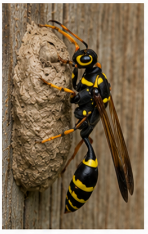
Euodynerus Potter Wasps (Euodynerus species) are solitary hunting wasps that play an important role in controlling caterpillar populations in gardens, forests, orchards, and residential landscapes. Unlike social wasps such as yellowjackets and hornets, these wasps do not live in large colonies or aggressively defend their nests. Each female works alone, locating a suitable cavity, constructing mud partitions, and stocking individual brood cells with paralyzed caterpillars for her developing larvae.
Although their black-and-yellow markings may cause them to be mistaken for more aggressive wasps, Euodynerus species are generally calm and pose little risk to people or pets. They are considered beneficial biological control agents because they remove leafrollers, cutworms, crambid caterpillars, and other plant-feeding larvae from the environment. Adults also visit flowers for nectar and may contribute to pollination.
Overview
Euodynerus is a genus within the potter and mason wasp subfamily Eumeninae. These wasps are sometimes called mason wasps because many species construct mud partitions inside existing holes rather than building exposed clay pots. Suitable nesting locations may include hollow stems, abandoned beetle tunnels, old mud-dauber nests, cracks in wood, and artificial nesting blocks.
Their nesting behavior is highly organized. A female creates a series of separate chambers inside a cavity, places a single egg in each chamber, adds several paralyzed caterpillars, and seals the chamber with mud. The larva later hatches and feeds on the stored prey before pupating and emerging as an adult.
Taxonomy and Classification
- Order: Hymenoptera
- Family: Vespidae
- Subfamily: Eumeninae
- Genus: Euodynerus
- Common Group: Potter Wasps and Mason Wasps
Euodynerus wasps undergo complete metamorphosis, progressing through egg, larval, pupal, and adult stages. They are closely related to other solitary potter wasps, including species in the genera Eumenes, Monobia, and Ancistrocerus.
Physical Description
Euodynerus wasps are compact, strongly built insects with the classic narrow waist associated with vespid wasps.
- Length: Usually 10–18 mm, depending on species.
- Color: Commonly black with yellow, ivory, orange, or reddish bands and spots.
- Body: Compact and muscular with a narrow connection between the thorax and abdomen.
- Wings: Clear to smoky and folded lengthwise over the back while resting.
- Eyes: Often notched along the inner margin.
- Antennae: Long, segmented, and slightly curved.
The exact color pattern varies considerably among species, making detailed identification difficult without examining body markings, wing veins, and facial structures.
Distribution and Habitat
Euodynerus wasps occur in North America and many other regions of the world. They are most common in habitats that provide flowering plants, caterpillar prey, mud, and existing nesting cavities.
Common habitats include:
- Home gardens
- Woodland edges
- Open forests
- Meadows
- Orchards
- Agricultural field margins
- Parks and suburban landscapes
- Areas containing hollow stems and dead wood
They may also nest around human structures, especially in fence posts, siding gaps, window tracks, garden sheds, and unused holes in outdoor wood.
Nesting Behavior
Most Euodynerus species are cavity nesters. A female searches for a suitable pre-existing opening rather than excavating a large nest of her own. She may reuse:
- Abandoned beetle emergence holes
- Hollow plant stems
- Old mud-dauber nests
- Carpenter bee tunnels
- Narrow gaps in wood or masonry
- Artificial bee-hotel tubes
Once a cavity is selected, the female gathers damp soil or clay and uses it to build a mud wall at the back of the cavity. She then creates a brood chamber, provisions it with prey, lays an egg, and closes the cell with another mud partition. This process continues until the cavity contains several sealed chambers.
Hunting and Provisioning
Female Euodynerus wasps are specialized hunters of caterpillars. They search leaves, rolled foliage, stems, and plant crevices for suitable prey.
Common prey may include:
- Leafroller caterpillars
- Cutworms
- Crambid moth larvae
- Small noctuid caterpillars
- Geometer moth larvae
- Other soft-bodied moth caterpillars
The female stings each caterpillar, paralyzing it without killing it. The immobilized prey is then carried back to the nest and placed inside the brood chamber. Because the caterpillar remains alive, it stays fresh for the developing wasp larva.
A single brood cell may contain several caterpillars, depending on their size. Through this repeated hunting activity, one female may remove a substantial number of plant-feeding larvae during the nesting season.
Life Cycle
The life cycle begins when the female suspends or places a single egg inside a prepared nest chamber. After the chamber has been supplied with caterpillars and sealed with mud, the egg hatches.
The wasp larva consumes the stored prey and grows through several developmental stages. Once fully fed, it spins a protective covering or pupates within the sealed chamber. Depending on the species and climate, the developing wasp may emerge later in the same season or remain inside the nest through winter.
Adults chew through the mud partitions and exit the nesting cavity when development is complete.
Adult Feeding and Pollination
Adult Euodynerus wasps do not eat caterpillars. Instead, they feed primarily on nectar and other carbohydrate-rich liquids.
They commonly visit:
- Goldenrod
- Milkweed
- Yarrow
- Mountain mint
- Queen Anne’s lace
- Other flowers with shallow, accessible nectar
As they move between flowers, they may transfer pollen and provide limited but useful pollination services. Their primary ecological value, however, remains their role as predators of caterpillars.
Benefits in Gardens and Landscapes
Euodynerus wasps provide several important ecological benefits.
- Natural Pest Control: Remove caterpillars that damage leaves, buds, flowers, and fruit.
- Reduced Pesticide Dependence: Help suppress pests without chemical treatments.
- Pollination: Adults visit nectar-producing flowers.
- Biodiversity: Support healthy and balanced insect communities.
- Food-Web Support: Serve as prey for birds, spiders, and other wildlife.
Their presence is usually a sign of a healthy landscape containing suitable nesting habitat, flowering plants, and adequate prey.
Human Interaction and Safety
Euodynerus wasps possess a functional sting used to paralyze prey, but they are not naturally aggressive toward humans. Because each female nests alone, there is no large colony or hive to defend.
Stings are uncommon and usually occur only when a wasp is:
- Handled directly
- Pressed against the skin
- Trapped inside clothing
- Accidentally squeezed
People with known insect-sting allergies should still avoid close handling of any wasp, but routine observation from a short distance is safe.
Management and Prevention
Management is rarely necessary because these wasps are beneficial and do not damage structures. They use existing cavities rather than chewing through sound wood.
- Leave Nests Undisturbed: Mud-sealed holes often contain developing beneficial wasps.
- Avoid Broad-Spectrum Insecticides: These products may kill both adult wasps and their caterpillar prey.
- Provide Nesting Habitat: Hollow stems and properly maintained insect hotels may support local populations.
- Grow Nectar Plants: Native flowers provide energy for adults.
- Relocate Nesting Materials Carefully: Move occupied stems or blocks only when necessary and without opening the cells.
If nesting occurs in an inconvenient location, sealing the cavity after the adults have emerged is usually sufficient to prevent reuse.
Conservation and Research
Solitary potter wasps are increasingly studied for their potential role in sustainable agriculture and Integrated Pest Management. Researchers examine their prey preferences, nesting requirements, seasonal activity, and sensitivity to pesticides.
Conservation practices that preserve flowering plants, hollow stems, standing dead wood, and untreated nesting areas can support Euodynerus populations. Reducing unnecessary insecticide use is particularly important because these wasps may encounter pesticide residues while hunting caterpillars or feeding on flowers.
Conclusion
Euodynerus Potter Wasps are valuable solitary predators that help regulate caterpillar populations in gardens, forests, orchards, and agricultural landscapes. Their carefully partitioned mud nests, specialized hunting behavior, and low risk to people make them excellent examples of beneficial wasps. Rather than being treated as pests, these insects should generally be conserved as natural allies that provide biological control and contribute to healthy ecosystems.
Related Articles
“`