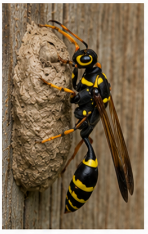
Potter Wasps (Eumenes species) are among the most remarkable solitary wasps in the world, famous for constructing tiny clay nests that resemble miniature pottery vessels. These beautifully engineered mud structures give the insects their common name and distinguish them from all other North American wasps. Unlike yellowjackets or paper wasps, Potter Wasps are solitary, non-aggressive beneficial insects that spend their lives hunting caterpillars and other soft-bodied insects to feed their developing young.
Found throughout much of the United States and around the world, Potter Wasps are valuable biological control agents in gardens, orchards, forests, and natural landscapes. Adult wasps feed primarily on nectar and help pollinate flowering plants, while females capture caterpillars that would otherwise damage vegetation. Because they rarely sting unless directly handled, Potter Wasps are considered one of the most beneficial wasp groups for homeowners and gardeners.
Taxonomy and Classification
Potter Wasps belong to the family Vespidae, which also includes yellowjackets, hornets, and paper wasps. Unlike their social relatives, members of the subfamily Eumeninae are solitary nest builders.
- Order: Hymenoptera
- Family: Vespidae
- Subfamily: Eumeninae
- Genus: Eumenes
The genus Eumenes contains numerous species distributed throughout North America, Europe, Asia, Africa, and Australia, all sharing similar nesting behavior.
Physical Description
Potter Wasps are elegant insects with an unmistakable body shape.
- Length: Approximately 10–20 mm.
- Color: Usually black with yellow, orange, or reddish markings depending on species.
- Body: Extremely narrow, elongated waist (petiole) connecting the thorax and abdomen.
- Wings: Transparent wings folded lengthwise when at rest.
- Nests: Small jug- or pot-shaped mud structures measuring approximately 10–15 mm across with a flared opening.
Their exceptionally slender waist and handcrafted clay nests make Potter Wasps easy to distinguish from other solitary wasps.
Distribution and Habitat
Potter Wasps have a nearly worldwide distribution and occupy a wide variety of habitats wherever suitable nesting materials and prey are available.
Common habitats include:
- Home gardens
- Woodlands
- Meadows
- Prairies
- Parks
- Orchards
- Areas with exposed soil and flowering plants
Nests are commonly attached to twigs, plant stems, rocks, fences, barns, sheds, bridges, and the sheltered sides of buildings.
Behavior and Life Cycle
Potter Wasps undergo complete metamorphosis consisting of egg, larva, pupa, and adult stages.
Females collect damp clay or mud to construct small vase-shaped nests, each containing a single chamber. After completing the nest, the female hunts small caterpillars—often inchworms, leafrollers, and other moth larvae—which she paralyzes with her sting rather than killing them.
Several living but immobile caterpillars are placed inside the mud pot before the female suspends a single egg from the chamber ceiling using a fine silk thread. This remarkable adaptation prevents the egg from being crushed by the stored prey. Once the chamber is sealed with mud, the larva hatches and feeds on the fresh caterpillars before pupating and eventually emerging as an adult wasp.
Ecological Importance
Potter Wasps are among the most beneficial predatory insects found in gardens and natural landscapes.
- Biological Control: Females remove numerous caterpillars that damage ornamental plants, shrubs, and trees.
- Pollination: Adults feed on flower nectar and assist in pollinating many native plants.
- Wildlife Support: Serve as prey for birds and other insect predators.
- Biodiversity: Contribute to healthy and balanced ecosystems.
- Minimal Risk: Rarely sting people because they have no colony to defend.
Unlike social wasps, Potter Wasps pose virtually no nuisance around homes and should be regarded as valuable beneficial insects.
Management and Prevention
Potter Wasps do not require pest control and are best managed through conservation.
- Leave Mud Nests Intact: Small clay pots do not damage buildings and allow new adults to emerge.
- Avoid Broad-Spectrum Insecticides: Preserve beneficial predators and pollinators.
- Provide Flowering Plants: Nectar sources support adult wasps throughout the growing season.
- Maintain Damp Soil: Moist clay provides the raw material needed for nest construction.
- Observe Without Disturbing: Potter Wasps rarely sting unless directly handled or trapped.
Conservation and Research
Scientists continue studying Potter Wasps because of their remarkable nest-building behavior, sophisticated prey selection, and important role in biological control. Their tiny clay vessels represent one of the most advanced examples of insect architecture, while their specialized hunting strategies help naturally regulate caterpillar populations in forests, gardens, and agricultural landscapes. Increasingly, Potter Wasps are recognized as valuable allies in sustainable Integrated Pest Management (IPM) programs.
Conclusion
Potter Wasps are extraordinary solitary insects whose handcrafted clay nests and specialized caterpillar-hunting behavior make them one of nature’s finest biological control agents. Completely different from aggressive social wasps, they pose little risk to people while providing free pest management and pollination services. Encouraging Potter Wasps in gardens and landscapes supports healthier ecosystems and reduces the need for chemical insecticides.