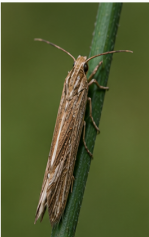
Pitch Twig Moths (Petrova albicapitana) are small tortricid moths whose larvae bore into the twigs of pine trees, stimulating the production of large, resinous pitch masses that protect the developing caterpillars. Although rarely fatal to mature trees, these insects can deform branches, stunt new growth, and reduce the ornamental value of landscape pines and the quality of nursery stock. The species is considered an occasional forestry and landscape pest throughout portions of North America, particularly where young pine trees are grown.
The caterpillars spend nearly their entire development concealed within resin-covered tunnels, making them difficult to detect and control. Most infestations are localized, but repeated attacks can weaken young trees and create permanent branch deformities.
Taxonomy and Classification
Pitch Twig Moths belong to the family Tortricidae, commonly known as tortricid or leafroller moths. Many members of this family are economically important pests of forest trees, fruit crops, and ornamental plants.
- Order: Lepidoptera
- Family: Tortricidae
- Genus: Petrova
- Species: Petrova albicapitana
Unlike many tortricid moths that roll or tie leaves together, Petrova species specialize in boring into pine shoots and twigs where they are protected by hardened resin.
Physical Description
Adult Pitch Twig Moths are relatively small and inconspicuous, blending well with pine bark.
- Wingspan: Approximately 15–20 mm.
- Color: Gray to brown forewings with fine mottled markings that provide camouflage.
- Body: Compact and slender, typical of tortricid moths.
- Larvae: Cream-colored to pale pink caterpillars with brown heads that develop inside pine twigs.
- Diagnostic Sign: Large, hardened masses of resin (pitch) surrounding infested twigs.
The conspicuous pitch masses are often much easier to identify than the moths themselves.
Distribution and Habitat
Pitch Twig Moths occur throughout portions of North America wherever suitable pine hosts are available.
Typical habitats include:
- Pine forests
- Christmas tree plantations
- Tree nurseries
- Urban landscapes
- Parks
- Residential properties with ornamental pines
Young pines and actively growing shoots are generally more susceptible than mature forest trees.
Behavior and Life Cycle
Pitch Twig Moths typically produce one generation each year, although timing varies depending on climate.
Adult females lay eggs on pine shoots and small branches during the growing season. After hatching, young caterpillars bore directly into tender twigs where they begin feeding beneath the bark.
As feeding continues, the tree responds by producing large quantities of sticky resin. This resin gradually hardens into a protective pitch mass that surrounds the larva while it continues developing inside the twig.
The caterpillar eventually pupates within the resin-covered gallery before the adult moth emerges through a small exit hole to begin the next generation.
Damage and Pest Status
Most injury is caused by larval feeding inside twigs.
- Pitch Mass Formation: Large resin masses develop around feeding sites.
- Twig Dieback: Infested shoots may wilt, die, or break.
- Branch Deformities: Repeated attacks can produce crooked or stunted branch growth.
- Reduced Tree Quality: Ornamental trees, nursery stock, and Christmas trees may lose commercial value.
- Limited Forest Impact: Healthy mature pines usually tolerate light infestations without serious long-term injury.
Although infestations rarely kill established trees, repeated attacks can reduce vigor and negatively affect tree appearance.
Management and Prevention
Integrated Pest Management (IPM) provides the most effective long-term approach.
- Prune Infested Twigs: Remove and destroy pitch-covered shoots before adult moths emerge.
- Inspect Young Pines: Monitor susceptible trees during the growing season for fresh resin masses.
- Maintain Tree Health: Proper watering, mulching, and fertilization improve resistance to attack.
- Encourage Natural Enemies: Birds and parasitic insects help suppress populations naturally.
- Chemical Treatments: In nurseries or high-value landscapes, insecticides may be used when timed to target newly hatched larvae before they bore into twigs.
Conservation and Research
Forest entomologists continue studying Pitch Twig Moths to improve monitoring techniques and reduce damage in pine nurseries and Christmas tree plantations. Research focuses on understanding the relationship between tree resin production, insect survival, and biological control agents that naturally suppress populations. Improved Integrated Pest Management strategies help minimize pesticide use while protecting valuable pine resources.
Conclusion
Pitch Twig Moths are specialized pine pests whose hidden larvae create distinctive resin masses while feeding inside twigs. Although they seldom threaten mature forests, they can reduce the quality of ornamental pines, nursery stock, and Christmas trees. Regular monitoring, pruning of infested branches, and maintaining healthy trees remain the most effective methods for long-term management.