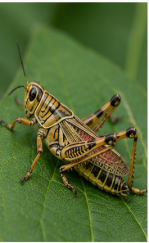
Plains Lubber Grasshoppers (Brachystola magna) are among the largest native grasshoppers in North America and are a familiar sight across the Great Plains. Unlike most grasshopper species, Plains Lubbers are flightless, possessing reduced wings that are incapable of supporting flight. Instead, they rely on walking and short hops to move through prairies, rangelands, and agricultural fields. Their large size, colorful markings, and slow-moving behavior make them easy to recognize.
Although Plains Lubber Grasshoppers are natural components of prairie ecosystems, they can become occasional agricultural pests when populations increase. Large numbers may feed on forage crops, grains, vegetables, and native vegetation, causing localized economic losses. However, under normal conditions they are an important food source for birds, reptiles, and mammals while contributing to healthy grassland ecosystems.
Taxonomy and Classification
Plains Lubber Grasshoppers belong to the family Romaleidae, commonly known as lubber grasshoppers. Members of this family are characterized by their robust bodies, relatively slow movement, and reduced flying ability.
- Order: Orthoptera
- Family: Romaleidae
- Genus: Brachystola
- Species: Brachystola magna
Brachystola magna is one of the largest grasshopper species native to North America and is well adapted to life on open prairie landscapes.
Physical Description
Plains Lubber Grasshoppers are impressive insects with heavy bodies and relatively short wings.
- Length: Approximately 40–65 mm, with females generally larger than males.
- Color: Yellow, olive green, tan, or brown with black mottled markings that provide camouflage among grasses.
- Body: Thick, heavy-bodied, and robust.
- Wings: Reduced and non-functional, making the species incapable of sustained flight.
- Legs: Powerful hind legs enable strong jumping despite their large size.
Their inability to fly distinguishes them from most other grasshopper species found throughout North America.
Distribution and Habitat
Plains Lubber Grasshoppers are native to the central United States and northern Mexico, where they inhabit open grassland environments.
Preferred habitats include:
- Native prairies
- Rangelands
- Agricultural fields
- Pastures
- Roadsides
- Open grasslands
They are particularly common throughout the Great Plains, where extensive grassland vegetation provides abundant food and breeding habitat.
Behavior and Life Cycle
Plains Lubber Grasshoppers complete one generation each year.
Females deposit egg pods several inches beneath the soil surface during late summer or autumn. The eggs overwinter underground before hatching the following spring.
Young nymphs resemble miniature adults but lack fully developed wings and reproductive organs. As they grow, they molt several times before reaching adulthood in midsummer.
Adults remain active through late summer and early fall, feeding extensively before mating and producing the next generation of eggs.
Because they cannot fly, these grasshoppers disperse slowly by walking and hopping across grassland vegetation.
Damage and Pest Status
Plains Lubber Grasshoppers feed on a broad range of grasses and herbaceous plants.
- Grass Feeding: Consume native prairie grasses and pasture vegetation.
- Crop Damage: Occasionally feed on alfalfa, wheat, corn, soybeans, vegetables, and forage crops.
- Defoliation: Heavy populations may strip foliage from susceptible plants.
- Localized Outbreaks: Economic damage is usually limited to areas experiencing unusually high grasshopper populations.
Despite their large size, Plains Lubbers are generally less destructive than some highly migratory grasshopper species because their limited mobility restricts rapid spread.
Management and Prevention
Integrated Pest Management (IPM) provides the most effective strategy for managing Plains Lubber Grasshoppers when populations become excessive.
- Regular Monitoring: Survey fields and rangelands early in the season for developing nymph populations.
- Encourage Natural Predators: Birds, reptiles, rodents, spiders, and predatory insects naturally suppress grasshopper numbers.
- Habitat Management: Healthy, diverse grassland ecosystems often support greater numbers of natural enemies.
- Target Young Nymphs: Management is most effective before grasshoppers reach adulthood.
- Chemical Control: In severe agricultural outbreaks, labeled insecticides may be used following local recommendations and Integrated Pest Management guidelines.
Conservation and Research
Although Plains Lubber Grasshoppers occasionally become agricultural pests, they are also important components of prairie ecosystems. They provide food for numerous birds, mammals, reptiles, and predatory insects while helping recycle plant material through herbivory. Researchers continue studying their population dynamics, outbreak cycles, and responses to changing grassland management practices to improve sustainable pest management while preserving prairie biodiversity.
Conclusion
Plains Lubber Grasshoppers are impressive native insects whose large size and inability to fly make them unique among North American grasshoppers. While localized outbreaks can damage crops and pasture vegetation, they are normally valuable members of prairie ecosystems. Careful monitoring and Integrated Pest Management provide effective long-term control when populations exceed economic thresholds.