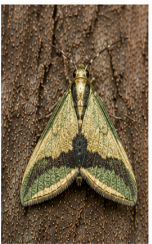
Pistachio Emerald Moths (Thalera pistaciaria) are attractive geometer moths recognized for their brilliant emerald-green wings and exceptional camouflage among leaves and shrubs. Found throughout much of Europe, North Africa, and parts of western Asia, these moths are a familiar sight in grasslands, woodland edges, gardens, and hedgerows during the summer months. Their vibrant coloration gradually fades to pale green or yellow with age, but they remain one of the most distinctive members of the geometer moth family.
Unlike many agricultural moths, the Pistachio Emerald Moth is not considered a significant pest. Its caterpillars feed on a variety of low-growing plants and shrubs but rarely reach populations capable of causing noticeable economic or landscape damage. Instead, the species serves as an important component of healthy ecosystems, providing food for birds, bats, and other insect-eating wildlife.
Taxonomy and Classification
The Pistachio Emerald Moth belongs to the family Geometridae, one of the largest moth families in the world. Members of this family are commonly called geometer moths because their caterpillars move with the distinctive looping motion that gives rise to the name “inchworm.”
- Order: Lepidoptera
- Family: Geometridae
- Genus: Thalera
- Species: Thalera pistaciaria
The species belongs to the emerald moth group, whose members are famous for their vivid green wing coloration and leaf-like camouflage.
Physical Description
Pistachio Emerald Moths are medium-sized moths with elegant wing shapes and brilliant green coloration.
- Wingspan: Approximately 25–30 mm.
- Color: Bright emerald-green wings with fine white or cream-colored crosslines.
- Body: Slender and similarly colored green, allowing the moth to blend into surrounding vegetation.
- Antennae: Feathered in males and thread-like in females.
- Larvae: Slender green inchworms that closely resemble plant stems and twigs.
The brilliant green pigment slowly fades after emergence, causing older adults to appear pale green or yellowish before the end of their relatively short lifespan.
Distribution and Habitat
The Pistachio Emerald Moth is widely distributed across Europe, North Africa, and portions of western Asia. It thrives in warm, open habitats containing abundant low vegetation.
Common habitats include:
- Grasslands
- Woodland edges
- Hedgerows
- Meadows
- Gardens
- Scrublands
The species favors areas with diverse herbaceous plants that provide suitable food for developing caterpillars.
Behavior and Life Cycle
Pistachio Emerald Moths undergo complete metamorphosis through four life stages: egg, larva, pupa, and adult.
Females deposit eggs on suitable host plants during the summer. After hatching, the inchworm-like caterpillars feed on a variety of herbaceous plants and shrubs while relying on excellent camouflage to avoid predators.
When fully developed, the caterpillars pupate within leaf litter or loose vegetation. Adults emerge during late spring and summer, depending on local climate, and are primarily active at night.
Like many nocturnal moths, adults are frequently attracted to porch lights and other artificial illumination.
Ecological Importance
Pistachio Emerald Moths contribute to healthy ecosystems in several important ways.
- Food Source: Caterpillars and adults provide nutrition for birds, bats, spiders, and predatory insects.
- Biodiversity: They contribute to the diversity of native moth communities.
- Pollination: Adults may visit flowers for nectar and provide limited nighttime pollination.
- Indicator Species: Stable populations often reflect healthy grassland and woodland-edge habitats.
Because they rarely occur in damaging numbers, they are generally viewed as beneficial components of natural ecosystems.
Management and Prevention
Pistachio Emerald Moths require no pest control because they seldom cause noticeable plant damage.
- No Chemical Control Needed: Populations rarely become problematic.
- Preserve Native Vegetation: Maintaining diverse plant communities supports healthy moth populations.
- Reduce Pesticide Use: Limiting insecticide applications protects moths and other beneficial insects.
- Encourage Natural Predators: Birds and beneficial insects naturally regulate caterpillar populations.
Conservation and Research
Researchers study Pistachio Emerald Moths to better understand insect camouflage, pigment chemistry, and habitat requirements. Their remarkable green coloration provides valuable insight into evolutionary adaptations that reduce predation. Conservation efforts emphasize preserving grasslands, woodland edges, and diverse native vegetation that support healthy populations of emerald moths and countless other beneficial insects.
Conclusion
The Pistachio Emerald Moth is one of Europe’s most beautiful geometer moths. Its vivid green wings, excellent camouflage, and harmless nature make it an important and fascinating member of woodland and grassland ecosystems. Although occasionally attracted to outdoor lights, this species poses no threat to gardens or crops and contributes to healthy biodiversity throughout its range.